 Follow Us on Google News


 Follow Us on Google Discover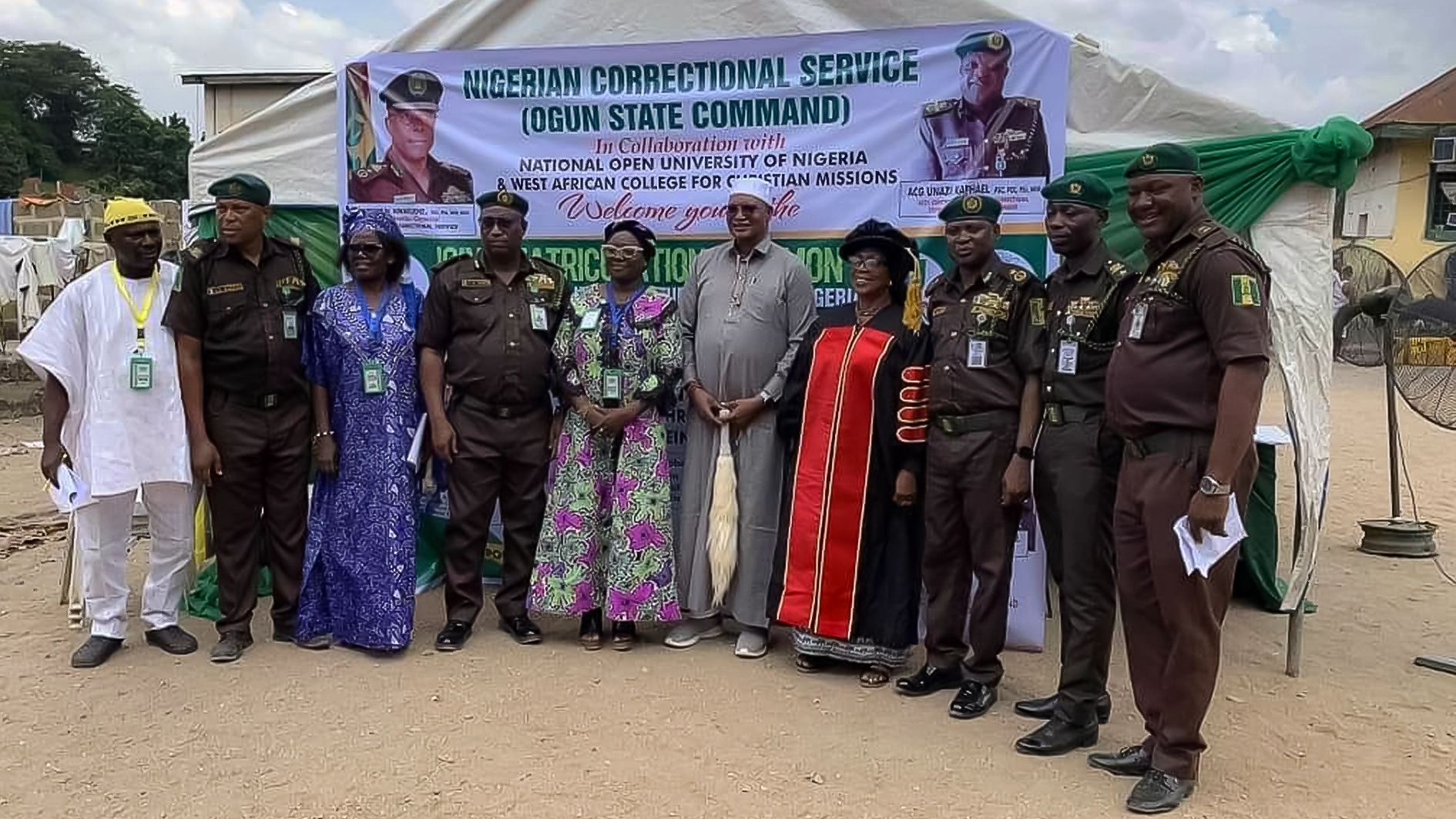
As part of its rehabilitation efforts, Nigerian Correctional Service, Ogun State Command, has matriculated 52 inmate students into educational programmes in order to equip the inmates with relevant knowledge and skills to facilitate their successful reintegration into the society after release.
The educational programmes was offered to the inmates in collaboration with the National Open University of Nigeria(NOUN) and the West Africa College for Christian Missions.
Speaking at the Joint Matriculation Ceremony yesterday at the Ibara Correctional Centre, The Controller of Corrections, Ogun State Command, Abioye Adesina, said that the matriculation would give the inmates educational opportunities to better their lives after leaving the centre back into the society.
Adesina, who identified education as the only instrument to reform and rehabilitate the inmates, said that the initiative was designed not only to equip them with knowledge and skills but also to nature their abilities and empower them lead meaningful lives upon the completion of their sentences.
He said that the programmes would no doubt orientate the inmates to live a changed lives while calling for continuous support from government, philanthropist, non governmental organizations and relevant stakeholders to sustain the initiative.
“We also have a lot of challenges, which is the main reason why I always tell the public that the government alone cannot do everything for us. We need help from philanthropists, non-governmental organisations and other stakeholders,” he said.

The Controller further urged the government to strengthen its support for the effective implementation of the Nigerian Correctional Service Act 2019, especially in promoting the reformation, rehabilitation and successful reintegration of inmates into society.
He emphasised that the effectiveness of correctional facilities should be assessed not only by their ability to keep offenders in custody but also by their success in rehabilitating inmates and equipping them to lead responsible and productive lives after their release.
Also Speaking, the Olu of Imasayi, Oba Lukman Kuoye, encouraged the newly matriculated students to stay focused on their education and remain determined to build a better future, regardless of their past experiences.
Kuoye who spoke on the theme, “Unlocking Potentials for Life After Incarceration Through Education: Resilience and Reintegration,” stressed that education could transform lives and create opportunities for people from disadvantaged backgrounds.
Citing a personal experience, Oba Kuoye said that he was once a bus conductor but remained focused on his ambitions despite the circumstances surrounding his early life.
“There was a time I was a bus conductor, meaning that I did not allow that situation then to obstruct my focus. And what is my focus? Today, I am a PhD holder, and I am not a bus conductor of yesterday. This happened because I did not allow my past to override my future,” he said.
The monarch encouraged the inmates to approach their education with determination, stressing that their present circumstances should not prevent them from achieving their aspirations.
“My candid advice, not only to the inmates but to everyone outside here, is that the education they are embarking on as a journey today should be pursued with commitment so that, at the end of the day, after three or four years, they become graduates. No matter what, they should not allow their past to obstruct their future,” he added.
Olalekan also urged traditional rulers to play more active roles in community development, noting that their contributions were important to societal progress and national development.
Also speaking, the Director of the Centre for Justice, Mercy and Reconciliation, an Ibadan-based non-governmental organisation, Pastor Ezekaya Adeboye Olujobi, said education was essential to the rehabilitation of inmates and their eventual acceptance into society.
Olujobi, who identified advocacy, rehabilitation and reintegration as the organisation’s major areas of focus, said his team visited custodial centres across the South-West to receive complaints from inmates, investigate cases and pursue appropriate interventions for those believed to have been wrongfully convicted.
“We carry out investigations to facilitate their freedom,” he said.
He stressed that education could help inmates acquire the knowledge and skills required to rebuild their lives, warning that the absence of educational opportunities could make reintegration into society more difficult.
The cleric urged the newly matriculated students to take their studies seriously and strive for excellence, while calling on governments, individuals and organisations to support educational programmes for inmates.
He said such interventions would enable the students to maximise the opportunities available to them and improve their prospects of becoming productive members of society.
In his remarks, the Managing Director and Chief Executive Officer of IGAI Group, Olusegun Amure, who is also a minister with the Redeemed Christian Church of God and a prison evangelist, said his commitment to supporting inmates was driven by what he described as a divine calling.
Amure explained that his interventions went beyond educational sponsorship to include the general welfare and well-being of inmates.
It is not only about educational sponsorship. It is all about the welfare and well-being of the inmates. What motivated me is that I was inspired by God. God called me to this assignment in 2003, instructing me to go to the prison to minister and help those who are genuinely in need, and to ensure that they become better people,” he said.
He urged the students to make the most of the opportunity, describing the programme as a platform through which they could acquire qualifications, broaden their knowledge and prepare for a better future.
Amure added that access to education within custodial facilities could help inmates pursue academic goals despite their confinement and improve their chances of contributing meaningfully to society after their release.
Meanwhile, the Deputy Controller of Corrections and Officer-in-Charge of the Medium Security Custodial Centre, Ibara, Abeokuta, Ujukola Onyadewale, described education as one of the major tools for achieving the reformation and rehabilitation objectives of the correctional service.
He said the matriculation exercise was designed to add value to the lives of the inmates and ensure that they returned to society better equipped with knowledge and skills than when they entered the custodial facility.
However, Onyadewale raised concerns over the operational challenges facing the centre, particularly the shortage of vehicles for transporting inmates to court.
He explained that the correctional service was responsible for conveying inmates on remand to and from court for their daily proceedings, but inadequate vehicles had made it difficult to meet the demand.
According to him, the shortage had forced the facility to ration the transportation of inmates to court, a situation he described as undesirable because of its potential to slow down the administration of justice.
The officer also lamented what he described as inadequate support from the Ogun State Government, despite the state’s contribution to the inmate population in the facility.
He called on the state government to provide the necessary logistical support, stressing that the rehabilitation and reformation of inmates required cooperation between the federal and state governments.
Onyadewale maintained that providing educational opportunities, improving custodial facilities and addressing transportation challenges were important steps towards achieving the broader objective of preparing inmates for successful reintegration into society.

