 Follow Us on Google News



 Follow Us on Google Discover
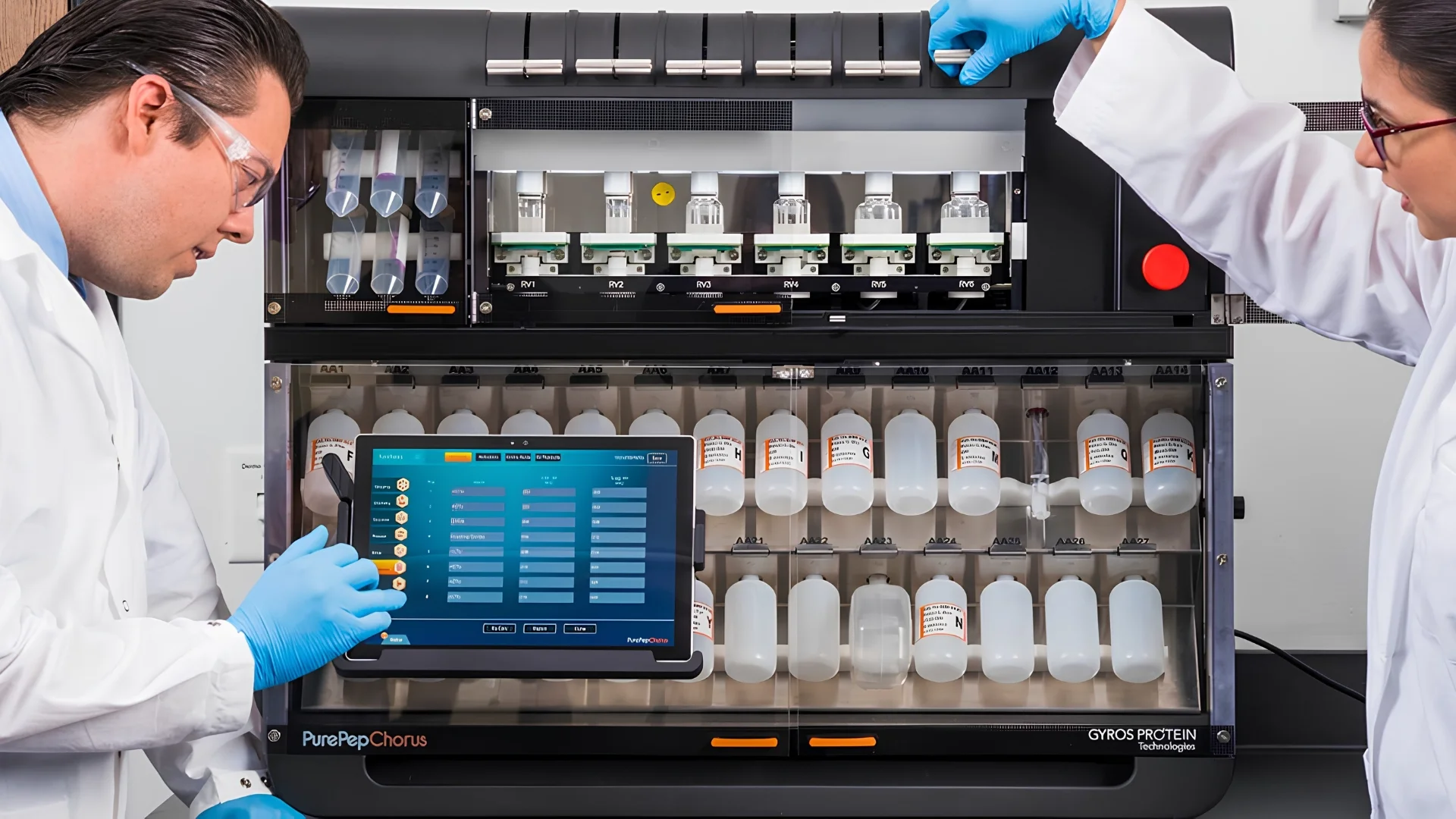
Peptides are short strings of amino acids, the same building blocks that make up proteins, linked one after another in a fixed order. Nature assembles them inside cells. Chemists assemble them on tiny resin beads, one link at a time, using a method that won its inventor a Nobel Prize. Here is how that method works, why it leaves impurities behind, and what happens to a peptide between the reaction vessel and the vial.
Building a chain on a bead
Before the 1960s, chemists made peptides in solution. After each new amino acid was added, the growing chain had to be isolated and cleaned up before the next step. For anything more than a handful of residues, the losses and the labour added up quickly.
In 1963 the American chemist Robert Bruce Merrifield published a different approach. He anchored the first amino acid to an insoluble resin bead and built the chain outward from it. Because the chain stays attached to something solid, excess reagents and by-products can simply be washed away after each step. The idea, now called solid-phase peptide synthesis or SPPS, earned Merrifield the 1984 Nobel Prize in Chemistry. It remains the standard way to make synthetic peptides.
The cycle, repeated
Every amino acid has two ends that can react, so chemists temporarily block the end they do not want involved, using what is called a protecting group. Building a chain then becomes a short cycle repeated once for each residue.
- The temporary protecting group on the end of the growing chain is removed, exposing a reactive amine.
- The next amino acid, chemically activated and with its own end blocked, is added. It forms a peptide bond with the exposed amine.
- Solvent flushes out everything that did not attach.
Most laboratories today use the Fmoc method, named after its protecting group, which comes off with a mild base. An older approach, Boc chemistry, uses acid instead. Many amino acids also have reactive side chains, and these carry their own, sturdier protecting groups that stay on until the very end.
The cycle is well suited to machines. Automated synthesisers run it unattended, and some use microwave heating to speed up each coupling. Because the chemistry does not rely on a cell’s machinery, chemists can also insert building blocks that biology does not use, such as mirror-image amino acids or chemically modified residues.

Why every batch starts out impure
No chemical step is perfect, and SPPS multiplies small imperfections. If each coupling succeeds 99 percent of the time, roughly four in five chains of a 20-residue peptide come out complete. The rest are near misses:
- Deletion sequences, where one coupling failed and a residue is missing from the middle.
- Truncated chainsthat stopped growing early.
- Incompletely deprotected chains, still carrying a fragment of a protecting group.
These relatives look very like the target, which is why the later stages matter as much as the synthesis itself. Length makes it harder still. Beyond about 50 residues, chemists often build shorter segments separately and join them afterwards, using techniques such as native chemical ligation.
Cleavage, purification and drying
When the last residue is in place, the chain is released from its bead. In Fmoc chemistry this is done with a strong acid, trifluoroacetic acid, which removes the side-chain protecting groups at the same time. Scavenger chemicals are added to mop up the reactive fragments those groups leave behind.
What comes out is a crude mixture. It is purified by preparative high-performance liquid chromatography (HPLC), which separates the target from its near misses according to how strongly each one clings to a packed column. Fractions holding the target are collected, pooled and freeze-dried into the white powder familiar from a laboratory vial.
That powder is not pure peptide. Acid from the cleavage and purification stays behind as counter-ions paired with the chain, a point covered in more depth in this guide to salt forms and net peptide content. Some batches go through an extra exchange step to swap those counter-ions for lighter ones.
How a finished batch is checked
Two measurements answer the basic questions about any synthetic peptide. Mass spectrometry confirms that the molecule has the expected mass, consistent with the intended chain of building blocks. Analytical HPLC shows how much of the material is the target and how much is related impurities. A certificate of analysis for the batch should report both, with the underlying chromatogram and spectrum attached.
A greener future for an old method
SPPS is reliable, but it is not tidy. Every wash uses solvent, and the volumes run to many litres per batch. The most common solvent, DMF, now faces tighter restrictions in Europe, and chemists are testing greener alternatives and ways to recycle what they use. The basic idea, a chain built step by step on a solid support, is not expected to change.
The bottom line
A synthetic peptide is the end product of dozens of repeated chemical steps, each slightly imperfect, followed by purification and drying. Knowing that process explains what a laboratory document is reporting: the identity of the chain, how much of the batch it accounts for, and what else came along for the ride.
Prepared by Peptide Titans (peptidetitans.com), which supplies peptide materials to laboratories for research use only.

