 Follow Us on Google News



 Follow Us on Google Discover
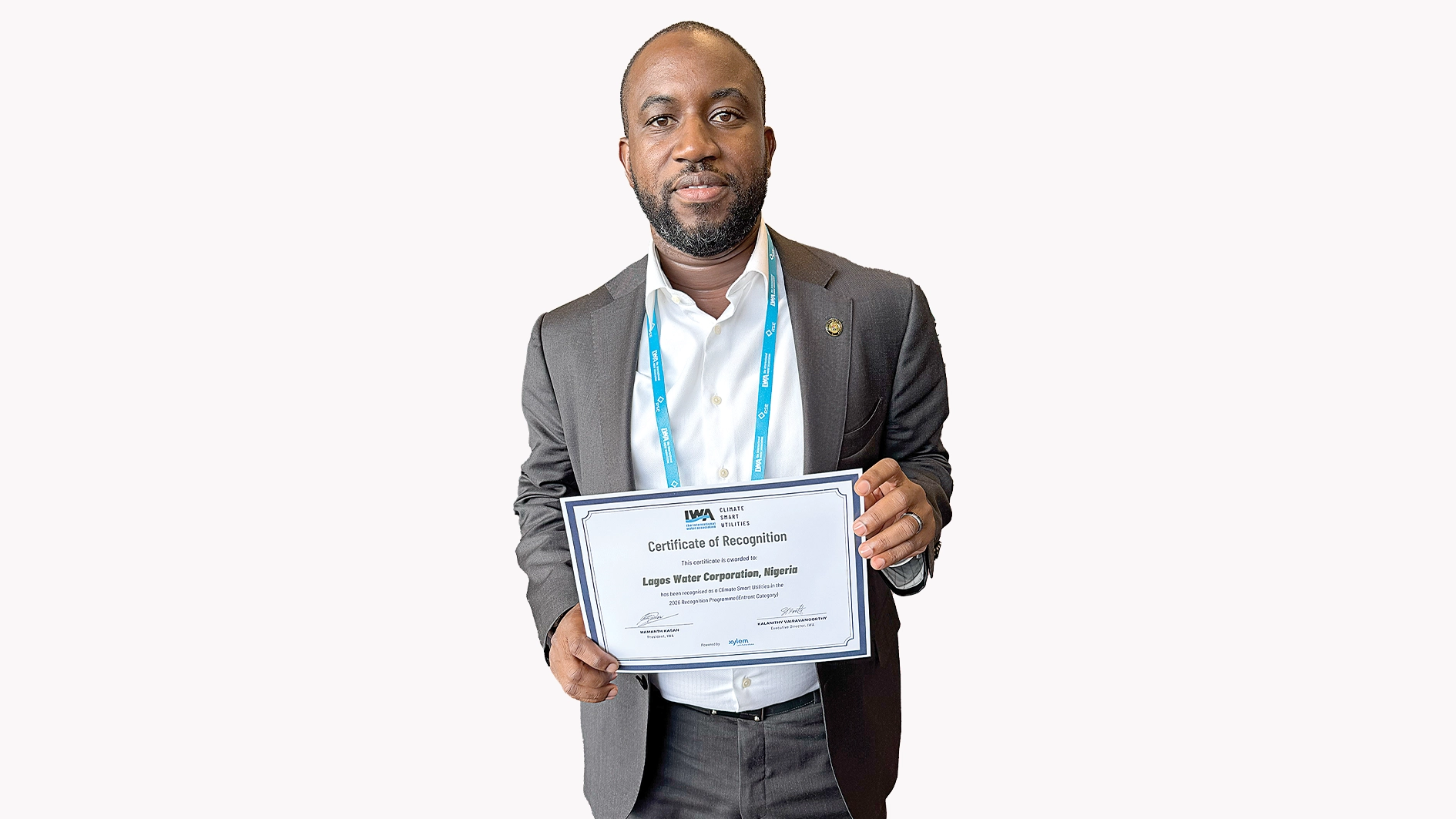
From ageing treatment plants and unreliable power to leaking pipelines and a widening supply gap, Lagos Water Corporation is pursuing an infrastructure overhaul. The real test, however, is whether the reforms will deliver safe, reliable and affordable water to more residents.
For millions of Lagos residents, access to clean water remains a daily challenge. Many households depend on boreholes, water vendors and private water facilities, raising concerns about groundwater contamination and the reliability of alternative sources.
Addressing the crisis requires more than increasing production. Treatment plants must function efficiently, distribution networks must be maintained, electricity must be reliable and sustained investment must support operations.
Against this backdrop, the ongoing reforms at Lagos Water Corporation (LWC), under its Managing Director, Engr. Mukhtaar Tijani, have assumed significance. The Corporation recently received international recognition in Glasgow under the 2026 International Water Association (IWA) Climate Smart Utilities Recognition Programme. It became the second Nigerian utility to receive the honour after Kaduna in 2022 and the first in southern Nigeria.
The programme assesses utilities on climate adaptation, greenhouse-gas mitigation and climate-smart leadership. While the recognition highlights LWC’s efforts, the more consequential question is whether the reforms can address the structural weaknesses that have constrained public water supply across Africa’s largest city.
When Tijani assumed office in July 2023, alongside Helen Omolanke Taiwo as Executive Director, Operations, only two of the four major treatment plants were reportedly functional, producing a combined 15 million gallons daily. Of 48 mini and micro waterworks, only six were operating, and even those were performing below capacity.

The management’s response has involved rehabilitating existing facilities, replacing critical equipment, restoring dormant waterworks, improving pipeline mapping, exploring public-private partnerships and advancing the long-delayed Adiyan II project.
Addressing Infrastructure Deficit
One immediate priority has been replacing critical equipment at major treatment facilities. At Iju Waterworks, the Corporation has received six clear-water pumps with motors and an additional pump head after the existing equipment had served for more than three decades. Two raw-water pumps, with motors and control systems, have also been received for the Adiyan Intake.
Installation of the new equipment at Iju is ongoing. The intervention, supported by the Lagos State Government under Governor Babajide Sanwo-Olu, is expected to improve production and operational reliability.
However, replacing ageing equipment must form part of a broader asset-management strategy. Regular condition assessments, preventive maintenance, adequate spare parts and transparent reporting of plant performance are essential to prevent rehabilitated facilities from returning to the cycle of breakdowns and emergency repairs.
Electricity is another major constraint. Treatment plants and pumping stations depend on reliable power, and interruptions can disrupt production while increasing operating costs.
The rebuilding of the Akute Independent Power Plant is therefore central to the Corporation’s recovery programme. On April 26, 2026, Sanwo-Olu presided over the signing of a power agreement with Fenchurch for the rebuilding of the 26-megawatt plant. Work commenced on September 26, with existing engines being removed for replacement with new gas engines.
Financed by Zenith Bank under the state’s public-private partnership arrangement, the project is expected to deliver 10 megawatts within four months and the remaining 16 megawatts within 12 months. The plant is intended to supply Akute Intake, Iju and Adiyan waterworks.
If delivered as scheduled, the investment could improve production across the facilities. Its success, however, will depend on the reliability and cost of the power supplied and whether this translates into more treated water reaching consumers.
Funding Constraints, Rehabilitation
The rehabilitation programme has also faced financial uncertainty following the withdrawal of USAID support for the Lagos Urban Water, Sanitation and Hygiene (LUWASH) programme, originally valued at approximately $45 million.
The withdrawal disrupted plans for a four-year rehabilitation programme, forcing the Corporation to reassess its priorities and identify projects the state government could fund.
The experience highlights the risks of relying heavily on external financing for essential infrastructure. Beyond construction and equipment, water utilities require predictable funding for electricity, treatment chemicals, laboratory testing, repairs, network maintenance and customer service.
A sustainable financing strategy must therefore provide for both rehabilitation and long-term operations, with clear priorities, realistic timelines and mechanisms for measuring value for money.
The Corporation has also pursued the revival of smaller waterworks to bring production closer to underserved communities.
Mosan Okunola Waterworks was recommissioned on December 14, 2023, with reported production restored to two million gallons daily. Supply was extended to Baruwa, where residents had experienced prolonged water scarcity and concerns over groundwater contamination.
Similarly, Akilo Waterworks was recommissioned on December 12, 2025, following rehabilitation undertaken with WaterAid Nigeria and Armani Beauty’s Aqua for Life initiative. With a stated capacity of 4,500 cubic metres daily, the facility is designed to serve approximately 100,000 residents through its distribution network and 20 water kiosks.
The project included new boreholes, replacement of electromechanical equipment, distribution network rehabilitation, household enumeration, hygiene promotion and community engagement.
These interventions demonstrate the importance of combining engineering works with distribution improvements and community participation. Water produced at a treatment plant cannot improve household access if the pipelines and connections needed to deliver it remain inadequate.
Other projects include a new mini waterworks on Lagos Island and the rehabilitation of Ajegunle Waterworks.
A $2.5 million grant-backed rehabilitation of Ojokoro Waterworks is also being supported by WaterAid Nigeria and TeamWater, with the involvement of YouTuber MrBeast. The contract, signed with Bayroyal International Ltd. on September 4, 2026, covers infrastructure upgrades, borehole rehabilitation, solar integration, pressure monitoring, leakage detection, automated network management, metering and network expansion.
The project is expected to benefit approximately 72,000 residents, while the Lagos Island, Ajegunle and Ojokoro projects are targeted for completion within 12 months.
The critical test will be whether projected benefits translate into measurable improvements in household access, water quality, service continuity and affordability.
Adiyan II and the question of scale
While smaller waterworks can provide relief to individual communities, Lagos requires large-scale infrastructure to meet its growing demand.
Adiyan II is central to that ambition. The long-delayed project was revived in November 2023 following renewed government funding commitments, the remobilisation of contractors and stronger project oversight. Sanwo-Olu inspected the site in February and December 2025 as construction progressed.
At the first Lagos Physical Planning Summit in October 2024, the governor acknowledged Tijani’s role in advocating for the project’s revival. His remarks followed an appeal by former Governor Babatunde Fashola for the state to prioritise the waterworks.
When completed, Adiyan II is designed to produce 320,000 cubic metres of treated water daily, equivalent to more than 70 million gallons, with a projected service population exceeding five million residents. The project is expected to become operational in 2027.
Its potential impact makes it one of the most consequential components of the state’s water infrastructure programme. However, construction must be matched by adequate power supply, transmission infrastructure, distribution networks, technical personnel and operational funding.
A large treatment plant cannot independently resolve shortages across a sprawling metropolitan area. Water must be conveyed through functional trunk mains and local distribution networks, with sufficient pressure to reach intended communities.
Regular public updates on construction milestones, commissioning schedules and distribution readiness would help residents assess progress and understand when the expected benefits may become available.

