 Follow Us on Google News



 Follow Us on Google Discover
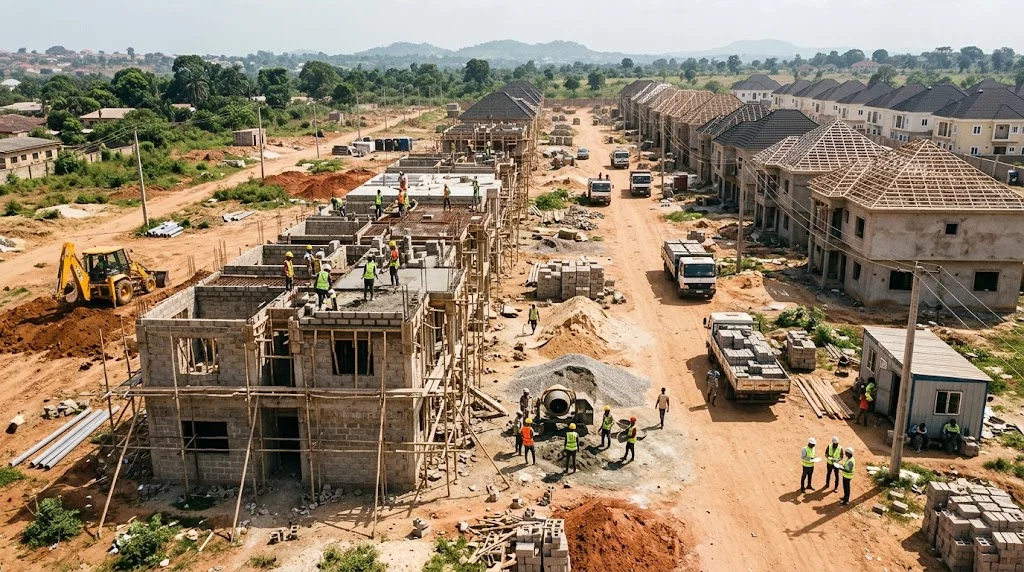
Nigeria’s housing conversation is dominated by numbers.
How many houses do we need? How large is the housing deficit? How much will it cost to close the gap? How can mortgages become more accessible? How much land can government make available? How quickly can developers deliver new units?
These are necessary questions.
Nigeria undoubtedly needs more housing, and expanding access to decent accommodation should remain an important national priority.
But there is another question that receives far less attention:
What quality of housing are we producing?

If Nigeria succeeds in increasing the number of housing units while producing homes that deteriorate prematurely, contain significant defects or require expensive repairs soon after occupation, we will have improved one statistic while creating another problem.
The housing challenge is therefore not simply about quantity.
Nigeria needs more homes, but Nigeria also needs better homes.
A completed house is not necessarily a quality house
One of the weaknesses in how housing delivery is discussed is our tendency to treat completion as the ultimate measure of success.
A housing estate is commissioned. Keys are handed over. Photographs are taken. Officials announce the number of units delivered.
The project enters the housing statistics.
But what happens two years later?
Or five years later?
Do the roofs perform properly?
Does the drainage cope with heavy rainfall?
Are the electrical systems safe?
Does the plumbing work as intended?
Have persistent cracks appeared?
Is water entering areas where it should not?
Are residents spending significant amounts correcting defects that originated during construction?
These questions matter because housing is not truly delivered when the paint dries.
A home is supposed to perform over time.
The pressure to build quickly must not undermine quality
Nigeria’s housing shortage naturally creates pressure for speed.
Governments want to demonstrate delivery. Developers need to control financing costs and complete projects. Buyers want possession.
But construction quality cannot become collateral damage in the race to increase supply.
The consequences of poor construction often emerge after the people responsible for delivering the project have moved on.
A defect identified while construction is ongoing may be relatively straightforward to correct.
The same defect discovered after walls have been plastered, ceilings installed, tiles laid and residents have moved in can become significantly more disruptive and expensive.
This leads to an important principle for housing policy:
Quality should not be inspected into a building at the end. It should be verified throughout construction.
From quality control to quality evidence
Housing projects already involve architects, engineers, builders, quantity surveyors, contractors, subcontractors, developers, government agencies and other professionals.
Each has defined responsibilities.
But Nigeria should increasingly ask another question:
Where is the evidence showing that critical stages of construction were properly executed?
The future of quality assurance should involve better documentation.
Important construction stages can be inspected and recorded. Defects can be documented. Corrective actions can be tracked. Photographic evidence can be retained. Where appropriate, tests can be conducted and results associated with particular stages of work.
Instead of merely declaring that a housing unit has been completed, we should be able to demonstrate a traceable process through which quality was assessed.
This is particularly important for large-scale housing developments where the same construction defect can potentially be repeated across dozens or hundreds of units.
Finding a systemic problem early can prevent it from becoming a much larger liability.
Public housing requires particular accountability
The principle becomes even more important where public funds are involved.
Government-backed housing schemes ultimately involve public resources, whether through direct expenditure, subsidised land, infrastructure, guarantees, financing arrangements or other forms of support.
Taxpayers therefore have an interest not merely in how many houses are announced, but in the quality of the assets delivered.
Construction payments are frequently tied to milestones.
There is a strong case for strengthening the evidence required to establish that those milestones have genuinely been achieved to the appropriate standard.
The principle can be expressed simply:
Build. Inspect. Verify. Pay.
Before funds associated with important construction milestones are released, there should be reliable information about what has physically been completed, outstanding defects and whether the relevant work is ready to proceed to the next stage.
This is not about creating unnecessary obstacles for contractors.
It is about ensuring that financial progress corresponds with physical and qualitative progress.
Buyers should not become the final quality-control department
Too often, defects are discovered during handover or after occupation.
Residents move in and gradually compile lists.
The tap is leaking.
Water is entering through a window.
The socket does not work.
The bathroom floor does not drain properly.
A door cannot close.
Dampness appears on a wall.
Cracks begin to show.
At that point, the homeowner effectively becomes the project’s final quality-control officer.
That should not be the standard.
Snagging and pre-handover inspection are valuable, but quality assurance should begin much earlier.
The goal should be to prevent defects from being concealed by subsequent construction stages rather than waiting for a finished building to reveal them.
Housing affordability includes the cost of defects
There is also an economic dimension that deserves more attention.
We normally define affordable housing by acquisition price or rent.
But the true cost of housing continues after purchase.
A supposedly affordable home that requires extensive remedial work shortly after occupation may not be affordable at all.
The homeowner may face the cost of repairing plumbing, replacing electrical components, correcting drainage, addressing moisture penetration or carrying out other work that should have been properly executed during construction.
For a household already servicing a mortgage or recovering from the financial strain of buying a home, unexpected repair costs can be substantial.
Construction quality is therefore part of housing affordability.
Durability is part of affordability.
Maintainability is part of affordability.
A cheap building that repeatedly demands expensive repairs can become an expensive home.
Technology gives us an opportunity
Digital technology can help change how quality assurance is conducted across large housing developments.
Inspection platforms can document defects, assign corrective actions, record photographs, track completion and create an auditable history for individual properties.
Imagine a housing unit having a digital quality record from construction to handover.
A developer could demonstrate what inspections occurred.
A financier could have better visibility into construction progress.
A government agency could review evidence associated with publicly supported projects.
A buyer could receive useful information about the home being purchased.
This would move the market away from relying almost entirely on assurances towards a system increasingly supported by evidence.
We should measure housing differently
Nigeria must continue building.
Our population, urbanisation and household formation make increased housing supply unavoidable.
But the national housing conversation needs a second metric.
Alongside the number of homes delivered, we should begin paying much greater attention to how those homes were built and how they perform.
Success cannot simply mean 1,000 units completed.
It should mean 1,000 homes delivered to defined standards, appropriately inspected, defects addressed and capable of serving their occupants safely and effectively.
This requires collaboration rather than another professional turf war.
Architects, engineers, builders, developers, regulators, financiers, inspectors and homeowners all have roles within a functioning quality ecosystem.
The objective should be common: buildings that perform as intended.
From housing delivery to housing assurance
The next evolution of Nigeria’s housing policy should therefore move beyond delivery towards housing assurance.
We should want to know not merely that a house exists, but that reasonable systems were used to verify its quality.
Not simply that the contractor completed the project, but that critical work was checked.
Not simply that government commissioned an estate, but that the homes can withstand the test of occupation and time.
And not simply that a Nigerian family finally received the keys to a home, but that the home they worked so hard to acquire will not immediately become another financial burden.
Nigeria’s housing crisis is unquestionably a supply crisis.
We need more homes.
But every house added to the national stock should represent an improvement in people’s lives, not simply another number in a housing-delivery announcement.
That requires us to ask a more demanding question whenever we celebrate new housing:
How many houses did we build?
And then:
How many can we confidently say were built right?
Until both questions matter equally, Nigeria’s housing crisis will remain not only a crisis of quantity.
It will also be a crisis of quality.

Ikechukwu Casper Chidubem is a building quality and property verification professional, President of Home Inspectors Nigeria (HINL) and CEO of InspectAfrica, a Pan-African building quality ecosystem providing inspection, professional training, certification, technology and standards development. He works with homeowners, investors, developers and institutions on property verification, construction quality assurance and technical due diligence across Africa.

