 Follow Us on Google News



 Follow Us on Google Discover
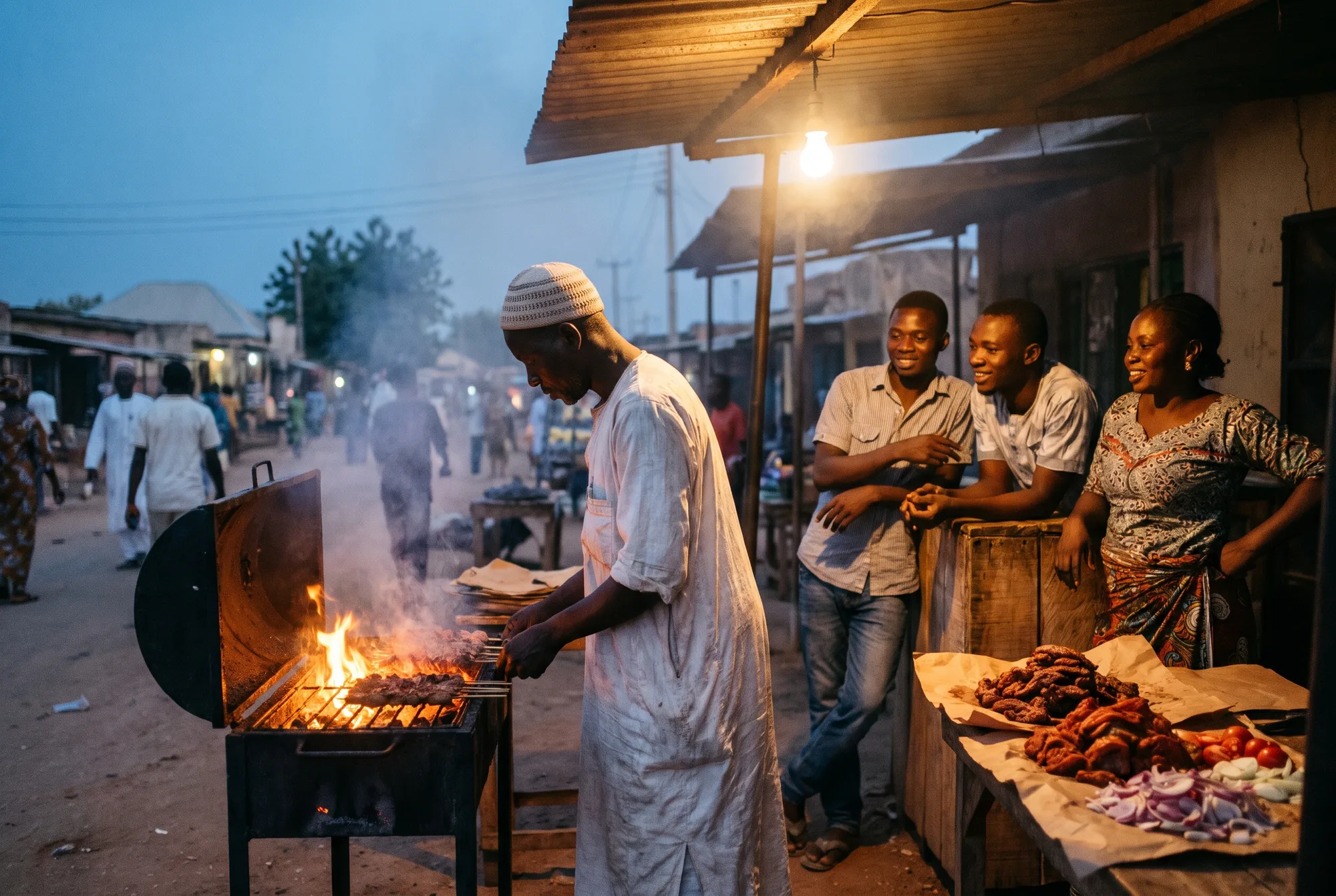
Welcome, and pull up a stool. This piece is the conclusion of months of research across market stalls, abattoir reports and government data, sitting on top of years of experience writing about how this country eats. It started with a WhatsApp message from a friend in Leeds who had just watched a documentary and wanted to know, with some alarm, what animals do Nigerians eat. My first answer was “goat, mostly, and plenty of it.” Then I remembered the wild game that West and Central Africans have hunted for generations, my uncle’s grasscutter pepper soup, and a Saturday afternoon in Calabar that I will come to later.
So the honest answer is longer, and a good deal more interesting, than either of us expected.
Nigerians eat cattle, goats, sheep and chickens in enormous numbers. We eat fish from the creeks and the lagoons, snails the size of a fist, rams at Sallah and turkey at Christmas. In some places we eat grasscutter, antelope, bush pig and fruit bat. In a handful of states, we eat dog.
None of that is a scandal. Every cuisine on earth is a map of what was available, affordable and allowed, and ours is no different (the French eat horse and frogs, and nobody sends worried WhatsApp messages about Lyon).
What has changed is the price, the safety picture and the conservation stakes. A kilo of beef now costs what a week of meat cost a decade ago, Lassa fever is killing a larger share of the people it infects than it did last year, and several species we grew up eating are vanishing from the forest. So this piece does three things. It answers the question plainly, it puts numbers behind each answer, and it shows you how to buy and cook meat in this country without getting ill.
Let us start where most Nigerian plates start.

Which Meat Is Most Consumed in Nigeria Today?
Beef. Then chicken. Then goat.
That is the order the trade analysts give, and it matches what I see at Bodija market in Ibadan every time I go. Beef is the meat of the ordinary pot: cut into stew, sliced thin for suya, dried into kilishi, with the hide itself boiled into ponmo. Chicken has taken second place over the past twenty years as commercial poultry spread across Ogun, Oyo and Kaduna. Goat comes third in volume but first in affection, and it costs more per kilo than either of the other two.
Beef in Nigeria is rather like rice. Everybody eats it, and almost nobody thinks about where it came from.
Where it came from, mostly, is a household. The National Bureau of Statistics surveyed the country’s farms for its first agricultural census since 1993, and the census of agricultural households it published in 2024 counted about 40.2 million farming households, 48 per cent of which raise some kind of livestock. Jigawa had the highest share of livestock households at 84.2 per cent, followed by Bauchi at 79.7 per cent, while Benue led for poultry at 65.2 per cent and Ebonyi was close behind at 63.3 per cent. Analysts who have worked through the same data put chickens in about 42.5 per cent of farming households and goats in about 41.3 per cent, with sheep at 21.9 per cent and cattle at only 16 per cent.
Read that again and the shape of Nigerian meat becomes clear. Cattle are concentrated in relatively few, mostly northern, hands. Goats and chickens are everywhere, in compounds from Sokoto to Uyo, and that is why they turn up at every naming ceremony.
The cattle themselves travel a long way before they reach your plate. Gbenga Akinfenwa’s investigation for this newspaper into the hygiene of the slaughter slabs that feed our markets reported that more than 1.3 million cows are slaughtered every year to meet Nigerian demand, and that cattle supply roughly 30 per cent of all the meat we eat. He also found animals being killed beside open canals with no vet in sight, which is not the image anyone wants with their pepper soup.
The government knows. In July this year the Minister of Livestock Development, Idi Mukhtar Maiha, told the national butchers’ union that many existing slaughter facilities no longer meet acceptable standards, promising modern abattoirs, cold storage across the federation and training for the people who run them. The butchers, for their part, asked for refrigerated vans so that meat no longer rides to market on the back of an okada. I will believe the vans when I see them on the Lagos to Ibadan expressway, but the admission matters.
And then there is the price. A friend who runs a small buka in Yaba told me in September that she now buys beef by the half kilo, not the kilo, and cuts every piece a little smaller than she did in 2023. Her customers have noticed. Nobody has complained, because nobody can afford to go anywhere else.
Here is the uncomfortable statistic underneath all of this. Trade estimates put Nigerian beef consumption at roughly 1.7 kilograms per person per year, against a global average of about 9.1 kilograms. We are a meat-loving nation that, on average, does not eat very much meat.
Goat and ram sit at the top of that pyramid. During the Sallah season, our metro desk found that small and medium rams in Suleja and Maje were going for ₦200,000 to ₦300,000, with bigger animals at ₦400,000 and above, and plenty of families simply waited until Sallah morning hoping prices would fall. That is roughly a month’s salary for many workers, for one animal, for one day.
Fish deserves a mention here too, because for millions of southern households it is the animal protein that turns up most often. Catfish pepper soup, bonga in stew, crayfish ground into almost everything. If you counted every flake of crayfish in every pot of egusi, fish might win the whole contest.
What Is the Most Eaten Animal in Africa, and How Does Nigeria Compare?
Across the continent as a whole, the answer is the chicken.
Africa keeps something like 1.9 billion chickens, against roughly 374 million goats, 350 million sheep and 320 million cattle. Market analysts estimate that the continent consumed about 9.6 million tonnes of chicken meat in 2024, ahead of 7.2 million tonnes of beef and 2.2 million tonnes of pork. FAO and OECD figures put the average African’s meat intake at about 9.6 kilograms a year, of which chicken accounts for around 3.8 kilograms.
So why does Nigeria put beef first?
Partly history and partly geography. The northern savanna has carried cattle for centuries, the Fulani pastoral system moved beef south along the old trade routes, and suya culture made beef the meat of the street long before fast-food chicken arrived. In North Africa and South Africa, by contrast, industrial poultry took off decades earlier.
Scale is the other surprise. FAO’s market review put Nigeria’s total meat output at about 1.47 million tonnes, which sounds large until you set it beside South Africa at about 3.5 million tonnes and Egypt at about 2.8 million tonnes, for populations a fraction of ours. One quirk does stand out: Nigeria and South Africa are the two biggest pig meat producers on the continent, thanks to the pork-eating communities of the south and the middle belt.
Then there is the meat that never appears in any of those tables. A survey commissioned by WildAid of 2,000 people in Lagos, Abuja, Port Harcourt and Calabar, which Victor Gbonegun reported for this newspaper as conservationists warned about the city appetite for wild meat, found that 71 per cent of respondents had eaten bushmeat at some point and 45 per cent had done so in the previous year. The same survey found that grasscutter was eaten by 44 per cent of bushmeat consumers, antelope by 25 per cent, snake by 21 per cent and wild pig by 15 per cent.
That is not a rural habit. That is Lekki and Maitama.
Rodents are where the comparison turns serious, because the multimammate rat carries Lassa fever, and bush rats are still trapped, smoked and sold in parts of the south and the middle belt. The Nigeria Centre for Disease Control’s situation report for the week ending 26 July 2026 counted 1,000 confirmed Lassa cases and 237 deaths so far this year, a case fatality rate of 23.7 per cent against 18.8 per cent at the same point in 2025. Ondo accounted for 32 per cent of confirmed cases, Bauchi 25 per cent, Taraba 13 per cent, Edo 10 per cent and Benue 6 per cent. Most infections come from contact with rat urine and droppings around the home rather than from eating the animal, but handling and butchering a rat is exactly that kind of contact.
So, What Animals Do Nigerians Eat? The Straight Answer
Nigerians eat a wide range of animals, led by farmed livestock and fish, with regional and wild meats layered on top. The everyday core is cattle (beef), chicken, goat, sheep and fish, which together make up the great majority of the meat sold in markets and cooked in homes from Kano to Port Harcourt. Pork is widely eaten in the south and the middle belt but largely avoided in the Muslim north, while turkey, guinea fowl and duck appear at festive tables. Around that core sits a second ring of delicacies that vary by region: the giant African land snail, grasscutter (the cane rat), antelope, bush pig, porcupine and fruit bat as bushmeat, and dog meat in parts of Cross River, Akwa Ibom, Plateau, Enugu and a few other states. Offal is prized rather than wasted, so cow skin, tripe, liver, intestines and goat head all have their own dishes. In short:
- Everyday meats: beef, chicken, goat, mutton and fish
- Regional and festive meats: pork, turkey, guinea fowl, ram at Sallah
- Delicacies: snail, grasscutter, antelope, bush pig, fruit bat
- Regional and contested: dog meat
- Offal favourites: ponmo, shaki, isi ewu, liver and kidney in suya
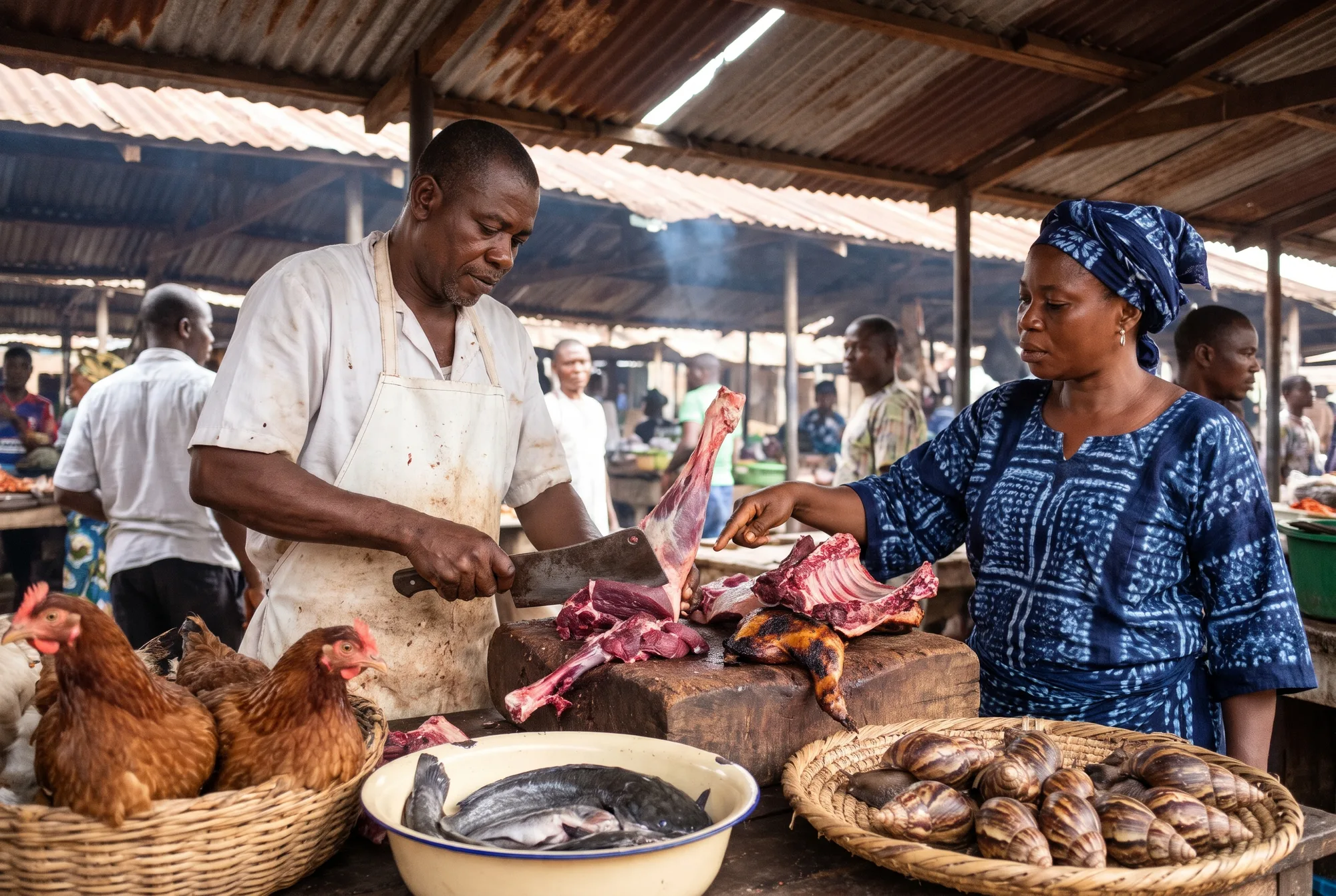
That is the whole picture. The table below shows how the main animals compare on region, dishes, price and the one safety point worth remembering for each.
Animals Nigerians Eat Compared by Region, Dish and Price
| Animal | Role on the plate | Where it is eaten most | Signature dishes | Indicative 2026 price | Safety point |
|---|---|---|---|---|---|
| Cattle (beef) | Most widely eaten red meat | Nationwide, strongest in the north | Suya, kilishi, stew beef, ponmo | ₦7,000 to ₦8,500 per kg | Buy from a licensed abattoir |
| Chicken | Second place and climbing | Nationwide; Benue leads household rearing | Fried chicken, pepper soup, stew | ₦5,000 to ₦7,500 per kg frozen | Cook to a 75°C core |
| Goat | Premium everyday red meat | Nationwide; reared mostly in the north | Asun, isi ewu, goat pepper soup | ₦7,500 to ₦9,500 per kg | Look for firm, clean flesh |
| Sheep (ram) | Festive and ceremonial | Muslim households everywhere | Sallah ram, tsire, suya | ₦200,000 to ₦400,000 or more per live ram | Buy live from a seller you know |
| Fish | Everyday protein in the south | Coast, creeks, lagoons, Kainji, Lake Chad | Catfish pepper soup, banga, bonga stew | ₦4,000 to ₦7,000 per kg fresh catfish | Smell the gills before paying |
| Grasscutter | Most popular bushmeat, now farmed | South-west, south-south, middle belt | Smoked in soup, roasted, pepper soup | ₦25,000 to ₦45,000 per animal | Choose farmed over hunted |
| Snail | Prized delicacy | South-west, south-east, south-south | Peppered snail, snail in efo riro | ₦1,500 to ₦4,000 per large snail | Wash out all slime, then boil well |
| Dog | Regional delicacy | Cross River, Akwa Ibom, Plateau, Enugu | Pepper soup with palm wine | ₦3,000 to ₦6,000 per plate | Rabies risk from stray dogs |
The pattern is simple once it is laid out. Farmed meat is cheaper per kilo and easier to trace, while the wild and regional meats cost more, carry more risk and depend on where in Nigeria you happen to be eating. (Prices are indicative ranges from my own checks in Lagos, Ibadan, Enugu and Jos plus published market reports, so expect your local market to differ.)
Now, a word on presentation, because how we serve meat says as much about us as what we serve.
Suya belongs on brown paper or newspaper, with raw onion rings, sliced tomato and cabbage, and a little twist of extra yaji on the side. Plating it on a slate board with microgreens is a small crime. If you are hosting, give each guest about 150 to 200 grams of sliced suya and lay the sticks in a single layer so the spice stays crisp rather than steaming.
Pepper soup wants a deep clay pot or an enamel bowl with a lid, one ladle of broth to every three or four pieces of meat, and a sprig of scent leaf laid on top just before serving. Asun looks best piled on a wooden tray with plenty of sliced green and red pepper for colour. Peppered snail travels well on short skewers, three snails to a stick, which also stops guests fishing in a communal bowl.
For a party table, colour does most of the work. A tray of dark, glossy asun beside golden fried chicken and white rice reads as generous; three brown meats in a row reads as a canteen. And if you want the backstory to that suya stick, I traced where it and our other street classics came from in my piece on what food did Nigeria create.
Which State in Nigeria Eats Dog Meat the Most?
Nobody has counted. There is no official survey of dog meat consumption by state, so anyone who gives you a confident ranking is giving you an opinion.
The opinions are fairly consistent, though.
Cross River, and Calabar in particular, carries the reputation, followed closely by Akwa Ibom, where dog pepper soup and palm wine are an established pairing at roadside joints. Plateau has the trade: the Dawaki market in Kanke Local Government Area is widely described as the largest dog market in the country, run largely by women traders and drawing buyers from several states. Ondo, Taraba, Ekiti and Nasarawa also have long-standing dog meat cultures. And Professor Edem Eniang, a wildlife scholar at the University of Uyo, has argued that the single heaviest dog-eating area is actually Nike in Enugu State, with Plateau second and Akwa Ibom only third.
So if you need one answer, the honest one is this: Cross River and Akwa Ibom have the reputation, Plateau has the market, and Enugu may have the appetite.
The local nickname, if you have ever wondered, is “404”, and nobody can quite agree on why.
I tasted it once, on that Saturday in Calabar I promised to tell you about. A colleague took me to a joint near Watt Market where a red flag hung outside to tell regulars the day’s dog had been slaughtered. The pepper soup was dark, fiercely hot and, I will admit, good. The meat itself was close-grained and slightly sweet, somewhere between goat and pork. I did not go back, and not because of the taste.
What kept me away was everything I learnt afterwards about where the dogs come from, which I will come to in a moment.
The beliefs around dog meat are worth knowing, because they explain much of its pull. People will tell you it cures malaria, protects against poison and witchcraft, strengthens a man and smooths a woman’s skin. None of those claims has evidence behind it. What the meat does offer is protein, at a price point (a plate of pepper soup for a few thousand naira) that beef and goat now struggle to match.
Politically, it is not going anywhere soon. In December 2025 the Akwa Ibom House of Assembly rejected a motion to ban the sale and consumption of dog meat in the state, and not a single member besides the sponsor supported it. Rather like palm wine, dog meat is woven into the social life of the places that eat it, and a ban written in Uyo or Abuja would simply move it behind a curtain.
Is Dog Meat or Bushmeat Good for Eating?
Nutritionally, both are lean, protein-rich meats, and neither is any healthier than a well-sourced piece of goat. The problem is never the protein. It is the sourcing.
Take dog meat first. Most dogs in the trade are not farmed. They are strays or stolen pets, many of them transported long distances from the north in cramped cages, and none of them vaccinated. A study at the University of Calabar Teaching Hospital found that the stray dog trade, fuelled by demand for dog meat, was a direct risk factor in a cluster of fatal rabies cases admitted in 2012. Butchers and the people who handle raw carcasses carry the highest risk, because rabies spreads through the blood and saliva of an infected animal. Thorough cooking kills the virus in the meat, but it does nothing for the person who skinned the dog.
There is a quieter danger too. In 2015 five people died in Woji, Rivers State, after eating dog meat at a local hotel, a case whose cause was never clearly explained to the public. Meat from an animal of unknown health is always a gamble, and a dog sold because it was already sick is the oldest trick in the trade.
Bushmeat raises a different set of questions, and they have grown louder this month. With health officials investigating a confirmed Ebola case in the FCT, the old warnings about fruit bats and primates are back in every family group chat. Bats and monkeys are known carriers of Ebola, bush rats carry Lassa, and handling infected carcasses has been linked to mpox and anthrax across the region. The meat itself, once boiled for a long time, is rarely the risk. The hunting, the skinning and the smoking are.
Then there is the conservation side. Nigeria now has fewer than 50 wild lions, a story I told in full in my explainer on what is Nigeria’s national animal, and one of the main reasons is that hunters have stripped out the antelope those lions used to eat. Pangolins, primates and many antelopes are protected under Nigeria’s endangered species law, which means buying them is not just risky but illegal, however openly they hang at the roadside.
The good news is that the two most popular wild meats are increasingly farmed. Grasscutter rearing has spread across the south-west and south-south, and snail farming has become one of the more popular small agribusinesses for young people, with training programmes run by legislators and state agencies. A farmed grasscutter tastes like a hunted one, comes from a known pen and does not empty a forest.
So, is it good for eating? A farmed grasscutter, a clean snail or a properly sourced goat, cooked through, is perfectly good eating. A stray dog, a bat or a bush rat of unknown origin is a gamble I would not take, and neither would most of the vets I spoke to while researching this piece.
How to Buy and Cook Meat Safely in Nigeria in Seven Steps
Whatever animal you choose, the same habits will protect your household. These are the steps I follow myself, refined over years of shopping in open markets with a cool bag and a suspicious nose.
- Ask the butcher which abattoir the meat came from, and favour stalls that buy from a licensed slaughterhouse; a seller who cannot or will not tell you is giving you your answer.
- Inspect before you pay: beef should be cherry red with creamy fat, goat a deeper red, chicken pale pink with no slime, and fish should have bright eyes and red gills with no sour smell.
- Make the meat the last thing you buy, carry it in an insulated bag with a frozen bottle of water, and have it in the fridge within one hour (a decent cool bag costs around ₦5,000 to ₦10,000).
- Keep your fridge at 4°C or below and your freezer at minus 18°C, and if NEPA takes the light for more than four hours, cook or boil the meat that day rather than refreezing it.
- Never buy wild meat that was found dead, smells off or comes from an animal you cannot name, and leave bats, primates, pangolins and bush rats alone completely.
- Use a separate board and knife for raw meat, wash your hands with soap after handling it, and wear gloves if you are skinning or cutting up any wild animal.
- Cook every piece to a core of at least 75°C for poultry, offal and game, which a simple probe thermometer of around ₦8,000 to ₦15,000 will confirm, and boil pepper soup at a rolling boil for at least 30 minutes before you serve it.
Seven habits. None of them is expensive, and together they remove most of the risk from most of the meat sold in this country.
Final Thoughts on What Animals Nigerians Eat
So what animals do Nigerians eat? Mostly the ones every nation eats: cattle, chicken, goat, sheep and fish, cooked with more pepper and more imagination than most. Around that everyday core sits a ring of delicacies, the snail, the grasscutter and the antelope, and at the edge of it, in a few states, dog.
The real story is not the list. It is that meat has become a luxury for many households, that the abattoirs feeding our cities are still far from where they should be, and that some of the wild animals we grew up eating are disappearing. Each of those is fixable, and none of them requires anyone to give up suya.
My friend in Leeds, for the record, visited Lagos in August. She ate asun, peppered snail and catfish pepper soup in a single evening and flew home asking for recipes. Food has a way of settling arguments that documentaries start.
If you want somewhere to begin this week:
- Swap one bushmeat meal this month for a farmed grasscutter or snail from a named farm, and ask the seller to show you where the animals are kept.
- Ask your regular butcher, kindly, which abattoir supplies the stall, and move your custom if the answer never comes.
- If you serve dog meat or bushmeat at a family event, tell your guests what it is, where it came from and how it was cooked, so everyone can choose for themselves.
Related Articles
If the question of which animals Nigerians refuse to eat has caught your interest as much as the ones we do, my earlier piece asking what animal is sacred in Nigeria looks at the creatures whole communities protect rather than cook, and why those beliefs have lasted.
And because so many of our food choices are governed by unwritten rules rather than taste, my exploration of what is taboo in Nigerian culture sets out the customs and prohibitions that shape daily life, including at the dinner table.
Key Takeaways
- Nigerians eat mainly beef, chicken, goat, sheep and fish, with pork in the south and middle belt and snail, grasscutter and other bushmeat as regional delicacies.
- Chicken is the most eaten animal across Africa, but beef leads in Nigeria, where per person meat intake remains far below the global average because of price.
- Dog meat is concentrated in Cross River, Akwa Ibom, Plateau and Enugu, and both dog meat and wild meat carry real disease and conservation risks that farmed meat avoids.
Frequently Asked Questions About What Animals Nigerians Eat
What animals do Nigerians eat?
Nigerians mainly eat cattle, chicken, goat, sheep and fish, with pork, turkey and guinea fowl common in many homes. Snail, grasscutter, antelope and other bushmeat are regional delicacies, and dog meat is eaten in a few states.
Which meat is most consumed in Nigeria?
Beef is the most widely consumed meat in Nigeria, followed by chicken and then goat. Fish is also eaten daily in many southern homes and rivals beef as the most common source of animal protein there.
What is the most eaten animal in Africa?
The chicken is the most eaten animal across Africa, with about 9.6 million tonnes of chicken meat consumed in 2024 against roughly 7.2 million tonnes of beef. Nigeria is an exception to the continental pattern because beef still leads on Nigerian plates.
Which state in Nigeria eats dog meat the most?
No official survey ranks states by dog meat consumption, but Cross River and Akwa Ibom have the strongest reputation. Plateau hosts the Dawaki market, described as the largest dog market in the country, and one Uyo wildlife scholar argues that Nike in Enugu State eats the most.
Is dog meat good for eating?
Dog meat is a lean source of protein, but it offers no proven health benefit over goat or beef despite popular claims. The main danger is rabies and contamination, because most dogs in the trade are unvaccinated strays handled with no veterinary checks.
Is dog meat eaten in other parts of Africa?
Yes, dog meat is eaten in pockets of West and Central Africa, including parts of Ghana and Cameroon as well as Nigeria. It remains a minority practice everywhere it appears, and many communities on the continent regard it as taboo.
What is the most popular bushmeat in Nigeria?
Grasscutter, also called the cane rat, is the most popular bushmeat in Nigeria, eaten by 44 per cent of bushmeat consumers in a survey of four major cities. Antelope, snake and wild pig follow, and grasscutter is now widely farmed as well as hunted.
Is bushmeat legal in Nigeria?
Hunting and selling species protected under Nigeria’s endangered species law is illegal, and that covers pangolins, primates and many antelopes. Common rodents such as the grasscutter are not protected, which is why they are sold openly and increasingly farmed.
Why do Nigerians eat bushmeat?
Most consumers say they choose bushmeat for its taste, and many also cite tradition and a belief that wild meat is more natural than farmed meat. Surveys show that almost all urban buyers accept that fish, chicken or goat would make a suitable alternative.
Do Nigerians eat snails?
Yes, the giant African land snail is a prized delicacy, especially in the south-west, south-east and south-south. It is usually boiled, peppered and served on skewers or cooked into soups such as efo riro and egusi.
Do Nigerians eat pork?
Yes, pork is widely eaten in the south and the middle belt, and Nigeria is one of the two largest pig meat producers in Africa. It is largely avoided in the Muslim north, so you will rarely find it on menus in cities such as Kano or Sokoto.
Which animals do Nigerians avoid eating?
Muslims avoid pork, and many families and clans keep their own taboos against animals such as snakes, crabs, certain fish or a totem animal linked to their lineage. Some communities also refuse animals they regard as sacred, such as the royal python in parts of Anambra and other south-eastern towns.

