 Follow Us on Google News



 Follow Us on Google Discover
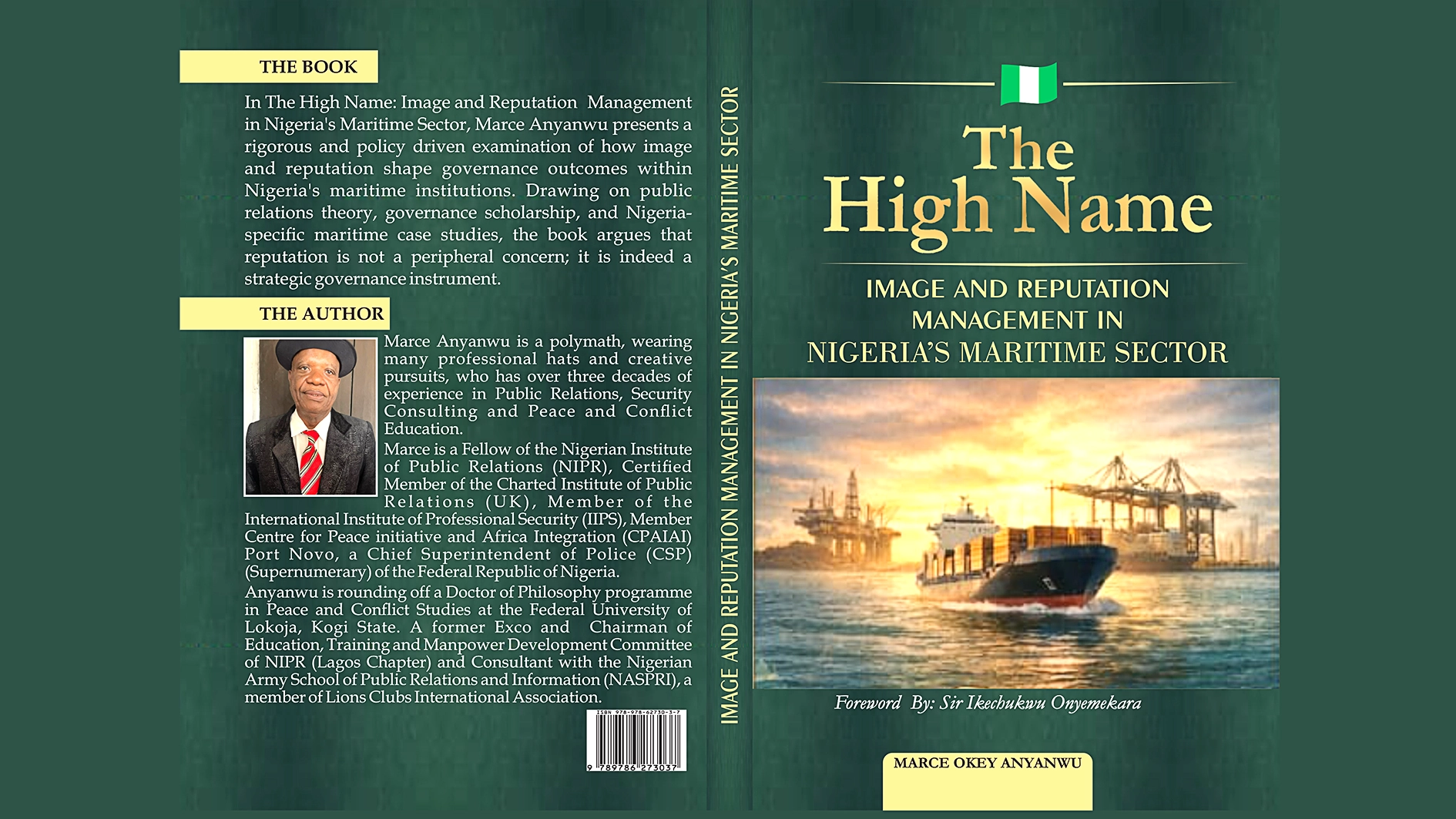
By Marce Anyanwu
THERE is a peculiar irony at the heart of Nigeria’s maritime story. The country has posted real, verifiable gains at sea in recent years; piracy numbers are down, port revenues are up, Tincan, Apapa Port, ranked among the top 20 most improved Ports in the world, and Nigerian officials now sit at the table in bodies like PMAWCA and the IAPH. Yet ask the average ship-owner, insurer, or foreign investor what comes to mind when they hear “Nigerian waters,” and the answer rarely matches the data. That gap, between what is actually happening and what the world believes is happening, is the subject Marce Anyanwu sets out to untangle in “The High Name: Image and Reputation Management in Nigeria’s Maritime Sector.”
It is an ambitious book, and it wears its ambition openly. Across twenty-one chapters, Anyanwu ranges from sixteenth-century English privateering to predictive analytics in twenty-first-century port systems, using each stop along the way to make a single, patiently argued point: reputation is not a public relations afterthought bolted onto maritime governance, it is the governance. It has to be built, protected, and actively managed, in the same way a port authority manages berths or a shipping line manages fuel costs.
The opening chapter sets the tone nicely. Anyanwu reaches back to Elizabethan England, where the Crown issued “letters of marque” allowing private seafarers, the so-called Sea Dogs, to raid Spanish ships on the state’s behalf. It was piracy with royal paperwork attached. Depending on which side of the Atlantic you stood on, the same act read as either patriotic enterprise or naked theft. Anyanwu uses that centuries old ambiguity as a mirror for the present, arguing that Nigeria’s own maritime institutions, chiefly the Nigerian Ports Authority (NPA) and the Nigerian Maritime Administration and Safety Agency (NIMASA), face a version of the same problem: their actions can be legally sound and operationally sensible, yet still be read abroad as chaotic or untrustworthy if nobody controls the narrative around them.
That framing carries the whole book. Chapter after chapter, whether the subject is trust and distrust between agencies, corporate social responsibility, or trade unionism on the docks, Anyanwu keeps circling back to the same question: does this build the “high name,” or does it quietly erode it? It is a smart organizing device, and it keeps a book that could easily have splintered into twenty-one disconnected essays feeling like a single, coherent argument.
The strongest material in the book, unsurprisingly, isThe chapter built around the Exxon Valdez disaster is a standout. Anyanwu recounts how Exxon’s cleanup, by the US Coast Guard’s own assessment, was declared technically complete and satisfactory, yet the company never recovered its public standing. The lesson Anyanwu draws is blunt and useful, well beyond the maritime world: doing the right thing operationally does not automatically translate into being seen as having done the right thing. Perception has its own logic, and it does not wait for facts to catch up.
Elsewhere, the case study on the wreck of the San Jose, the Spanish galleon that sank off Colombia in 1708 carrying a cargo now estimated near seventeen billion dollars, reads almost like a maritime legal thriller. It is a curious inclusion for a book aimed at Nigeria’s port sector, but it works, because it illustrates how ownership disputes, historical claims, and international law can shape a nation’s maritime identity long after the ships themselves have gone down.

Where the book is less surefooted is in its density. This is not a breezy read. Anyanwu writes for an audience that already has some fluency in public relations theory and maritime policy, and the prose leans heavily on academic scaffolding — citations stacked within sentences, taxonomies of “image types” laid out almost like a lecture slide, long passages devoted to defining terms before applying them. Readers coming to the subject purely out of curiosity about Nigeria’s ports may find themselves working harder than they expected to. A tighter edit in places, particularly in the more definitional early chapters, would have let the sharper, more narrative sections, and there are several, do more of the talking.
It is also, by design, an insider’s book. Anyanwu writes with evident respect for NPA and NIMASA and a clear-eyed view of the reform agenda both agencies are pursuing, from digital port community systems to the Deep Blue Sea security project. Readers hoping for a more adversarial or investigative take on Nigeria’s maritime institutions will not find it here. What they will find instead is a serious, well-referenced argument for why those institutions cannot afford to treat communication as an afterthought, and a fairly comprehensive playbook for what taking it seriously would look like.
That playbook is where The High Name earns its keep. The chapters on accountability management, inter-agency communication, and crisis response read less like history and more like a working manual, useful not only to NPA and NIMASA staff but to communication professionals anywhere managing a public institution under scrutiny. The recurring insistence that reputation “accumulates slowly and is far harder to build, and to tear down, than image ever is” is a line worth sitting with, whether you work in shipping or not.
For students of public relations, maritime administration, or African governance, this book belongs on the shelf. It is thorough, well-sourced, and unusually willing to draw a straight line from sixteenth-century privateers to twenty-first-century port dashboards. General readers looking for a light introduction to Nigeria’s maritime sector may want to start elsewhere and come to this one once they are ready to go deep. But for anyone asking why a country can improve its numbers at sea and still struggle to improve its name, Anyanwu offers a thoughtful, well-argued answer: because a name, like a port, has to be actively managed, not merely earned and left alone.
The High Name: Image and Reputation Management in Nigeria’s Maritime Sector is reviewed by Innocent Nwachukwu, the publisher of Tentacles Magazine.

