
 Get Guardian on Google
The Westminster Foundation for Democracy (WFD) has called on Nigeria’s National and State Houses of Assembly to institutionalise Post-Legislative Scrutiny (PLS) to determine whether existing laws are achieving their intended objectives and address implementation gaps.
The foundation said the effectiveness of legislation should not be measured merely by the number of laws passed, but by their impact on citizens and their ability to respond to changing societal needs.
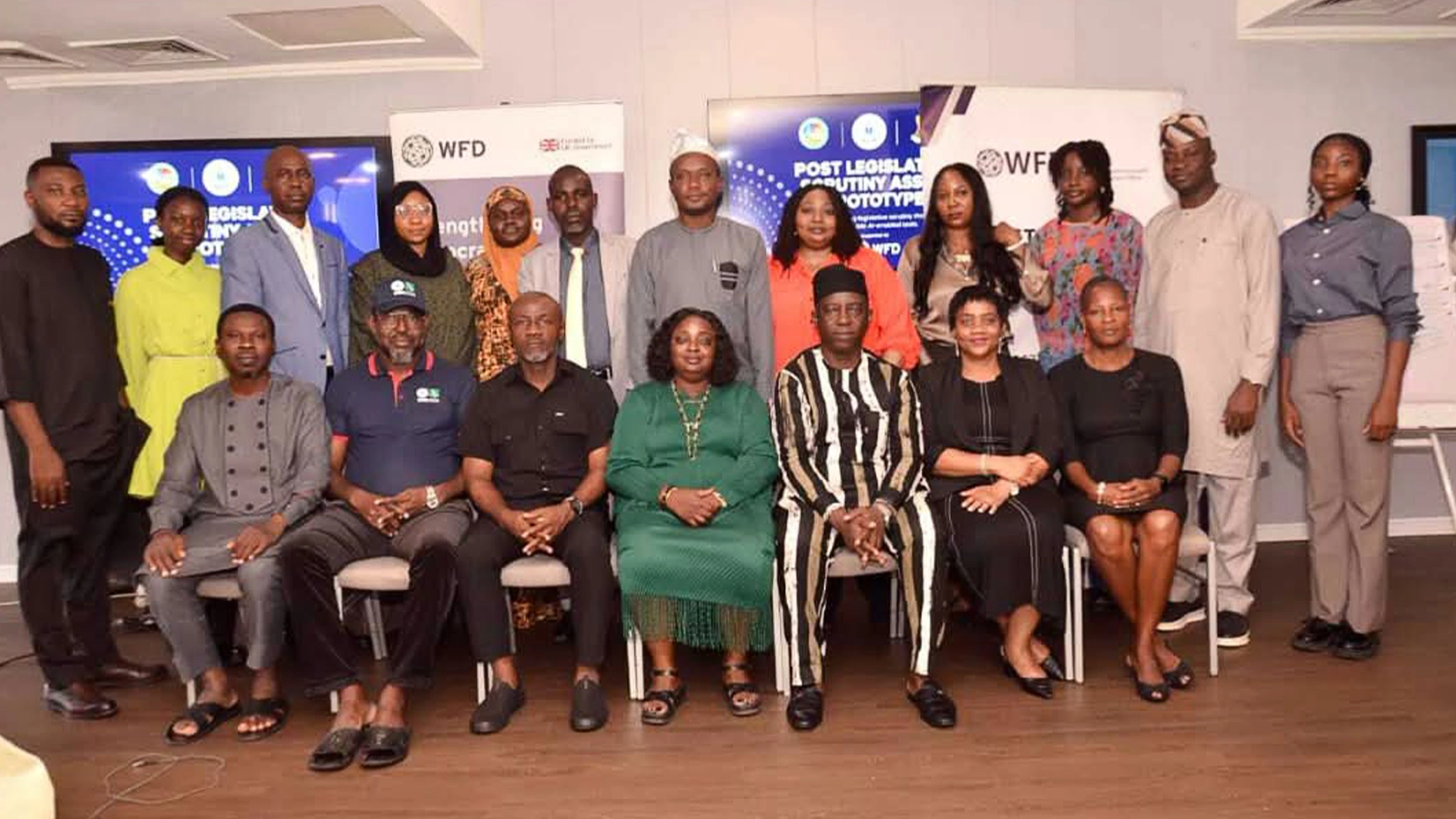
The Country Director of WFD in Nigeria, Adebowale Olorunmola, made the call at a two-day Post-Legislative Scrutiny (PLS) Assist Prototype Capacity-Building Workshop and Mock PLS Inquiry in Abuja.
Olorunmola explained that PLS provides a systematic approach for lawmakers to revisit legislation, usually two or three years after enactment, to assess its implementation, determine whether it has achieved its intended purpose and identify unintended consequences requiring legislative intervention.
He said the process was critical to ensuring that laws remained relevant, promoted social cohesion and contributed meaningfully to national development.
According to him, lawmakers should not wait for public complaints, protests or widespread dissatisfaction before assessing the effectiveness of legislation.

“There is always a purpose for passing laws. It is important for them to go back and look at whether the laws are meeting the expectations for which they were passed, or if there are unintended consequences that need to be addressed,” he said.
He stressed that PLS was distinct from routine legal reviews or legislative oversight, describing it as a methodological process that involves citizens, relevant stakeholders, law enforcement agencies and the intended beneficiaries of legislation.
Olorunmola noted that the initiative had recorded progress at both national and subnational levels, citing the establishment of a dedicated PLS unit at the National Institute for Legislative and Democratic Studies (NILDS).
He said the development followed an earlier PLS Academy organised in collaboration with NILDS and the subsequent production of a position paper on the institutionalisation of PLS in Nigeria.
He identified Oyo State as a leading example of subnational adoption, noting that its House of Assembly had established a PLS unit and conducted public inquiries into two laws.
These are the Oyo State Open Rearing and Grazing Regulation Law, enacted in 2019, and the Oyo State Security Network Agency Law, enacted in 2020, popularly known as the Amotekun Law.
He added that the Oyo State House of Assembly was preparing to conduct another inquiry into its Sexual and Gender-Based Violence Referral Centre Agency Law.
Delta State, he said, had also demonstrated commitment by establishing a PLS directorate and identifying legislation for possible scrutiny, although it was yet to establish a dedicated unit.
The WFD country director urged NILDS to sustain efforts to extend the initiative to all 36 state assemblies, stressing that institutional ownership would ensure continuity beyond the lifespan of development partners’ interventions.
“We don’t want to work for working’s sake. We don’t implement for implementation’s sake. We put sustainability into consideration,” he said.
He explained that WFD had developed guidelines to help state assemblies institutionalise PLS without necessarily depending on the foundation’s direct involvement.
Olorunmola also called for stronger collaboration between the legislature, executive, law enforcement agencies and citizens to ensure that findings from scrutiny exercises translated into improved implementation and policy decisions.
He expressed concern about Nigeria’s low level of social cohesion, arguing that effective implementation of relevant laws and regular scrutiny of their outcomes were necessary for building a more cohesive society.
On the need for public awareness, he said the foundation was encouraging NILDS to convene critical stakeholders and deepen understanding of the concept, noting that misconceptions about PLS remained widespread.
He clarified that PLS was not an assessment of the performance of a particular legislative assembly based on the number of bills passed or the frequency of plenary sessions.
Rather, he said, it was a process of determining whether enacted laws were delivering the outcomes for which they were introduced.
He expressed optimism that the Conference of Speakers of State Houses of Assembly could play a significant role in promoting the initiative across the country, particularly through the involvement of the immediate past chairman, the Speaker of the Oyo State House of Assembly, and the current chairman, the Speaker of the Delta State House of Assembly.
Speaking on Oyo State’s experience, the PLS Unit Coordinator of the Oyo State House of Assembly, Okundeji Aderonke, said the unit was inaugurated in January 2025, making the assembly the first in Nigeria to establish such a structure.
She said the initiative had enabled the assembly to examine the implementation of existing legislation and identify gaps preventing laws from achieving their intended purposes.
Aderonke disclosed that the assembly had completed inquiries into the Open Rearing and Grazing Regulation Law and the Amotekun Law, adding that preparations were underway for another inquiry into the state’s Sexual and Gender-Based Violence Referral Centre Agency Law.
She said the proposed inquiry would involve direct engagement with survivors and other stakeholders to obtain evidence on the implementation of the law and identify challenges requiring attention.
According to her, the participation of affected persons would be essential to producing credible findings and recommendations.
“We are expecting that those people will cooperate with us because this is a new initiative. We need to engage them to get the evidence that will back up the facts and what we are going to present in our report,” she said.
The coordinator urged governments to provide full support for PLS, particularly through stronger collaboration between the legislative and executive arms.
She explained that the process required cooperation with relevant institutions, including the Ministry of Justice, to ensure that identified gaps were properly addressed.
The two-day workshop, which commenced on Wednesday, November 4, and ends Thursday, November 5, is designed to strengthen participants’ understanding and practical application of PLS while introducing and testing the PLS Assist Prototype, a technology-driven tool intended to support legislative research and scrutiny processes.
Participants include representatives of NILDS, the Oyo State House of Assembly and the Delta State House of Assembly.
The programme features practical capacity-building sessions and a simulated, desk-based PLS inquiry aimed at demonstrating how the tool can support evidence-based legislative scrutiny.