
 Get Guardian on Google
The Commander of the Mining Marshals, Assistant Commandant of Corps (ACC) Attah John Onoja, has called for stronger cooperation between security agencies and the media in tackling illegal mining, saying public awareness and responsible reporting are essential to protecting Nigeria’s mineral resources.
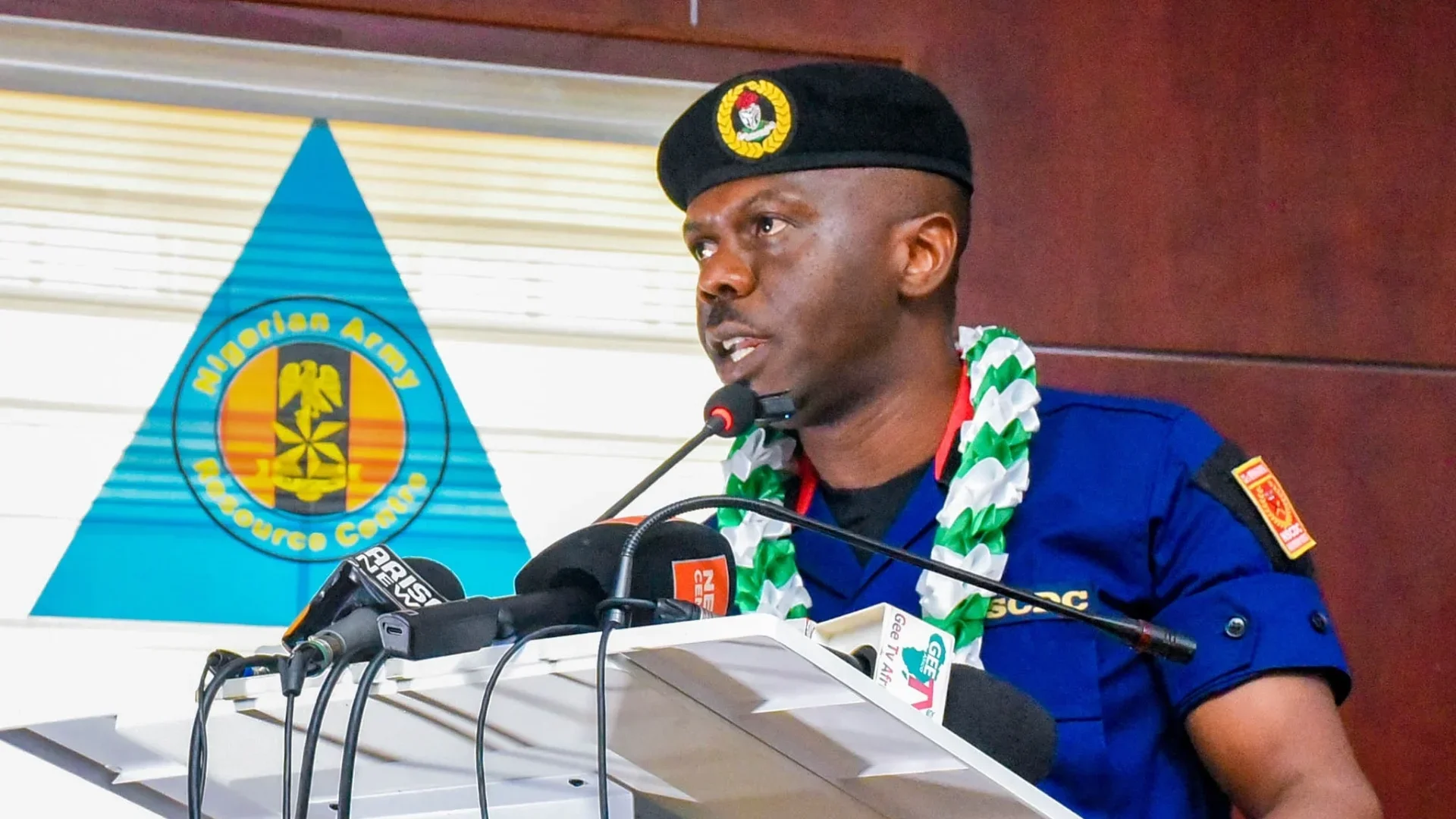
Onoja made the appeal on Thursday while receiving the Exemplary Leadership Award from the Association of Corporate Online Editors (ACOE) at its 2026 Annual Lecture and Awards, held at the Army Resource Centre, Abuja.
The association recognised him for his leadership and contributions to enforcement activities against illegal mining.
Speaking at the event, Onoja disclosed that the Mining Marshals had arrested at least 850 suspected illegal mining operators since the establishment of the special enforcement initiative.
He also claimed that government revenue from mining activities had increased substantially during the period, rising from approximately ₦6 billion annually before the intervention to ₦37 billion within a year and ₦101 billion in less than two and a half years.
The figures were presented by the commander as evidence of progress in the sector, although the statement did not provide the underlying revenue records or establish how much of the increase was directly attributable to the Mining Marshals’ operations.
The commander, who delivered a goodwill message on behalf of the Commandant-General of the Nigeria Security and Civil Defence Corps (NSCDC), Prof. Ahmed Abubakar Audi, described the award as recognition of the collective efforts of personnel involved in combating illegal mining.
He dedicated the honour to Audi, whom he credited with providing the institutional direction behind the Mining Marshals’ activities.
Onoja also acknowledged the Minister of Solid Minerals Development, Dele Alake, and the Minister of Interior, Olubunmi Tunji-Ojo, for their support for the campaign against illegal mining.
He extended his appreciation to officers and personnel of the Mining Marshals, saying they had continued to carry out their responsibilities despite operational and logistical challenges.
The commander also recognised journalists who, according to him, had demonstrated professionalism and commitment to the public interest in their reporting.
The event attracted representatives of government agencies, security institutions, media organisations and other stakeholders.
Providing an update on enforcement activities, Onoja said the Mining Marshals had adopted an approach that combined deterrence, community engagement and stakeholder collaboration with conventional law enforcement.
He explained that the initiative was designed not only to apprehend offenders but also to encourage mining operators to comply with relevant laws and regulations.
According to him, public sensitisation and engagement with communities had become important components of the operation’s strategy.
He maintained that encouraging voluntary compliance could produce longer-term results than relying exclusively on arrests and prosecution.
Onoja said at least 850 suspected illegal mining operators had been arrested since the initiative began.
He added that the operation had secured convictions in some cases, while other prosecutions remained before the courts.
The commander expressed optimism that additional convictions could be recorded before the end of the year, depending on the outcome of ongoing judicial proceedings.
Onoja also disclosed that the Mining Marshals had adopted unpredictable deployment patterns across different states to make it more difficult for illegal operators to anticipate enforcement activities.
He said the approach was intended to maximise available personnel and logistical resources while maintaining pressure on operators acting outside the law.
Onoja linked the enforcement campaign to improvements in compliance and government revenue from the mining sector.
He claimed that annual mining revenue stood at approximately ₦6 billion before the intervention but subsequently rose to ₦37 billion within a year.
According to him, the figure later reached ₦101 billion in less than two and a half years.
He argued that stronger enforcement and improved compliance could help Nigeria derive greater economic benefits from its mineral resources.
However, the figures were not accompanied by a detailed explanation of the revenue categories, reporting periods or methods used to calculate the increases.
The commander also did not distinguish between revenue gains attributable to enforcement activities and those potentially arising from other government policies, administrative changes or developments in the mining industry.
Onoja clarified that revenue generated through improved compliance did not accrue directly to the Mining Marshals but formed part of the broader financial benefits available to the government.
He maintained that further progress could be achieved through cooperation among regulators, security agencies, mining operators and host communities.
Addressing members of ACOE, Onoja described the media as an important institution in promoting accountability, public awareness and national development.
He said journalists had a responsibility to ensure that public discussions about security operations were based on verified information and balanced reporting.
According to him, the media’s role extends beyond reporting events to examining the activities of public institutions and providing citizens with information needed to understand issues affecting their communities.
He urged journalists covering the mining sector to familiarise themselves with relevant laws, enforcement procedures and the responsibilities of regulatory institutions.
Onoja also appealed to media organisations to provide opportunities for individuals and institutions accused of wrongdoing to respond before conclusions were drawn.
He maintained that allegations concerning the Mining Marshals should be subjected to proper verification.
The commander pledged that the operation would cooperate with legitimate requests for information and provide relevant documents and clarifications where legally permissible.
He said the Mining Marshals preferred to respond to enquiries with documentary evidence rather than relying solely on verbal explanations.
His remarks placed particular emphasis on the relationship between public accountability and the protection of the integrity of security institutions.
The commander also expressed concern over what he described as attempts by vested interests to frustrate the Mining Marshals’ activities.
He alleged that some individuals were using institutional disagreements, legal processes and sections of the media to undermine enforcement operations.
Onoja did not identify the individuals or institutions involved or provide specific examples to substantiate the allegations.
He argued that the campaign against illegal mining should not become a contest between government agencies or be influenced by private interests.
According to him, the protection of mineral resources should be treated as an issue of national economic security.
He urged stakeholders to prioritise cooperation and the effective implementation of mining regulations.
Onoja advised mining operators to familiarise themselves with applicable laws and obtain the necessary authorisations before commencing operations.
He warned that individuals and companies found operating outside the legal framework risked arrest and prosecution.
The commander maintained that regulatory compliance was essential to improving accountability and ensuring that mineral resources contributed to national development.
He also stressed the importance of cooperation between enforcement agencies and communities where mining activities take place.
According to him, community engagement could help identify unauthorised operations, encourage lawful practices and reduce conflicts associated with mineral extraction.
He argued that effective enforcement required sustained collaboration among relevant government institutions rather than isolated interventions.
Onoja thanked ACOE for the leadership award and reaffirmed the Mining Marshals’ commitment to working with journalists and other stakeholders.
He said the operation would continue combining enforcement activities with public sensitisation and efforts to encourage compliance.
The commander also called for stronger institutional cooperation, arguing that the protection of Nigeria’s mineral resources required a shared commitment from government agencies, industry participants and citizens.
He maintained that national economic interests should take precedence over personal or institutional disagreements.
For the Mining Marshals, he said, the objective remained the reduction of illegal mining activities and the improvement of compliance with the country’s mining laws.
The commander concluded by urging media practitioners and public institutions to carry out their responsibilities with fairness, professionalism and accountability.
He said sustained cooperation would be necessary to address illegal mining and ensure that Nigeria obtained greater benefits from its mineral resources.