
 Get Guardian on Google
By Sylvester Odion Akhaine
Greetings, Mr President. I am back from my two-month recess. I did not get the break I sought from cerebral exertions.
Indeed, I was still neck-deep in it, delivering several lectures here and there as a public intellectual and an academic. Mr President, I want to bring you up to speed on my thoughts on events over the last two months. I relate to three main events: the Presidential Campaign Council (PCC), the apparent resentment of your policies and the quest for a second term by sections of the population, and the growing climate of intolerance among partisans of the three leading political parties in the build-up to the January polls.
First, the PCC should not have included the Minister of Defence and the Minister of Justice and Attorney-General of the Federation. Institutions of state need relative autonomy for public trust. Believe it or not, public trust is important for regime survival. The aforementioned public officers can still rally support for the party behind the scenes. Retired General Christopher Musa, the Minister of Defence, comes from a constituency with huge electoral value that you certainly need for electoral victory. But the social capital is better harnessed covertly. Prince Lateef Olasunkanmi Fagbemi, SAN, the Minister of Justice and Attorney–General of the Federation comes from your primary constituency, the South-West; he need not be in the PCC because there are enough foot soldiers to work in the zone. This error of judgment means two things: desperation for power and personalisation of power in a democratic administration. Hegemony is better built through astuteness and concrete popular policy output.
I now turn to the Delusion Trap. This phenomenon is my conception. It is a situation in which the population, not citizens, of a society is exposed to long betrayal and intense immiserisation by those who rule, not govern. Their discontentment builds up along a curve that reaches a climax under a particular regime; the latter becomes the bogeyman responsible for all that has happened to them and is therefore held accountable. Note that I did not use the word citizens because citizenship means the enjoyment of a certain irreducible cluster of freedoms and a corresponding extension of what David Easton calls support, in other words, obligations to the state. Note that I also use the word rule, not govern, because the latter means order and abidance by the rule of law. These are prohibitive currencies in the Nigerian political landscape.
The Fourth Republic began in May 1999 under the People’s Democratic Party (PDP), a party that had boasted it would rule the country for 60 years or so. Under the party’s watch, electricity supply was inefficient; the refinery was not working, and elite perfidy ran freely. To its credit, the party managed to take the country out of the debt loop at a cost. The party did not build an accountable regime; rather, it escalated the cost of governance, while governors became emperors at the subnational level, accountable to none but themselves.
Between 2015 and 2023, General Buhari ran this country. He succeeded to power but never really governed. His famous misquote “from top to bottom” became policy. Insecurity never abated; the oil subsidy became a monumental skullduggery. The section of the country where he came from never saw anything wrong with his maladministration.
His appointment of public officers was underlined by nepotism and neopatrimonialism. Fulani herdsmen shut down thriving farming communities with their indiscriminate killings and kidnapping for ransom, while the administration engaged in land grabbing to establish so-called cattle colonies for his kinsmen across the country, and was vehemently resisted in its several iterations. Activities in tertiary institutions were halted due to industrial actions by academic staff who had continuously demanded an increase in funding for education. The administration demonstrated a disdain for the judiciary, as underlined by Justice Walter Onnoghen’s removal as Chief Justice of the federation. He never shirked the binge of loans from both Sukkuk and from the main actors in the development set, the World Bank and the International Monetary Fund. The nation’s crude oil was used as collateral in some cases. By the time Buhari left office in 2023, discontentment with his administration was such that statecraft was required to clean up the mess he left for his successor. Things were in dire straits.
The manifestation of the crisis created by the Buhari administration is now to be ascribed to you, Mr President. In some sense, they may be right. You helped cobble APC together to upstage the Jonathan administration under the PDP. To cut the umbilical cord and deny paternity would be dishonest. The ingenuity ought to lie in remediating and distinguishing policies from the more clueless Buhari administration. But you missed it. The oil subsidy and the devaluation of the naira did not help matters. The oil subsidy is a mathematical fiction; it is a swindle. It requires surgery, but not without anesthesia. You should have been front-loaded with safety nets to cushion the effect while ensuring a minimum domestic refining capacity to stabilise the prices of petroleum products. While these policies have eaten into the purchasing power of the population, you have not, through personal example, cut the cost of governance.
The perception of the miserable population is one of “poor man dey suffer, monkey dey work, baboon dey chop”. This is what has steeped you in the delusion trap and is seeking to undermine your second-term ambition. The population suffers from “intransitive consciousness”, not comprehending causality in the skewed state structure that you are gradually addressing and could be swayed by bread and butter on the table to meet their biological needs.
Ahead of the January 2027 elections, this is my policy brief for you. Instruct all agencies under the executive to ensure a level playing field for the opposition parties.
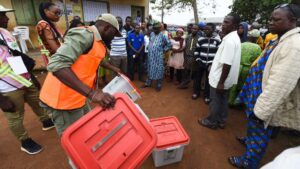
As I have noted in this column, opposition is a tonic for democracy, and you exemplified that while you held forth in Lagos as governor. There is the perception that the present cycle of elections will be violent, and there is a death toll to boot. Do not play into the hands of the nation’s bashers. Nigeria needs peace; a failed Nigeria is a failed Africa. Concentrate your energies in your catchment areas, South-West and Midwest; Vice President Shettima should man the North-East, especially Borno and Yobe. Reach out to the strongman of Taraba State, the respected Retired General Theophilus Danjuma; you will have at least 25 per cent of the votes.
The Middle-Belt, having been shortchanged by the skewed Nigerian federation, is exacting their autonomy. The re-federalisation policy is in their interest and should be drummed in, unless they want to be dominated in perpetuity. Let your minions sort the North-West. The unwritten principle of power rotation between the North and South in the polity must be respected. This should be a major message to the core north. Next, I shall advise you on a list of popular policies to undertake. Enjoy your day, Mr President.
Professor Akhaine is of the Department of Political Science, Lagos State University.