
 Get Guardian on Google
Living Richer Together: Cash Onadele’s Powerful Allegory of Greed, Oppression and the Struggle for a Just Society
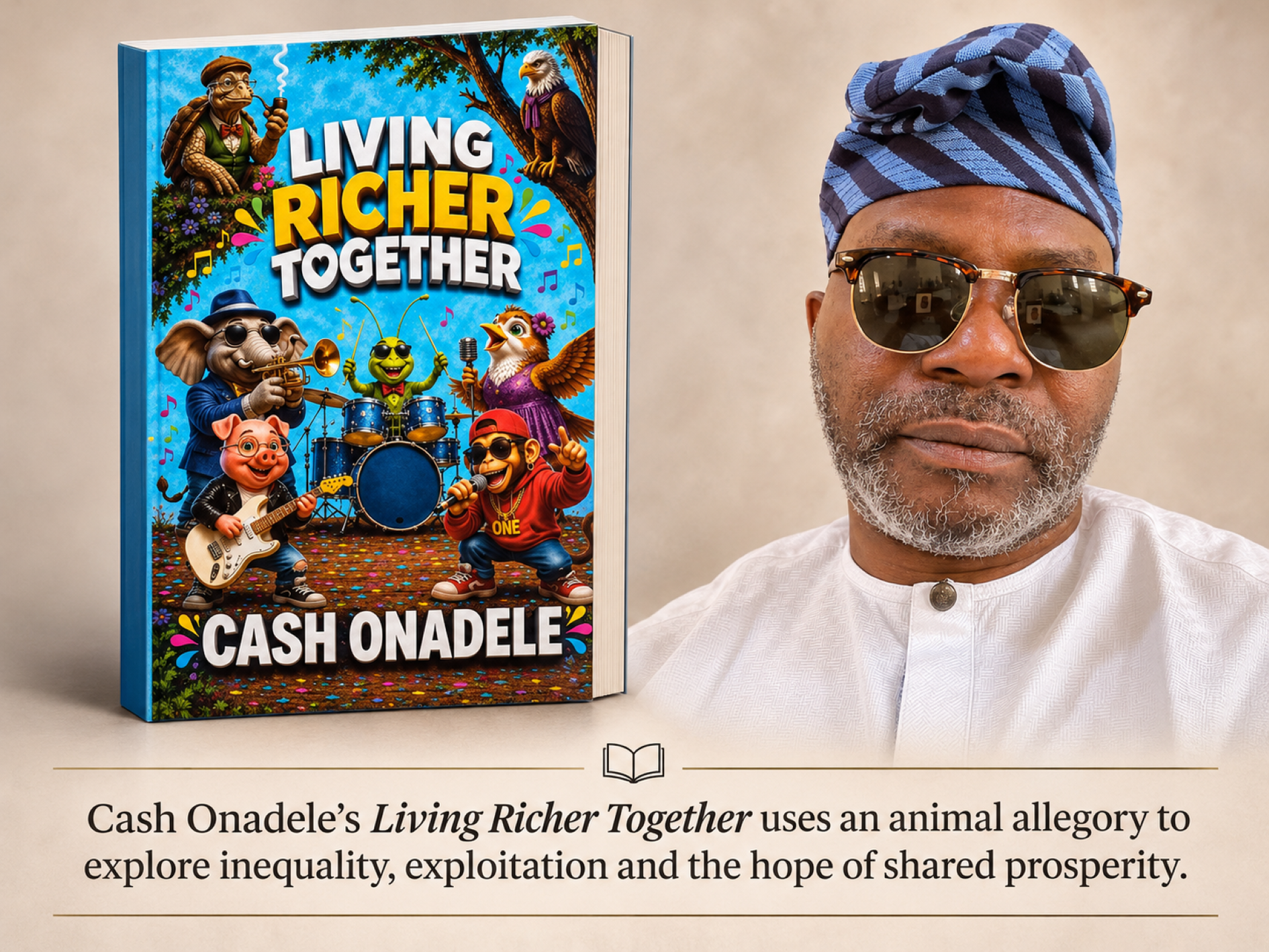
Through an imaginative kingdom of animals, Cash Onadele explores the inequalities that sustain poverty, the corruption of power and the extraordinary possibilities of collective action. His latest work is both a cautionary tale about exploitation and an ambitious argument for a society in which prosperity is shared rather than monopolised.
There is something profoundly unsettling about a society in which those who produce the wealth are condemned to poverty, those who control the resources grow increasingly powerful, and those entrusted with administering justice become instruments of oppression. It is a contradiction familiar to generations of Africans and, indeed, to much of the developing world. It is also the central concern of Living Richer Together, an imaginative and politically charged allegory by Nigerian writer Cash Onadele, who writes under the literary identity Aiye-ko-ooto.
At first glance, the book appears to be a charming animal fable, populated by talking gorillas, pigs, squirrels, tortoises, eagles and other creatures inhabiting the fictional Zumba Nation. Beneath its playful surface, however, lies a serious examination of economic inequality, institutional corruption, human dignity, political freedom and the moral responsibilities of those who exercise power.
Onadele constructs a world in which the animal kingdom mirrors the contradictions of human civilisation. Its inhabitants speak, trade, exploit, accumulate wealth, administer laws and occasionally discover that their greatest strength lies not in individual survival but in cooperation.
The result is a work that combines the traditions of African oral storytelling with contemporary political commentary, offering a critique of societies where exploitation has become an accepted economic arrangement.
At the centre of the narrative is Simple Ẹlẹdẹ Pig, an orphan whose life is defined by deprivation, servitude and the constant threat of violence.
Simple lives under the authority of Crimple Crumple Slaughter, an intimidating silverback gorilla whose name immediately establishes his character. Slaughter presides over a farm and zoo, exercising almost absolute control over the creatures beneath him. He is wealthy, ruthless and convinced that his power entitles him to unquestioning obedience.
Simple works tirelessly, performing menial chores and transporting animal meat and bones to traders. She receives no wages, enjoys little personal freedom and endures repeated humiliation.
Her master justifies this arrangement by reminding her that she is fortunate to have food and shelter. It is the familiar argument of exploitative systems: dependence is presented as generosity, while obedience is demanded as gratitude.
What makes Simple’s circumstances particularly disturbing is the mystery surrounding her missing family. Her mother and siblings have disappeared, leaving her haunted by questions she cannot answer. The bags of meat and bones she carries become an ominous symbol of the violence concealed beneath the kingdom’s commercial activities.
Through this seemingly simple arrangement, Onadele introduces one of the book’s strongest arguments: economic exploitation rarely survives through brute force alone. It requires a network of beneficiaries, collaborators and institutions willing to overlook injustice.
Madam Ọkẹrẹ Squirrel represents another dimension of this arrangement. A prosperous merchant, she is concerned primarily with profit and the preservation of her commercial advantage.
When Simple seeks freedom, Madam Squirrel objects because her liberation would interfere with the supply of unpaid labour on which her business depends.
Her position exposes the moral weakness of an economic system that measures success exclusively through accumulation, without considering the circumstances under which wealth is produced.
Onadele is not necessarily condemning enterprise itself. Rather, he challenges capitalism stripped of ethical responsibility, where market efficiency becomes an excuse for exploitation.
The distinction matters because the book ultimately advocates economic development, entrepreneurship and investment. Its objection is not to wealth creation but to prosperity built upon the systematic impoverishment of others.
Yet Living Richer Together is more than an indictment of economic injustice. It is also a story about personal transformation.
Simple’s encounter with Ìjàpá Tortoise marks a decisive turning point. The elderly tortoise recognises her musical ability and encourages her to develop it. He teaches her to read and write and introduces her to the possibility that talent, properly cultivated, can become a pathway towards independence.
For the first time, Simple discovers that she possesses something her master cannot easily control: the capacity to imagine another life.
Her guitar becomes an instrument of liberation, representing education, creativity and economic opportunity.
This aspect of the narrative is particularly compelling because it offers an alternative to the fatalism that often accompanies discussions of poverty. Onadele suggests that deprivation need not extinguish ambition, although ambition alone cannot dismantle an unjust social order.
Indeed, one of Simple’s earliest mistakes is believing that individual talent and personal savings will be sufficient to secure her freedom.
Her growing relationship with other musicians gradually challenges that assumption.
Àwòko Nightingale, Ìrẹ Cricket, Trunk Elephant and Ọbotúndé Monkey demonstrate the possibilities of collaboration. Together, they produce richer music, attract greater appreciation and share their earnings.
Their musical partnership becomes a miniature representation of the society Onadele hopes to see: one in which individuals contribute different abilities towards a common purpose.
The lesson is straightforward but important. Shared prosperity does not necessarily require the suppression of individual achievement. Properly organised, cooperation can multiply its value.
This idea acquires greater significance when Simple’s circumstances deteriorate and her companions must decide whether friendship extends beyond entertainment and financial benefit.
Initially reluctant to confront Slaughter, the musicians eventually participate in an elaborate rescue operation, combining their different abilities to secure Simple’s release.
It is among the book’s most effective sequences because the moral argument emerges through action rather than instruction. Courage becomes collective, and solidarity acquires practical meaning.
Onadele also explores the complicity of seemingly ordinary individuals in sustaining oppressive systems.
Ọpọlọ Frog and Àkùkọ Rooster, who serve Slaughter, repeatedly invoke duty and obedience to justify their treatment of Simple. Their conduct illustrates how institutional cruelty can become routine when individuals surrender personal judgment to authority.
They are not the principal architects of oppression, but they help maintain it.
The broader political implications become unmistakable when Simple and her companions confront a judicial system that appears more interested in preserving established power than establishing justice.
The courtroom proceedings, involving a prosecutor, a compromised witness and an authoritarian judge, expose the distance that can exist between legality and morality.
Here, Onadele raises an important question: what happens when institutions created to protect society become instruments for perpetuating its inequalities?
The answer, in his fictional kingdom, is the birth of a new political order.
Following their condemnation to Zoo Island, the animals eventually establish an alternative community guided by principles of cooperation, accountability and shared prosperity.
Under the leadership of Ìjàpá Tortoise, the community develops a constitution embracing environmental protection, investment in human capital, public infrastructure, social cohesion, transparent governance and economic opportunity.
The establishment of Zoo Island LRT represents the book’s philosophical centre.
It is here that the title, Living Richer Together, acquires its fullest meaning.
Prosperity, Onadele argues, should not be understood merely as the accumulation of private fortunes. A genuinely prosperous society must also provide education, healthcare, housing, environmental security and the institutional conditions that allow ordinary citizens to flourish.
These proposals resonate strongly with the development challenges confronting African economies.
Across the continent, extraordinary natural resources coexist with widespread deprivation. Economic growth frequently fails to produce corresponding improvements in living standards, while corruption, weak institutions and limited access to opportunity constrain social mobility.
Onadele’s fictional society offers an imaginative response to these contradictions.
His emphasis on domestic production, technical competence, merit, infrastructure and responsible governance reflects a recognisable development philosophy: national prosperity depends upon both productive capacity and the equitable distribution of opportunity.
The book explicitly identifies the United Nations Sustainable Development Goal of ending poverty as its inspiration.
Although presented as climate fiction, its most developed concerns are political and socioeconomic. Environmental protection features prominently in Zoo Island’s constitutional vision, but climate change itself is less central to the dramatic conflict than exploitation, injustice and institutional reform.
This distinction does not diminish the book’s relevance. It does, however, suggest that its strongest literary identity lies in political allegory rather than conventional climate fiction.
Stylistically, Onadele draws heavily upon the conventions of fable and oral storytelling.
The characters’ Yoruba-derived names enrich the fictional world, while songs, proverbs, humour and recurring verbal expressions give the narrative a distinctive cultural character.
Music is particularly important. It accompanies Simple’s suffering, expresses her emotional transformation and eventually becomes the language through which the community celebrates its collective identity.
The narrative’s combination of entertainment and moral instruction recalls the tradition of animal allegory most famously associated with George Orwell’s Animal Farm. Yet the two works pursue different conclusions.
Where Orwell’s revolutionary animals reproduce the tyranny they seek to escape, Onadele imagines the possibility of establishing institutions capable of delivering a more equitable society.
Nevertheless, the novel is not without weaknesses.
Its political philosophy sometimes overwhelms its dramatic storytelling. Characters occasionally deliver extended explanations of economic policy, constitutional development and social responsibility that might have been more effective if integrated naturally into unfolding events.
The transformation of Zoo Island into an organised society also occurs with a speed that understates the difficulties of institution-building.
A more sustained examination of competing interests, political disagreements and administrative failures would have given the proposed social experiment greater complexity.
The manuscript would also benefit from rigorous editorial refinement. Repetitive dialogue, uneven transitions, grammatical inconsistencies and occasional awkward expressions sometimes interrupt the narrative’s momentum.
These shortcomings are especially noticeable because the underlying ideas are substantial and deserve the clarity of a more disciplined literary presentation.
Yet the book’s final movement supplies an important corrective to its idealism.
The emerging society faces military aggression from forces determined to preserve the old order. Its struggle for survival culminates in a painful personal loss when President Tortoise dies before the conflict is resolved.
His death gives the narrative an emotional weight that its political declarations alone could not achieve.
The eventual victory of Zoo Island comes at a cost, reminding readers that liberation is neither automatic nor necessarily peaceful.
More importantly, it establishes that the survival of a just society must depend upon institutions and shared convictions rather than the continued presence of one exceptional leader.
That may be the book’s most enduring political insight.
For all its imperfections, Living Richer Together is an ambitious work of social imagination. It invites readers to question the arrangements that make inequality appear natural, the institutions that legitimise exploitation and the individual choices that allow injustice to persist.
Its greatest achievement is not the creation of a perfect fictional society, but the insistence that another social arrangement is possible.
In a world increasingly troubled by widening inequality, concentrated economic power and declining confidence in public institutions, Onadele’s message is timely.
A society cannot reasonably claim prosperity when those who sustain its economy remain trapped in deprivation.
Ultimately, Living Richer Together asks a question that extends well beyond its fictional animal kingdom: What is the value of wealth if the society that produces it cannot prosper together?
It is a question African governments, business leaders and citizens would do well to consider.
And it is precisely why Cash Onadele’s allegory, notwithstanding its literary imperfections, deserves attention.