 Follow Us on Google News


 Follow Us on Google Discover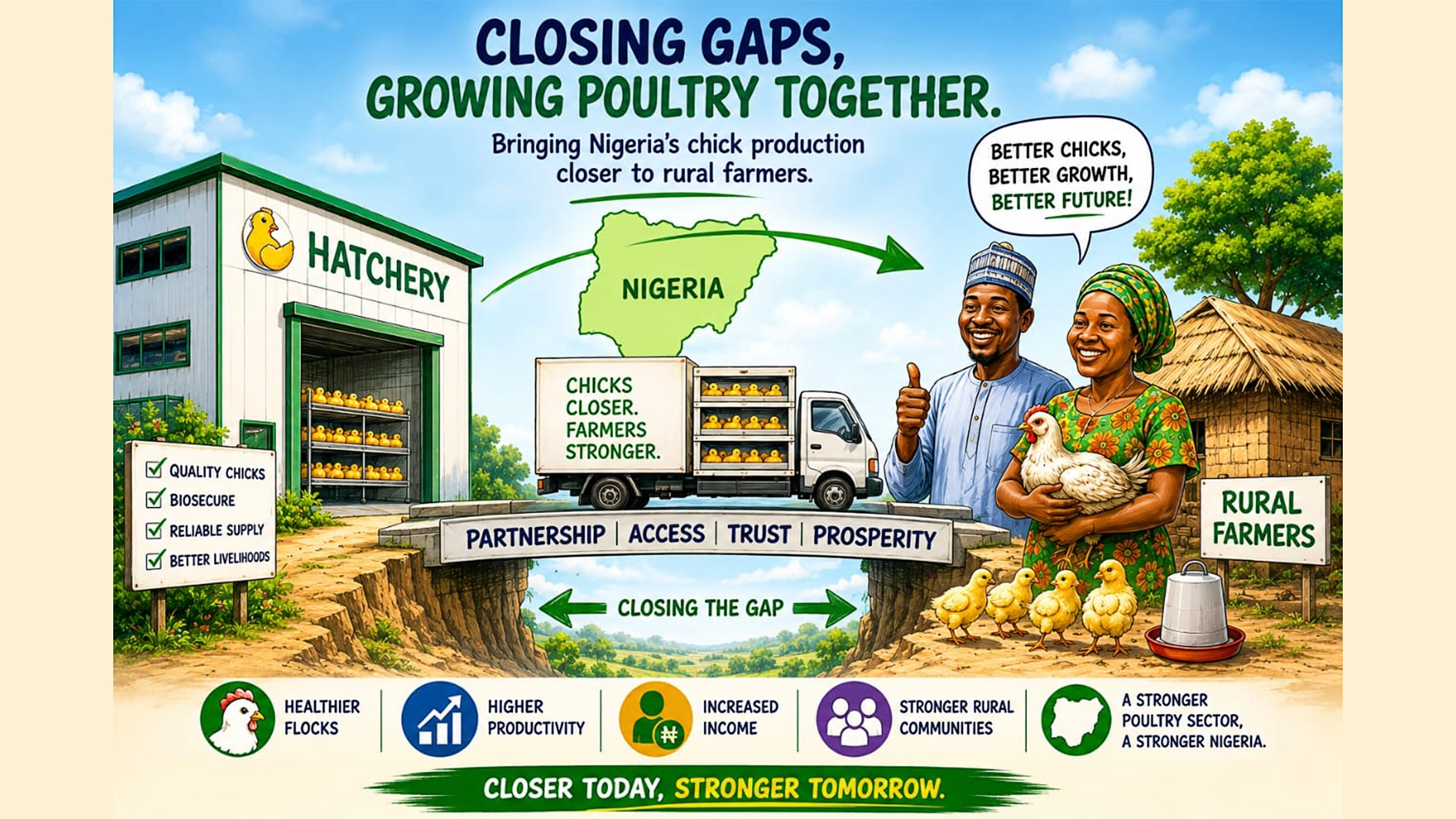
One of the major challenges faced by poultry farmers in the country is access to hatcheries, as they struggle daily to get hold of healthy day-old chicks—the starter stock that is the foundation of any poultry enterprise.
This is due to the fact that most of the hatcheries are concentrated in the Southwest region, far from farmers in other regions, especially in the north and east, who are forced to travel up to 10 hours to find chicks to buy. Such distances raise costs and stress and weaken the birds, with many chicks dying on the journey.
This “last-mile” problem, according to industry players, is one of the most critical bottlenecks in the country’s poultry system—and one that mostly affects the poorest farmers, many of whom are women. Such farmers also have to contend with high chicken feed costs, fluctuating market prices, and deadly outbreaks of poultry diseases. Together, these obstacles are preventing the rural poultry farmers from building viable businesses.
However, this will soon be a thing of the past, as a new research project known as the (uncatchy) “Sustainable Decentralised Dual-purpose Chick and Input Supply Delivery System”, or DDCDS, is set to close these gaps, by bringing the country’s chick production closer to its rural farmers.
This project, piloted by the International Livestock Research Institute (ILRI), was supported by SAAF Catalytic Fund, a funding mechanism within CGIAR’s Sustainable Animal and Aquatic Foods (SAAF) science programme that supports promising innovations, partnerships, and scaling opportunities in livestock and aquatic food systems. The fund is intended to help research teams and partners move innovative ideas from pilot stage toward broader adoption and impact.
The simple shift from centralised to decentralised chick production, the research shows, has true transformative potential. By shortening the distance between hatchery and farm, transport time and costs drop dramatically and chicks arrive on farms alive and healthy.

Through this research, it was learnt that instead of farmers having to rely on a few large hatcheries far from their communities, a network of community-level hatcheries could be located in the country’s underserved rural regions.
Crucially, these hatcheries would act as local “service hubs”, not only supplying the farmers with day-old chicks but also connecting them to affordable feed, veterinary services, poultry training, and financial credit.
Another key feature is the project’s focus on “dual-purpose” chickens—hardy native breeds improved by geneticists and developed to produce both meat and eggs. While consumer and farmer demand for these breeds is rising across Nigeria, supply has not kept pace. Linking community hatcheries with local farmers producing fertile eggs fixes that.
And the benefits of such a model extend beyond individual farmers. Decentralising hatcheries by necessity creates new business opportunities, especially for women and young people, with new jobs opening for hatchery operators and technicians, for feed suppliers and transporters, for vets and market sellers.
In order to co-develop and refine the DDCDS model, ILRI recently convened an Innovation Package and Scaling Readiness (IPSR) workshop with key stakeholders in Ibadan, Oyo State. This is essential because it takes a whole system—research, finance, logistics, local enterprise—to deliver healthy chicks to rural farmers.
The workshop brought together hatchery operators and breeders, feed producers and vets, chick transporters and poultry geneticists, government agencies and policymakers, microfinance institutions and agricultural extension services, and business advisors and non-governmental organisations.
According to the ILRI technology transfer specialist, Adebola Adebayo, the workshop expertly guided the participants through a structured process to determine potential bottlenecks the project could face and ways to resolve them, as well as what “enablers”— the conditions, capacities, institutions, incentives, and support systems—would help the innovation scale successfully and sustainably. He added that the participants then together developed a phased implementation roadmap for the project.
By scaling this decentralised model, the project team estimates that Nigeria’s rural poultry productivity can be increased by 20 to 30 per cent within the next three years.
“By 2030, ILRI and its partners aim to operationalise the DDCDS model across five Nigerian states, establishing 15 decentralised delivery systems and directly engage 1,500 farm households. The model is expected to generate approximately 6,000 jobs through hatchery operations and node-level activities along the broader value chain. In addition, the intervention seeks to expand access to affordable meat and eggs for 200,000 households in peri-urban communities.
“Nigeria does not lack demand for poultry. Nor does it lack farmers willing to raise chickens. What it lacks is a system that delivers the right inputs, in the right places, at the right times. The DDCDS approach addresses these gaps directly. By bringing chick hatcheries and poultry inputs closer to the country’s farming communities, we can build more inclusive and efficient supply chains that in turn create more reliable pathways out of poverty,” Adebayo said.
Speaking on the importance of this innovation, an ILRI innovation and scaling expert, Ijudai Jasada, said it will help people in major farming nations lift themselves out of poverty. “It’s smart to start with the assets people already have and build from there. Across Nigeria, even the poorest households raise a few chickens. That, other than human ingenuity, ambition, and muscle, is their major asset.”
Also speaking, the CGIAR scaling and innovation expert, Edwin Kang’ethe, said too many promising solutions to agricultural problems get stuck in their pilot phases (dubbed the “valley of death”) because the researchers developing the solutions are unable to secure the wider partnerships, capacities, and investments needed to reach people at scale.
“To change that, we’re going to have to move those innovations along a pathway to impacts. That’s the premise of a systematic and evidenced-based approach to scaling innovations developed and used by CGIAR called “Scaling Readiness.”

