 Follow Us on Google News


 Follow Us on Google Discover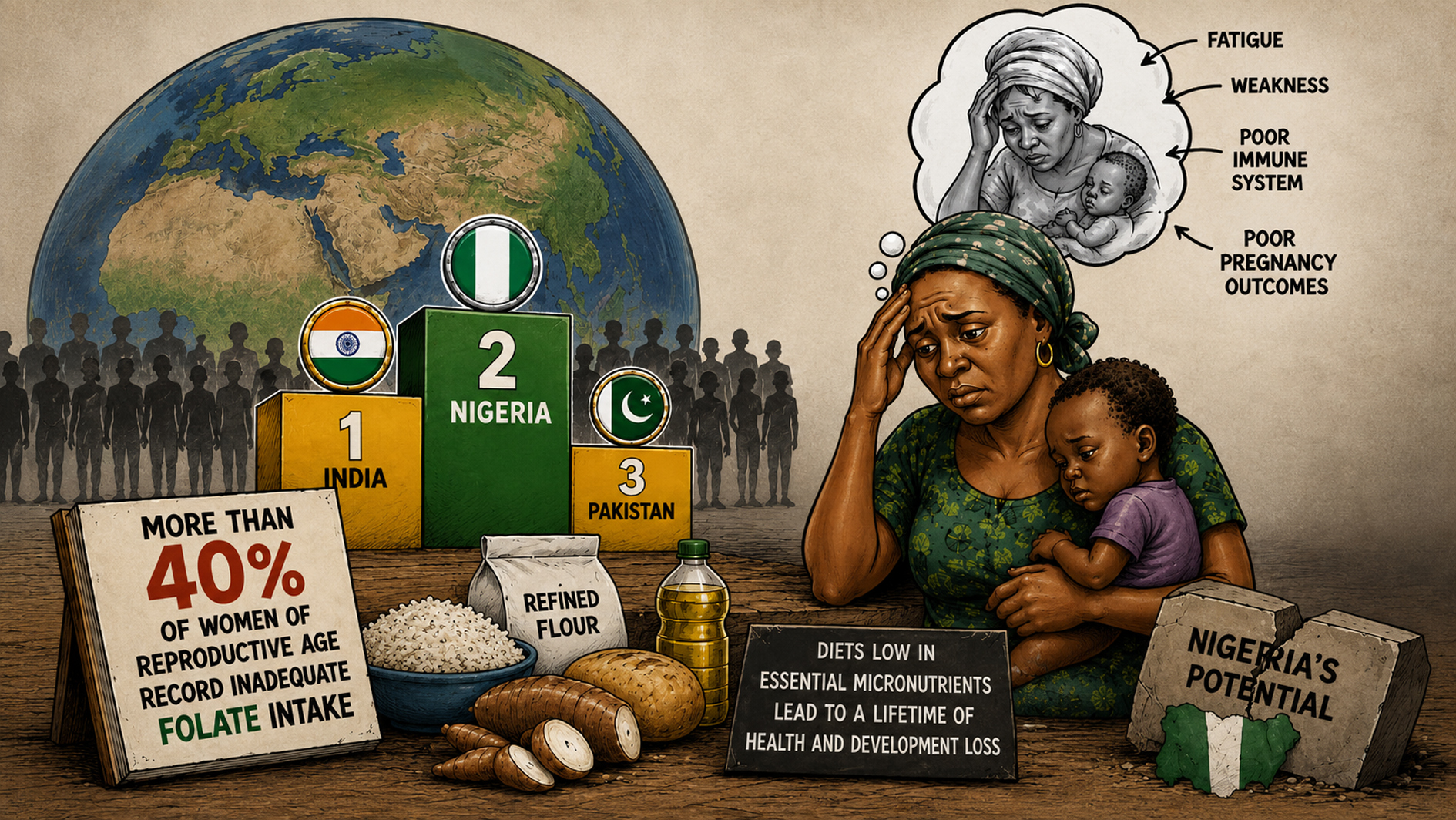
Nigeria ranks second in global hidden hunger indices among the world’s most populous countries, with more than 40 per cent of women of reproductive age recording inadequate folate intake.
Neural tube defects (NTDs), including spina bifida, anencephaly, and encephalocele are among the most serious and preventable consequences of folate deficiency.
These conditions form during the first weeks of pregnancy, often before a woman knows she is pregnant, making periconceptional nutrition critical.
Worried by this sad reality, nutrition experts are sounding note of warning over Nigeria’s growing hidden hunger crisis, warning that deficiencies in essential nutrients such as folate and Vitamin B12 are silently affecting millions of women and children across the country.
Unlike visible forms of malnutrition, micronutrient deficiencies often go unnoticed, while causing serious long-term consequences, including birth defects, impaired brain development, anaemia, poor educational outcomes, and reduced economic productivity.
Experts are calling for urgent government action through mandatory fortification of bouillon cubes, a product consumed daily in almost every Nigerian household, to help address widespread nutrient deficiencies and protect future generations.

According to industry experts, micronutrient deficiency does not announce itself. Unlike acute malnutrition, it operates invisibly eroding cognitive development in children, undermining maternal health, and compounding cycles of poverty across generations.
Though Nigeria’s deficits span several nutrients, but folate (vitamin B9) and vitamin B12 present a particular and urgent challenge, one for which bouillon fortification offers a uniquely powerful and proven solution.
According to research, NTDs occur at a rate of approximately 14.2 cases per 10,000 live births, with Sub-Saharan Africa bearing a disproportionately high—yet largely preventable—share of the global burden. In Nigeria alone, where an estimated 7.5 million children are born yearly, this translates to nearly 11,000 babies being born every year with NTDs.
Folate deficiency is the primary preventable cause. Population-level fortification reduces NTD risk by up to 70 per cent without requiring any individual action, making it one of the highest-impact public health interventions available.
It was learnt that the intervention window is narrow because NTDs occur in the first 28 days of neural tube closure; supplementation-based approaches that rely on knowing one is pregnant consistently miss the window. Fortification does not.
Further studies have shown that Vitamin B12 and folate are metabolically interdependent: B12 is required for folate to function correctly in the body. A deficiency in B12 renders adequate folate intake ineffective, both must be addressed together.
Irreversible neurological damage, megaloblastic anaemia, and cognitive impairment are reportedly the consequence of sustained B12 deficiency, particularly in infants and young children.
It was also revealed that B12 is found primarily in animal-source foods, placing populations with limited meat and dairy consumption at structural, persistent risk. Dietary solutions alone are insufficient at scale.
Furthermore, bouillon fortification delivers both folate and B12 simultaneously, directly and efficiently addressing the metabolic interdependence of the two nutrients in a single intervention.
Health experts suggest that effective fortification is not about putting every nutrient into one vehicle, it is about matching each nutrient to the vehicle that delivers it best, at scale, reliably, and with maximum bioavailability.
They noted that six properties make bouillon the optimal and, in many populations, the only viable delivery mechanism for folate and B12 at the scale required.
First, bouillon has universal household reach because it is used in virtually every Nigerian household across income levels, geography, and ethnicity; secondly, population modeling confirms that bouillon fortification reaches the poorest, most nutritionally vulnerable households, thirdly, there is no behaviour change required; fourthly, nutrients survive the cooking process, it has no organoleptic impact; and population-scale impact at minimal cost
They noted that the cost of fortifying bouillon with B9 and B12 is negligible per household per year. The cost of inaction measured in preventable NTDs, irreversible neurological impairment, and lost cognitive and economic potential, is not.
A millet hawker in Yauri area of Kebbi State, Habibat Mohammed attributed the growing challenge of bouillon in the region to financial strain in the country. “When families can’t afford enough of it, it’s not just about taste. It hits nutrition, income, and daily life, especially for women and children.
“With the high-cost of food, children now eat the same tuwo and soup three times a day. Without fortified seasoning, those meals have even fewer micronutrients. That means more cases of anemia, poor growth, and low immunity in kids under five. Mothers, many of whom are pregnant or nursing, also skip meals to let the children eat first.”
A Nutritionist based in Kuru, Jos, Plateau State, Mr Abayomi Olawoye, who noted that bouillon cubes and seasoning powders are in almost every Nigerian pot — from jollof to egusi to miyan taushe, regretted that with rising food costs, many households are cutting back on its usage.
He warned that the development could trigger nutritional concerns like hidden micronutrient gap; increased use of excess salt and Monosodium glutamate (MSG); and disproportionate impact on women and children.
“Most bouillon sold in Nigeria is fortified with iodine, iron, and B-vitamins. For many low-income families, especially in Northern Nigeria, that one cube is the main source of iodine and iron in a meal of grains + oil. A deficit means higher risk of goiter, anemia, fatigue, and poor child development.
“When bouillon is too expensive, people substitute with more plain salt, maggi powder, or no seasoning at all. Too much salt raises risk of high blood pressure and kidney problems. No seasoning often means children reject meals – lower food intake and malnutrition.
“Women who are pregnant, nursing, and children under five are most vulnerable. They need iron and iodine the most. When meals become bland and less frequent, we see more cases of stunting, low birth weight, and reduced immunity,” he said.
There was a recent study – CoMIT trial, considered as the most rigorous clinical evaluation of bouillon fortification in a West African context to date. Conducted in a population broadly representative of sub-Saharan Africa’s nutritional profile, it provides the evidentiary basis for mandatory policy action in Nigeria and across the region. The trial design blinded, randomised, multi-participant-group represents the gold standard of clinical evidence.
The evidence of the study shows strong signal in Folate (B9) and Vitamin B12, with significant improvement in serum vitamin B12 concentrations across all groups; reductions in B12 deficiency prevalence in lactating women and young children, and B12 status improvements sustained throughout the full nine-month trial period, among others.
With the current state of things in the country, it is evident that the policy trajectory is clear and the gap between what exists and what is needed is growing.
About two years ago, September 2024 to be precise, Nigeria introduces voluntary standards for bouillon fortification including folic acid, vitamin B12, iron, zinc, and iodine. A step forward, but insufficient at scale without enforcement.
In 2025, the country made another attempt, but fails to meet its national anaemia reduction target. The WHO African Region extends its deadline to 2030.
Olawoye advised on the need for the country to prioritise natural, nutrient-dense flavor bases and protect vulnerable groups first. “Government and manufacturers should keep bouillon affordable and fortified. It’s a public health tool, not just seasoning.
“Bouillon is not a magic food. But in Nigeria’s context, it’s a cheap delivery system for key nutrients.
A deficit won’t just make food bland — it can make people sick. If we combine smart cooking, natural alternatives, and policy to keep fortified bouillon accessible, we can protect women and children from the worst effects.”
As 2030 deadline approaches, nutritionists are agitating that mandatory fortification standards specifically for folate and B12 in bouillon must be enacted now to reach that target.
They are also expressing hope that Nigeria must take the lead as the most populous country and the largest bouillon-consuming market in sub-Saharan Africa.

