 Follow Us on Google News


 Follow Us on Google Discover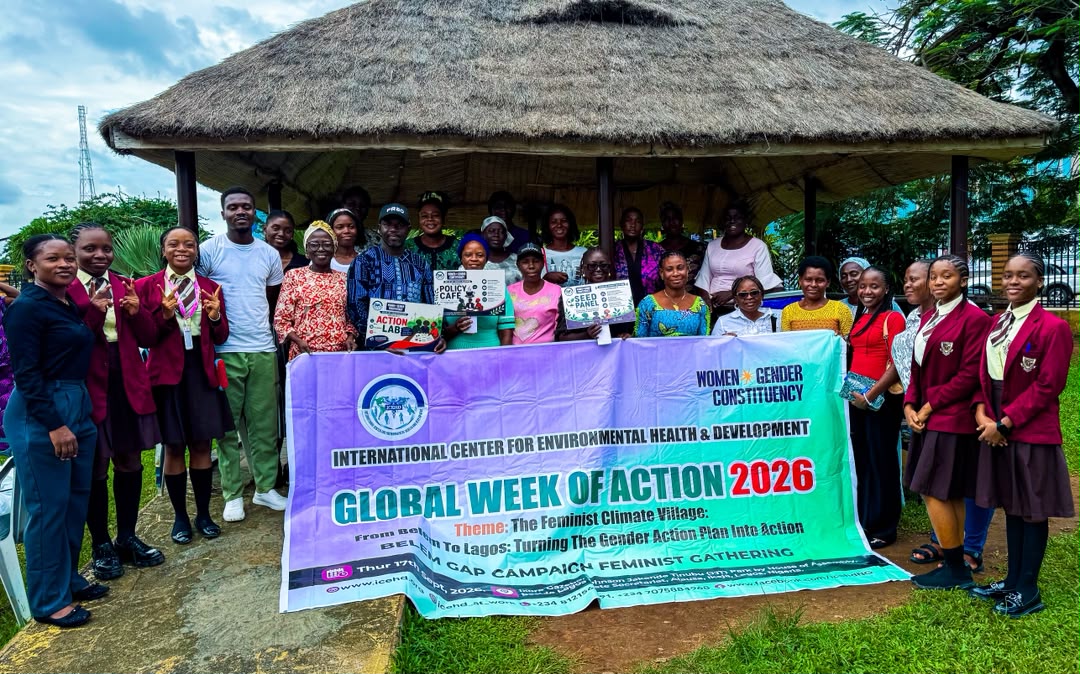
Women farmers have called for improved access to finance, land and other agricultural resources as erratic rainfall and other climate-related challenges deepen losses and threaten the viability of farming.
The farmers said unpredictable weather is disrupting production, reducing the value of farm produce and increasing the financial risks of agricultural investment, while limited access to land; finance and climate information was making it harder for them to adapt.
They spoke at the Feminist Climate Village, organised by the International Centre for Environmental Health and Development (ICEHD) in partnership with the Women and Gender Constituency (WGC) in Lagos, under the theme: “The Feminist Climate Village: From Belém to Lagos: Turning the Gender Action Plan into Action,” where stakeholders discussed the implementation of the Belém Gender Action Plan (GAP) and its implications for women and girls.
Sharing her experience, a representative of the Women Farmers Group, Dr Olubunmi Dipo-Adedoyin, said unpredictable rainfall had caused significant losses on her farm and forced her to sell produce below its expected value.
Dipo-Adedoyin said she had expected to earn between N900, 000 and N1.2 million from a cassava harvest, but eventually accepted about N600, 000 turnover after unpredictable rainfall affected the crop and its value.
She said the financial pressure was compounded by the cost of accessing land and farm services, noting that farmers could spend heavily on land preparation and machinery without necessarily recovering their investments.
“Funding is key,” she said, adding that farmers needed support to reduce the cost of production and improve their ability to withstand climate-related shocks.
She also said the rising cost of agricultural inputs was putting additional pressure on farmers, adding that farmers needed government support to reduce production costs and make agriculture more sustainable.
A civil society representative, Aladeyelu Azeez, said women farmers also faced cultural barriers to land ownership, limited access to finance and inadequate storage facilities.
He said farmers could reduce climate-related losses by diversifying crops, processing produce such as cassava for storage and sale, and adopting water-management practices such as water storage and irrigation. He also called for improved access to climate finance and other resources needed by women farmers to adapt to changing weather conditions.
Facilitator of the session, Oloruntosin Taiwo, said climate interventions would be less effective when women affected by climate change were excluded from decision-making.
“Climate change does not affect all of us the same way. It affects men differently. It affects women differently,” she said.
Oloruntosin said rural women farmers particularly needed access to climate information, noting that funds and other resources for climate action may exist without the intended beneficiaries knowing how to access them.
She said the Gender Action Plan was designed to move women and girls beyond being beneficiaries of climate programmes to becoming active participants, leaders and decision-makers.
The GAP focuses on five priority areas, including capacity building, knowledge management and communication; gender balance, participation and women’s leadership; institutional coherence; gender-responsive implementation and means of implementation; and monitoring and reporting.
Oloruntosin illustrated the importance of involving women in climate interventions with the example of a road project that failed to improve girls’ school attendance because the girls were still responsible for fetching water. She said the intervention had overlooked the actual barrier affecting the girls.

Representing the Young Female Generation, Oke Olabisi said young women were included in climate conversations “to an extent,” but meaningful inclusion should ensure their contributions were considered and implemented, while identifying access to climate information, funding and decision-making spaces as key to enabling more young women to participate effectively in climate action.
The forum also identified limited access to finance, land, technology and agricultural inputs, inadequate education and public information, patriarchy and cultural restrictions, unequal political representation, weak regulatory systems, and safety concerns as barriers to women’s participation in climate action.
Participants called for gender-responsive budget allocations, improved access to agricultural finance and technology, training and mentoring, small grants, women-led climate committees, regular community engagement and stronger monitoring of women’s participation in climate decision-making.
Programme Officer of ICEHD, Shalom Wusu, urged Nigerians at all levels to recognise climate change and called on the Ministry of Environment, Lagos State Environmental Protection Agency (LASEPA), Ministry of Women Affairs and Poverty Alleviation, and Ministry of Agriculture to implement the forum’s recommendations and make climate policies gender-responsive and inclusive, with results expected within the next 12 months.
The forum formed part of a nine-year implementation process around the Belém Gender Action Plan, with participants committing to increase women’s meaningful participation and leadership in climate decision-making over the next 12 months.

