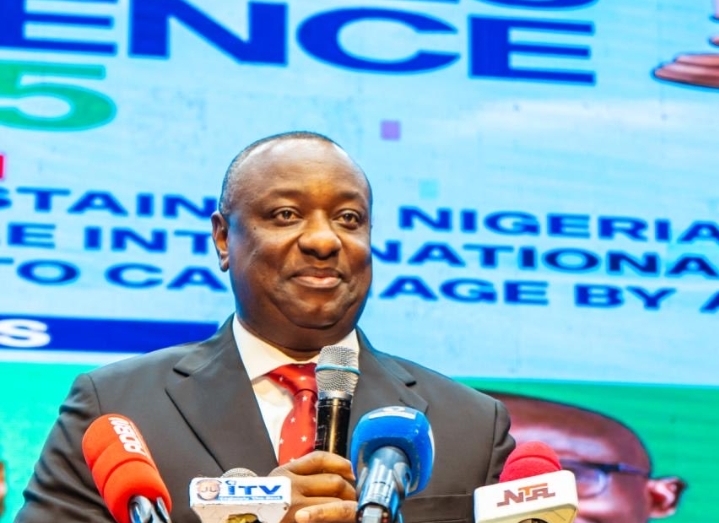
Allen Onyema, Chairman and Chief Executive Officer of Air Peace, has cautioned that Nigeria’s domestic aviation sector faces a serious financial strain as recently enacted tax provisions risk pushing ticket prices beyond ₦1 million and forcing airlines to suspend operations.
Speaking in an interview with ARISE NEWS on Sunday, Onyema said urgent action is needed to prevent a potential collapse of the industry, which could have ripple effects on passengers, banks and the wider economy.
“The Nigerian airlines are heavily overburdened by taxes, levies, and all manner of charges. Just take a ticket of about 350,000. What comes to the airlines is about 81,000 Naira. And people, everybody’s talking about the airlines as if they’re making a kill. It’s not true,” Onyema said.
He criticised what he described as multiple and overlapping charges, including a mandatory five per cent deduction on every ticket to the Nigerian Civil Aviation Authority (NCAA).
“We are suffering multiple taxation, multiple charges. For example, the NCAA, 5% for every ticket, mandatorily. That is to NCAA alone.
There are so many other charges,” he added.
Onyema stressed that the charges undermine passenger demand and conflict with global aviation standards, noting that the International Civil Aviation Organisation (ICAO) recommends cost recovery rather than revenue generation.
“That is, you charge according to the cost of the services you render to the airlines. Who are the ones suffering? The airlines. And that’s why the airlines are not growing,” he said.
He contrasted the current policy with the 2020 tax law, which removed customs duties and VAT on imported aircraft, spare parts, engines and ticket fares, providing critical relief to operators.
“Now, the tax law of 2020 removed customs duties, removed on imported aircraft and imported aircraft spares and engines, removed VAT on imported aircraft and other spare parts, removed VAT on ticket fares. That is the 2020 Act,” he said.
Under the new law, aircraft purchases and spare parts are once again subject to 7.5 per cent VAT. Onyema cited an $80 million aircraft purchase as an example, explaining the financial implications of the tax combined with high borrowing costs from banks, which he said range between 30 and 35 per cent.
“Funds borrowed from the bank are 30–35%. So you bring in spare parts, you pay 7.5% on your spare parts. Ticket fares will hit $1.7 million soon. At 35% we are choking. You don’t do that,” he said.
Onyema warned that these pressures will inevitably be passed on to passengers. “Because when you take 5% from what we charge, it reduces the demand. With this new tax regime?
Yes. From January. With 7.5% on ticket fares, ticket fares will hit $1.7 million soon. If we implement that tax reform, Nigerian airlines will go down in three months; at the end of the day, economy class tickets will go to about 1.7 billion Naira if it happens.”
He said the Airline Operators of Nigeria (AON) had repeatedly presented their concerns to the National Assembly and the tax reform committee, with officials reportedly acknowledging the scale of the burden and the risks to the wider economy.
“We submitted, nobody listened to us. We went to the National Assembly. We addressed them on this issue and they saw reasons with us. They were surprised at the kind of facts we’re bringing out,” Onyema said.
Onyema argued that aviation is a key driver of economic growth and integration, noting that governments in other countries support airlines as a strategic sector.
He urged a return to the 2020 Act, including the removal of VAT on ticket fares and imported aircraft, and called for consideration of alternative channels for equipment procurement.
“If we implement that tax reform, Nigerian airlines will go down in three months. Within one month, some will go down. Some big ones might go down in three months because if you’re bringing, you won’t be able to, and the banks in Nigeria will take a hit because of what they had invested,” he warned.
Despite the concerns, Onyema commended the federal government and President Bola Tinubu for previous responsiveness to industry complaints.
“One thing I like about the government is that they’re listening. I’m not being patronising. They’re listening because I know so many things we’ve asked them to do and they did it for us,” he said.