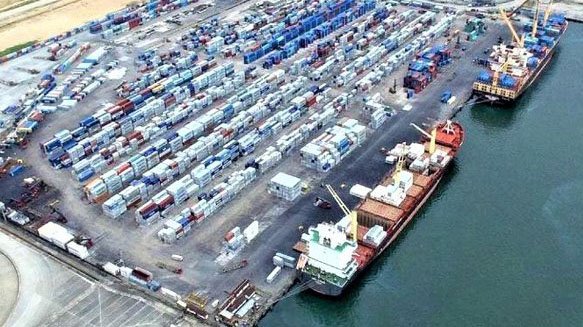
Nigeria could earn N70 trillion from maritime and blue economy yearly if ongoing reforms are coherently implemented and existing maritime-linked revenues consolidated, particularly those generated from international trade and port activities administered by the Nigeria Customs Service (NCS), the Sea Empowerment and Research Centre (SEREC) has said.
According to SEREC, the maritime and blue economy remains one of the country’s most potent but historically under-optimised economic frontiers.
In a press statement signed by the Head of Research, SEREC, Dr. Eugene Nweke and issued yesterday, the centre assessed the N70 trillion projection by Senior Advocate of Nigeria, Dr Olisa Agbakoba, who highlighted that decisive policy, institutional and operational reforms could enable Nigeria to harness enormous value from the sector.
SEREC stated that the N70 trillion projection should not be seen merely as a headline figure but as a strategic benchmark that signals what Nigeria stands to gain if the maritime and blue economy is treated as an integrated national revenue system rather than a collection of siloed agencies and policies.
The research body noted that the NSC revenue, largely derived from seaborne trade, already makes a major pillar of Nigeria’s maritime economy and delivers multi-trillion-naira inflows to the Federation Account yearly.
SEREC described the projection as timely and strategically significant, especially against the backdrop of Nigeria’s rising public debt, constrained fiscal space and the urgent need to grow sustainable non-oil revenue sources.
SEREC pointed to Nigeria’s progressive implementation of the African Continental Free Trade Area (AfCFTA) as opening new revenue opportunities for the maritime sector through increased cargo volumes, higher port throughput, expanded transshipment activity, growth in logistics services and improved regional trade facilitation.
Conservative projections, the centre said, indicate that AfCFTA could significantly expand intra-African maritime trade flows over the medium term, with Nigeria well-positioned to benefit if its port and border processes are made competitive.
Complementing these developments, SEREC highlighted recent reforms in the national tax administration framework, including greater central coordination, data integration and compliance monitoring, as signals of improved prospects for consolidating maritime-related revenues across agencies and reducing historical leakages.
Against this background, the research body said the N70 trillion figure should be understood as an aggregate long-term economic value rather than an immediate, stand-alone cash inflow.
SEREC explained that the estimate encompasses trade expansion, logistics efficiency, port productivity, inland waterways utilisation, cabotage enforcement, offshore maritime services and ancillary blue economy industries.
“Nigeria is not starting from a marginal base, but from a position where substantial maritime-derived revenues already exist, though fragmented, under-optimized, and weakened by coordination and enforcement gaps. What is required is deliberate consolidation, harmonisation, and scaling of these revenue streams,” the centre stated.
SEREC further observed that the National Policy on Marine and Blue Economy (2025–2034) already provides a comprehensive reform framework covering port modernisation, inland waterways development, cabotage enforcement, maritime security, local content deepening and technology adoption.
SEREC cited comparative benchmarks from other maritime hubs, referencing Ghana’s Tema Port, where automation, streamlined Customs procedures and public–private investment have boosted cargo throughput and revenue efficiency and Togo’s Port of Lomé, which has leveraged deep-sea infrastructure and competitive tariffs to become a major transshipment centre.
The centre also referenced South Africa’s Durban Port Complex, where integrated port–rail logistics and strong regulatory enforcement support significant Gross Domestic Product (GDP) contribution and Morocco’s Tangier-Med Port, which demonstrates how policy coherence and logistics integration can drive exports, industrial clusters and foreign direct investment.
According to SEREC, these countries show that scale alone does not determine maritime value, as efficiency, automation, regulatory certainty and inter-agency coordination are decisive in converting maritime activity into sustained national revenue and economic growth.