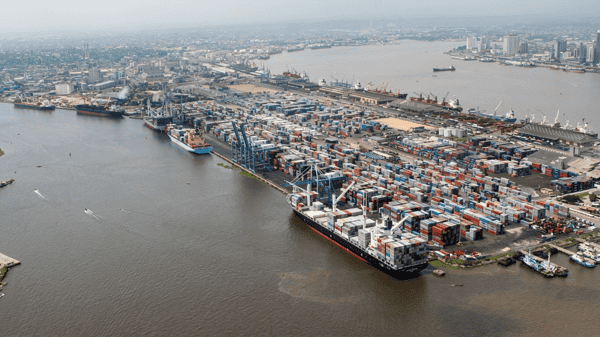
Shippers Association Lagos State (SALS) has decried the harsh operating trade environment at the seaports, highlighting rising multiple levies, illegal checkpoints, container stoppages, delays, bureaucratic processes and a system that punishes law-abiding operators.
The President, SALS, Nicodemus Odolo, said the situation discourages Nigerians from importing and exporting goods, with the number of shippers in business declining daily over a harsh operating business environment.
He stated this yesterday at the Shippers Day celebration organised by SALS in collaboration with the Nigerian Shippers’ Council (NSC) in Lagos.
Odolo said he suffers more delays because he refuses to cut corners, adding that non-compliant shippers have their goods cleared on time. After all, they sorted regulatory agency officials at the ports.
“My own cargo can stay in the port for three months because I want to do it right. Whoever wants to do things right in Nigeria suffers. Those who want to do it wrong get the benefits,” he said.
He decried situations where police officers stop export containers on highways to query customs duty, a role outside their mandate.
“Standardisation should be clear – one organisation issues the document after testing. Once you get to the port, within a day, your cargo should be on board. But too many people are doing the same thing. What concerns police with the duty you pay?” he asked.
Executive Secretary/Chief Executive Officer, Nigerian Shippers’ Council (NSC), Dr Pius Akutah, emphasised that multiple, overlapping and often contradictory taxes and levies imposed on shippers and service providers across the logistics chain distort pricing, create uncertainty and weaken Nigeria’s attractiveness as a trade hub.
He acknowledged stakeholders’ concerns on import costs and overall business sustainability over the Nigeria Customs Service’s four per cent tax on Free on Board (FOB) value of all imported goods.
Akutah said the council has already initiated engagements with relevant authorities to ensure that such policies, where necessary, are clearly evaluated, harmonised and aligned with national economic priorities.
He also emphasised the call for full implementation of the National Single Window as one of the Council’s strong supports, noting that the platform, which integrates all port processes, is essential for reducing delays, eliminating duplicated documentation and curbing inefficiencies that have long hindered seamless cargo clearance.
A maritime lawyer, Osuala Nwagbara, decried deep-rooted irregularities and unjust practices in Nigeria’s maritime sector, particularly the persistent imposition of multiple and excessive charges on shippers.
Nwagbara said his decision to specialise in maritime law was driven by the scale of infractions he observed within the sector and the urgent need to confront them through legal channels.
He expressed optimism that the growing agitation by shippers over arbitrary charges would no longer be ignored, adding that the industry is entering a phase where their concerns will receive the attention they deserve.
The maritime lawyer added that with stronger advocacy, collective action, and legal backing, the era of unchecked exploitation in Nigeria’s maritime sector is coming to an end.
Presenting a paper on ‘National Single Window: Simplifying Trade Process For Nigerian Shippers’, the Zonal Coordinator, Zone ‘A’, Babadede Mohammed, disclosed that the Federal Government’s unified platform is targeting an economic growth of $1 trillion by the first quarter of 2026.
He said the centralised electronic trade platform will integrate various trade and regulatory bodies, leading to more efficient operations, reduced bottlenecks and enhanced revenue generation for the government.
Mohammed listed agencies directly involved in clearance processes under the platform as administrators to include Standards Organisation of Nigeria (SON), National Agency for Food and Drug Administration and Control (NAFDAC), Nigerian Agricultural Quarantine Service (NAQS), and National Environmental Standards and Regulations Enforcement Agency (NASREA).
He also informed that the National Single Window and B’Odogwu are complementary and deeply integrated components of a unified digital trade ecosystem.
Mohammed added that the B’Odogwu system will work hand in hand with the National Single Window to fully align Nigeria’s trade processes with global best practices, eliminate duplication, reduce bottlenecks, and enhance efficiency and transparency across all aspects of trade for the benefit of shippers and traders.