 Follow Us on Google News


 Follow Us on Google Discover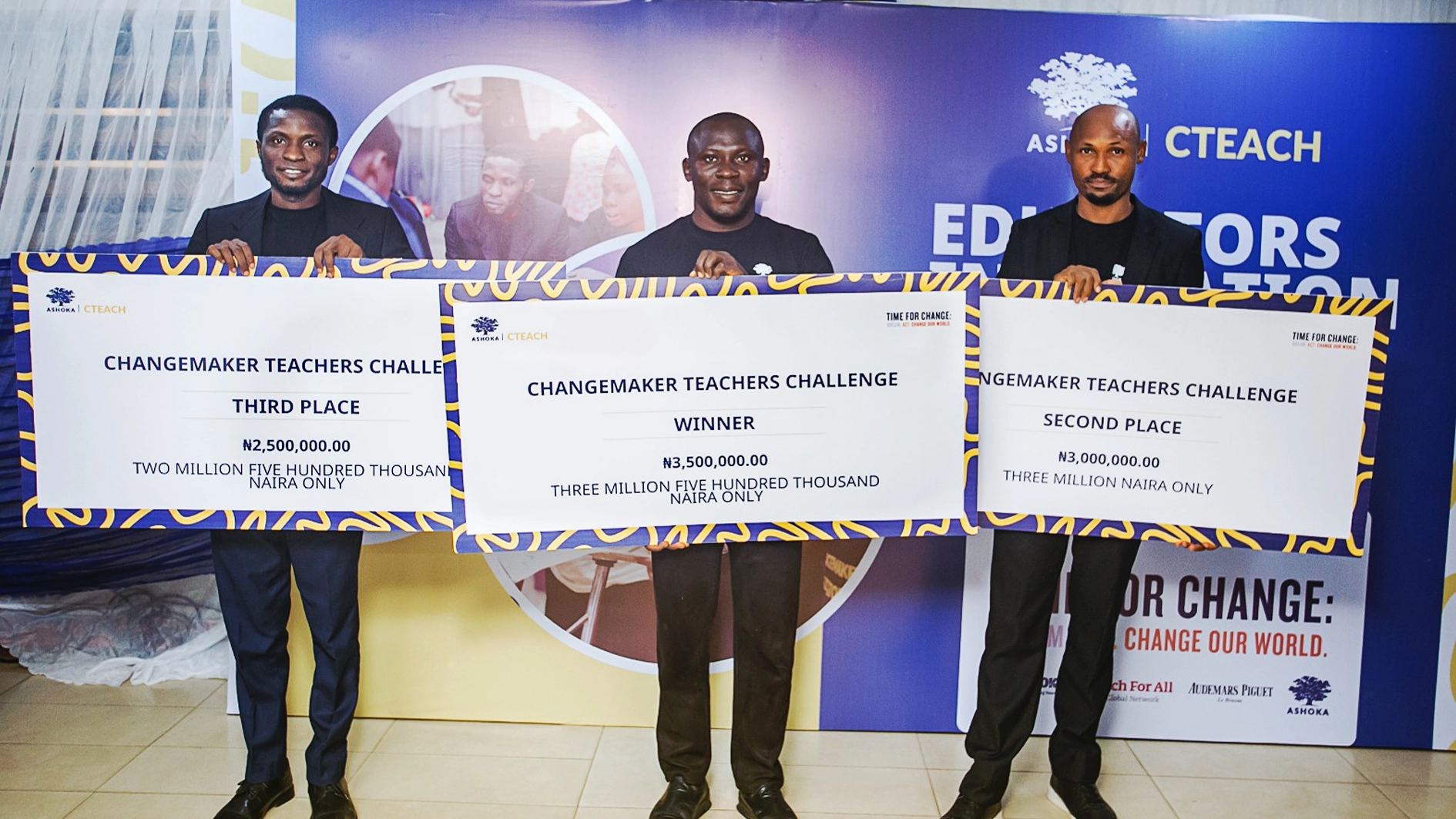
Teachers are emerging as critical drivers of social change, with the Ashoka Teachers Challenge demonstrating how educators can transform everyday classroom challenges into practical solutions that benefit students, schools and wider communities.
The initiative, organised under Ashoka’s changemaking programmes, is built on the belief that teachers should not merely implement educational reforms but should also be empowered to identify problems, develop innovative solutions and inspire students to become changemakers themselves.
The challenge culminated in the Educators Innovation Showcase, where three teachers emerged as winners. Adeyanju Adeyoola of Lagos State Model Junior College, Kankon, Badagry, won first place and N3.5 million for the BKind Anti-Bullying Game Initiative.
Felix Alabi of Abule-Eko Community Junior Grammar School came second with ClassSync and received N2.5 million, while Abraham Lawal of Lagos Progressive Junior Secondary School placed third with his Student Leadership for Future of Work initiative and received N1.5 million.
Speaking on the broader vision behind the programme, Angelou Ezeilo, Co-President of Ashoka Africa, said teachers occupy a strategic position in building a generation capable of responding to society’s most pressing challenges.
She explained that Ashoka’s “Everyone a Changemaker” vision was founded on the recognition that solving social problems should not be left to a small group of experts or social entrepreneurs.

“Why just have this elite group of people who are working on these solutions? Let’s make sure every single person understands that they can make change,” she said.
According to Ezeilo, Ashoka, founded in 1980, now operates in about 99 countries, with approximately 5,000 fellows globally, including about 500 across 26 African countries. She stressed, however, that the changemaking philosophy must begin early, particularly in schools.
This thinking informed the CTEACH programme, which seeks to equip teachers with changemaking skills and encourage them to integrate empathy, collaboration, shared leadership and problem-solving into everyday classroom activities.
“We weren’t adding a curriculum. We wanted them to integrate changemaking skills into the classroom, into the things that they do every single day,” Ezeilo said.
She said teachers were deliberately chosen because of their influence on children’s confidence, attitudes and aspirations.
“We thought that the bold way of transforming the classrooms was to pour into these teachers, making sure teachers understand what changemaking skills are,” she said.
The programme also seeks to reconnect teachers with their sense of purpose and remind them why they chose the profession.
Christianah Adeboye, Project Lead of the CTEACH Changemaker Teachers Challenge, said empowering teachers could produce a multiplier effect across the education system.
“We believe that teachers are very crucial in the transformation of the educational system. If you empower one teacher, you can inspire hundreds of students,” she said.
The Teachers Challenge provides a practical platform for this philosophy. More than 100 teachers from the first three cohorts applied, with 20 semi-finalists selected to test their ideas in their schools for four weeks and provide evidence of their impact. Five finalists subsequently presented their innovations at the showcase.
Among them was Felix Alabi, a Basic Science teacher at Abule-Eko Community Junior Grammar School, whose ClassSync project addresses gaps in mathematics learning.
Alabi developed the peer-learning initiative in response to the difficulty of providing individual attention to students in overcrowded classrooms. The programme pairs high-performing students with classmates who need additional support.
“ClassSync is a software built to help peer students based on their abilities. Top-performing students are paired with low-performing ones to create one-on-one support for every student, especially in overcrowded classrooms,” he said.
The initiative focuses on foundational mathematics, including addition, subtraction, multiplication, division, fractions and algebra, to help students develop strong basic skills before progressing to more complex concepts.
Adeyanju’s BKind Anti-Bullying Game Initiative uses a game-based approach to tackle bullying while encouraging kindness, empathy and positive relationships among students.
Abraham Lawal’s Student Leadership for Future of Work initiative focuses on equipping young people with leadership skills and competencies needed to navigate a changing world of work.
Another finalist, Abiola Alabi of Aguda Junior Grammar School, Surulere, used her Waste to Worth initiative to teach students that discarded materials can become useful resources.
The project transforms bottle caps, fabric remnants, cake boards and coconut shells into decorative items such as earrings, brooches and frames.
“I see waste as a resource. I see it as something of worth, not something useless,” she said.
Beyond creativity, the initiative teaches teamwork, environmental responsibility and problem-solving, with students involved in collecting, cleaning and transforming waste materials into new products.
Another finalist, Aderinoye Temitope, explored entrepreneurship through Basic Science.
The finalists were assessed by five judges: Bjorn Olatunde Lawal-Solarin, Director of Literamed Publications–Lantern Books; Zainab Olamide Saba, Ashoka Young Changemaker and founder of RADFIRST; Marian Oluyemisi Odunaiya, Chief Lecturer at the Federal College of Education (Technical), Akoka, Lagos; Dr Uzoma Okoro, Lecturer at the Institute of Humanities, Pan-Atlantic University; and Olaolu Akogun, Acting Executive Director of Junior Achievement Nigeria.
For Ezeilo, the ultimate objective is not simply to produce academically successful students, but young people with the confidence and skills to identify problems and participate in solving them.
She noted that rapid technological changes, including the growing influence of artificial intelligence, make collaboration, empathy, leadership and problem-solving increasingly important.
“It’s a mindset shift. It’s a different framework of looking at situations and communities,” she said.
Ezeilo added that changemaking should not be confined to entrepreneurship, noting that young people can create change within organisations, institutions, schools and communities.
“It takes an ecosystem to build a changemaker,” she said, stressing the need for families, schools, communities and organisations to work together.
Adeboye said the success of the Teachers Challenge would ultimately be measured by the extent to which teachers’ ideas spread beyond individual schools.
“If one teacher can take an idea from one school to another school, before you know it, you are changing the face of education in Nigeria,” she said.
The message from Ashoka’s Teachers Challenge is clear: meaningful educational transformation does not always begin with a new policy or expensive infrastructure. It can begin with a teacher who identifies a problem, believes it can be solved and gives students the opportunity to become part of the solution.
The three winning innovations—anti-bullying, peer-supported learning and student leadership for the future of work—demonstrate the breadth of challenges teachers can address when they are given the confidence, skills and platform to become changemakers.

