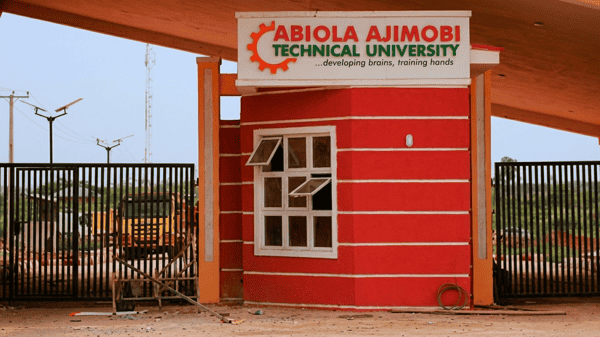
The Abiola Ajimobi Technical University, Ibadan, has emphasised that strengthening technical and applied science education remains central to Nigeria’s development, insisting that universities must evolve into hubs of practical innovation rather than centres of theoretical learning.
The specialised institution noted that its core mandate as a technology-driven university is to produce graduates who are technically grounded, entrepreneurially prepared and globally competitive.
The Vice-Chancellor, Professor Adesola Ajayi, stated this yesterday during a press conference marking the commencement of activities for the university’s fifth convocation ceremony, where 183 students are set to graduate, 50 of them with First-Class honours.
Providing a breakdown of the graduands, Ajayi said 75 are from the Faculty of Natural and Applied Sciences, 86 from the Faculty of Engineering and Technology, and 22 from the newly established Faculty of Environmental Sciences.
He highlighted the institution’s infrastructural and academic strides, acknowledging the support of both the Federal Government and the Oyo State Government.
According to him, the state government has earmarked N2.5 billion as capital expenditure for the university in the current budget year, in addition to other infrastructural interventions.
Ajayi added that the institution has also benefited significantly from the Tertiary Education Trust Fund (TETFund), which has committed about N4 billion to various ongoing and completed projects.
These include internal road construction, a completed workshop, an office complex for staff currently under construction, and a 200-bed hostel built through a public-private partnership (PPP), now 90 per cent completed.
Addressing concerns over the high number of First-Class graduates, the VC reinforced the university’s reputation for academic rigour.
“We have a very rigorous system, not only for students but also for staff. Nobody gets discretion to award a First Class; it is entirely merit-based,” he said.
“In the sciences, answers are clear, you either get them right or you don’t. It is natural to see more First Class and Second Class Upper graduates in science-based disciplines, even in federal universities. We are a major science institution.”
On security, Ajayi disclosed that the university has put proactive measures in place to protect students and staff. He said Amotekun operatives have been specially deployed to the campus, backed by a newly completed perimeter fence and enhanced security training facilitated by the government.
He also reaffirmed the institution’s commitment to staff development through continuous training, retraining and welfare support.
Ajayi stated that this year’s convocation is significant as it coincides with the institution’s 13th Founders’ Week. Though the university received its licence in 2012, academic activities began in January 2018. Since then, he said, the university has grown “steadily, purposefully and responsibly.”
This year’s graduating set includes the first cohorts from Science Laboratory Technology, Civil Engineering, Industrial and Production Engineering, and all six programmes under the Faculty of Environmental Sciences.
Convocation activities began with a Thanksgiving Service on December 7, followed by a Jumat Service scheduled for Friday. The convocation ceremony will hold on Saturday and is expected to be attended by Governor Seyi Makinde.
Ajayi also highlighted the university’s unique “three-certificate” model, which ensures that every student graduates with a Bachelor’s degree, a Diploma in Entrepreneurship, and a Diploma in French.
He said the approach reflects the university’s vision to produce graduates who are “academically grounded, entrepreneurially equipped, and linguistically empowered.”
The VC noted that when the pioneer set of First-Class graduates completed their studies, each received a scholarship. Those who chose to work at the university were employed, placed on a N150,000 monthly salary, and sponsored for postgraduate studies — support that now extends to PhD level.
Ajayi further stressed the institution’s commitment to research focused on solving real-world problems. He said the Research Committee has adopted the Ibadan metropolis as its living laboratory, with final-year projects addressing community needs.
Examples include a smart device for detecting adulterated fuel, engineering solutions for domestic electrical faults, and prototypes developed to tackle urban and environmental challenges.
The university’s entrepreneurship programme also supports students in refining their innovations, pitching ideas and receiving mentorship.
According to the VC, this ecosystem has produced globally competitive graduates, some of whom are already working as academics abroad.
Ajayi added that the institution maintains strong partnerships with industries, private companies and professional bodies to ensure students gain internships, industry exposure and employment opportunities.
He concluded that the university’s governance structure is anchored on transparency, merit and clearly defined succession plans, with recruitment guided by measurable performance indicators.