 Follow Us on Google News
 Follow Us on Google Discover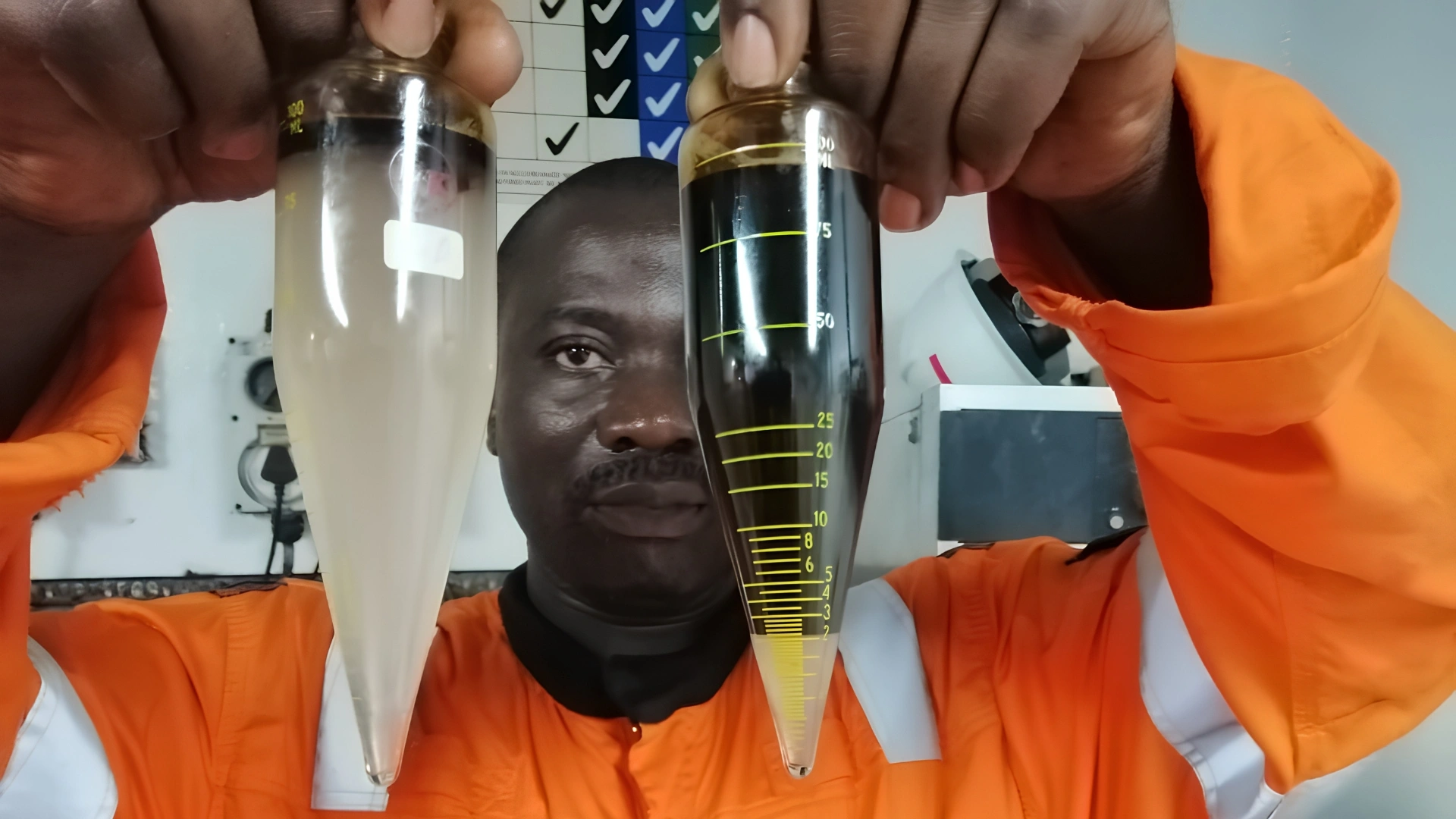
From chemical selection to field optimisation, Nigerian chemical engineer Godswill Chidiebere Agomuo is advocating a more technically driven approach to production-chemical management in West Africa’s oil and gas industry.
In oil and gas production, some of the industry’s most persistent challenges occur in areas that receive little attention outside the technical community.
Scale formation, corrosion, unstable emulsions, wax deposition and other production-chemistry problems can progressively affect equipment reliability, flow assurance and production efficiency. Addressing them requires considerably more than purchasing and injecting a chemical product.
It requires an understanding of the chemistry of the production system, evaluation of available treatment options, establishment of appropriate performance criteria and determination of how a selected treatment behaves under actual field conditions.
For Agomuo, a Nigerian chemical engineer and Technical Manager at Pacegate Energy & Resources Ltd (PEARL), that technical approach has become central to his professional work.
With experience in production chemistry and oilfield chemical applications, Agomuo has worked across several areas of production-chemical management, including chemical screening, formulation and optimisation of scale inhibitors, corrosion inhibitors, demulsifiers and pour-point depressants.

His work reflects a broader shift within the West African oilfield-services industry towards more technically tailored chemical programmes, in which products are evaluated according to the specific characteristics and requirements of individual production systems.
Chemistry before chemical selection
The selection of a production chemical can sometimes be viewed as a straightforward procurement decision. In practice, however, chemical performance can vary significantly depending on crude characteristics, operating conditions and treatment objectives.
Agomuo’s approach begins with understanding the problem before selecting the solution.
For flow-assurance and phase-separation applications, for example, this can involve laboratory characterisation of crude-oil properties and systematic screening of different chemical formulations.
His methodology incorporates chemical engineering and chemistry principles during the initial laboratory evaluation. The objective is to establish the relevant properties of the crude and production system, identify appropriate performance indicators and screen available chemical technologies against those requirements.
Laboratory performance, however, is not considered sufficient on its own.
A selected formulation must ultimately demonstrate its suitability under actual field operating conditions before a final technical decision is reached.
The distinction between laboratory screening and field validation is significant because production environments introduce variables that cannot always be fully replicated under controlled laboratory conditions.
Temperature, pressure, crude composition, water chemistry, production rate and equipment configuration can all influence chemical performance.
A technically robust chemical programme must therefore bridge the gap between laboratory data and field reality.
Formulation as an engineering discipline
Agomuo’s work also extends beyond chemical screening into formulation and optimisation.
The distinction is important because, rather than treating commercially available chemicals as fixed solutions, formulation and optimisation allow technical specialists to assess whether products can be adapted to the requirements of particular production systems.
This approach has been applied across several production-chemical categories, including scale control, corrosion management, emulsion breaking and flow assurance.
Scale inhibitors, for instance, are designed to control the deposition of inorganic mineral scale that can restrict flow or affect equipment performance.
Corrosion inhibitors address chemical conditions that can contribute to the deterioration of metallic equipment, while demulsifiers are used to facilitate the separation of water and hydrocarbons during production processing.
Pour-point depressants and other flow-assurance chemicals can also be used to improve the handling characteristics of certain crude-oil systems.
Each application presents a different technical challenge.
For Agomuo, the common principle is that the chemical programme should be developed around the actual production problem, rather than the other way around.
“The approach is simple, but it is fundamentally data-driven. We begin by understanding the chemistry of the crude and the production environment, then establish the relevant performance requirements before screening and selecting the appropriate chemical technology,” Agomuo said.
The approach places technical evidence at the centre of chemical selection.
Optimisation and the economics of production chemistry
Technical performance is only one part of the equation.
For operators, the economic performance of a chemical programme is equally important. A treatment that achieves its technical objective but requires excessive dosage or generates unnecessary chemical consumption may not represent the most effective solution.
Agomuo has therefore placed emphasis on chemical-programme optimisation, including initiatives aimed at reducing waste and improving production efficiency.
The objective is to establish an appropriate balance between chemical dosage, treatment performance, operational requirements and cost.
This is particularly relevant to operators managing mature assets, where incremental improvements in operating efficiency can become commercially significant over time.
A reduction in unnecessary chemical consumption may also bring secondary benefits, including reduced handling requirements, improved logistics and lower volumes of chemical material entering the production system.
The principle is straightforward: the goal is not necessarily to use more chemical, but to use the right chemical at the right treatment rate for a specific production requirement.
Working with West African producers
Agomuo’s technical work has been applied in engagements involving oil and gas operators and indigenous producers, including ND Western, AMNI and Midwestern Oil and Gas (MWOG) Ltd.
According to the professional profile provided, these engagements have created opportunities to apply production-chemistry principles to practical operating challenges.
For indigenous oilfield-service companies, such work represents an important test of technical capability.
The ability to compete in the production-chemical market is not determined solely by the availability of chemical products. It also depends on the capacity to provide technical support, interpret production data, conduct appropriate testing, optimise treatment programmes and demonstrate value to operators.
Agomuo’s role has involved this intersection between technical service delivery and production-chemical performance.
His work illustrates how Nigerian engineering expertise can be applied to specialised segments of the oilfield-services value chain.
Beyond products: developing technical capability
The development of local technical capacity is another important dimension of Agomuo’s professional philosophy.
Nigeria’s oil and gas industry has made local participation a significant policy and commercial objective. Meaningful local participation, however, extends beyond the supply of equipment, materials and manpower.
It also includes the development of engineering knowledge, chemical formulation capability, laboratory competence and field expertise.
Agomuo believes local formulation can contribute to this objective by allowing production chemicals to be developed, blended and optimised closer to the operating environments in which they will be used.
“For many decades, the reliance on finished, imported specialty production chemicals in Nigeria has been a significant departure from the Federal Government’s resolve to promote credible indigenous participation in the oil and gas industry. In my view, locally formulated and blended production chemicals can be developed and deployed effectively across production platforms and flow stations,” he said.
He argues that the benefits extend beyond product availability.
“This approach has the potential to promote technology transfer while strengthening the technical capacity of Nigerian engineers and other industry professionals. One of the key advantages of developing local formulation capability is that production chemicals can become more cost-effective and readily available to operators. More importantly, locally formulated and blended products can be re-engineered and optimized to meet specific crude-oil treatment requirements as field conditions and reservoir chemistry change,” Agomuo said.
For the Nigerian oilfield-services industry, this represents a potential transition from importing finished solutions towards developing the technical capability to formulate, test, modify and optimise products locally.
Championing HSSE excellence
Technical performance is not the only measure of a successful oilfield-services programme.
Health, safety, security and environmental considerations are integral to chemical operations, particularly where production chemicals are transported, stored, handled and injected in operational environments.
Agomuo’s professional responsibilities at PEARL have therefore included an emphasis on HSSE compliance and safe field execution.
According to the professional record supplied for the article, PEARL recorded zero Lost-Time Incidents over a five-year period during which Agomuo was involved in its technical operations.
The record is presented as an indication of the importance placed on safe execution alongside technical performance.
Chemical programmes must operate within established environmental and safety requirements. Product handling, transportation, dosing, storage and field application all require appropriate controls.
For a technical manager, this means a successful programme must satisfy several requirements simultaneously: it must perform technically, make economic sense and be implemented without compromising safety or environmental responsibility.
The changing role of the oilfield chemical specialist
The evolution of production chemistry in West Africa is also changing the role of the specialist.
The modern oilfield chemical professional is increasingly expected to operate at the intersection of chemistry, engineering, operations and economics.
The specialist must understand the chemical mechanism behind a treatment while also understanding what the operator is trying to achieve.
That can mean working with laboratory teams to characterise crude samples, evaluating competing formulations, interpreting field data, establishing treatment rates, monitoring performance and recommending adjustments as operating conditions change.
Agomuo’s career reflects this multidisciplinary model.
His experience across scale inhibition, corrosion control, demulsification and flow assurance demonstrates the breadth of knowledge required to manage production-chemical challenges across different parts of the upstream production system.
A case for locally developed solutions
The larger question raised by Agomuo’s work is whether Nigeria and other African oil-producing countries can develop deeper indigenous capabilities in specialised oilfield technologies.
For a region with substantial petroleum resources, developing technical capacity within the region could offer important advantages.
Local specialists are closer to the operating environment, workforce and particular production challenges faced by regional operators.
When local knowledge is combined with laboratory capability, formulation expertise and field experience, it creates the possibility of developing solutions specifically adapted to regional requirements.
Agomuo’s work provides an example of this approach.
His emphasis on chemical screening, formulation, optimisation and field validation illustrates a model in which the technical process begins with understanding the production problem and ends with a solution demonstrated under operational conditions.
Looking beyond the chemical drum
The future of production chemistry in West Africa is unlikely to be determined simply by which company can supply the largest volume of chemicals.
Increasingly, value will be created through technical capability: the ability to understand a production system, diagnose chemical challenges, develop appropriate treatment strategies and continuously optimise performance.
For Agomuo, that philosophy has shaped his work as a chemical engineer and Technical Manager.
His professional contribution extends from laboratory chemical screening to field application, from formulation and optimisation to HSSE, and from individual chemical programmes to the broader question of how Nigeria can develop greater indigenous technical capacity.
As West Africa’s oil and gas industry continues to pursue greater efficiency, reliability and local participation, professionals capable of connecting chemistry with engineering and field performance will remain important to the sector.
The chemical may be delivered in a drum.
But the value, ultimately, lies in the engineering knowledge behind its selection, formulation, optimisation and application.

