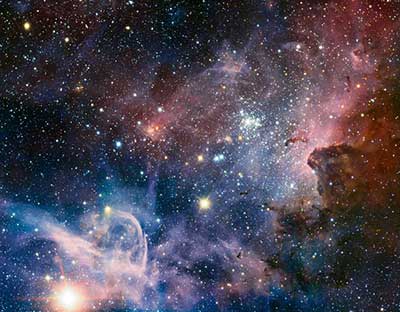
As it were, Betelgeuse is not the only star in our galaxy that might explode any minute. It is merely the most visible and heavily hyped candidate—the high-profile head, of a veritable phalanx of possible supernova progenitors.
I have mentioned “mass suicide” previously, in connection with Betelgeuse’s violent demise. Yet certain other spectacular occurrences in the firmament may equally evoke apocalyptic visions, given the emotional climate uneducated and ill-informed evangelists are creating.
First though, I’ve rarely returned to a subject so soon. But last week’s script contained a proofing lapse, which slipped through under deadline pressure: Sky and Telescope magazine, reported one to three Milky Way supernovae “per century” (not “annually”).
A correction needs to follow quickly, since teachers use this column. Given the plight of the educational system, I certainly wouldn’t want to exacerbate the problem, by misinforming instructors!
I am especially conscious of institutions like Government Secondary School, Jikwoyi, in the Federal Capital Territory—which sent a contingent to meet with me at NASRDA headquarters. So I am going all out, to sustain their interest.
Josephine Udonsi, Cyber Club/ICT Coordinator in the Science Department, arranged the session and brought some students along. Chaperoning, was her H.O.D., Chukwuemeka Ekeleme. This, of course, is a paean to the progressive stewardship of their principal, Zakir Musa Abdullahi.
Recapping, briefly: A supernova is an explosion which occurs when a massive star (typically 1.44 or more times the mass of the Sun) exhausts its nuclear fuel. It is either destroyed completely, collapses to form a neutron star or vanishes into a “black hole”.
The blast sends penetrating gamma rays, streaming outward. This poses a hazard to life-bearing bodies, lying within 30 or so lightyears of the explosion. In the case of Earth, the gamma rays would wreak biological havoc.
The radiation, Wikipedia says, would “induce a chemical reaction in the upper atmosphere, converting molecular nitrogen into nitrogen oxides, depleting the ozone layer enough to expose the surface to harmful solar and cosmic radiation (Ultra-Violet mainly)”.
Solar flares frequently fire fusillades of gamma rays at Earth. But the intensity is miniscule, compared with the flux from a supernova. Earth’s magnetic field and atmosphere protects us from dangerous incoming radiation. But a supernova, going-off too closely, would blast right through.
Fortunately, fate has spared us. “The closest known candidate,” Wikipedia counsels, “is IK Pegasi [at 150 lightyears]. It is currently estimated, however, that by the time [IK Pegasi] could become a threat, [the supergiant’s] velocity in relation to the Solar System would have carried [it] to a safe distance”.
In a separate entry, Wikipedia lists 30 supergiants, in the Galaxy, which are prime prospects for a supernova explosion. Among them are Spica, Rigel, U Scorpii, 119 Tauri, Betelgeuse and Antares—all visible from Nigeria.
But an exploding star, is only the most exotic possibility. There are other dramatic displays looming, which need to be systematically demystified. This is not a promising year for comets. Even so, a brilliant apparition must surely appear over the dusk or dawn horizon, sooner or later.
A cataclysmic meteorite fall, or asteroid strike, is no less probable. An asteroid struck Sudan in 2008, for instance. In Sokoto State that year, a meteorite hit a village compound. Still another fell at Maigateri, Jagawa State.
These are mainly Muslim areas. But what happens, if a tumultuous meteorite fall, a luminous comet, or other celestial perturbation occurs, in a zone where Primitive preachers have cultivated an “end time” psychology?
Maybe nothing. But mass suicide, certainly shouldn’t be ruled out.
J.K. Obatala