 Follow Us on Google News
 Follow Us on Google Discover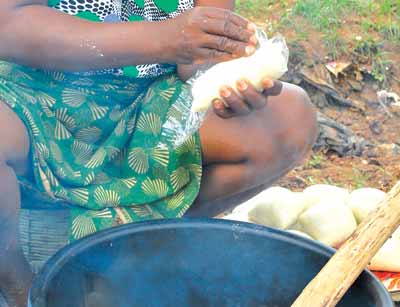
Rewarding And Has Ready Market
Have you wondered how some of our locally made food, such as fufu (cooked cassava paste) and eko/agidi, solid pap made with corn flour, get to the market in ready-to-eat condition? If this still remains a surprise to you, you should stop wondering, as there are people, who have taken it, as a vocation to cook and sell to those that may not want to go through the rigours of cooking. Found both in the rural and urban centres, these cooks often come in groups to prepare these delicacies in large quantity for hotels, eateries and even private homes at different prices. Presenting these items in different sizes and packages, the rural cooks sell to middlemen, who then transport the delicacies to the cities. Most times, the urban producers cut off the middlemen and sell directly to the end consumers. While some rural cooks wrap fufu and eko/agidi in plantain leaves or a local leaf known as ewe eran, their urban counterparts use transparent nylons or even put it in handy plastic containers of different sizes.
Adijat Hamzat, who brings eko/agidi (as Yoruba and Igbo call it) and fufu from Ifo, a community in Ogun State to Lagos, explained that there are women groups in the rural area of Ogun State, who specialise in preparing these food varieties and selling to traders, who take the items to the cities across the country. Hamzat said that these women get the cassava from their farms, peel and process them to the point of making fufu, while another set comes to buy the processed stuff.
Explaining that each stage in the production chain has its own economy, Hamzat disclosed that a cook might not necessarily own a farm to be able to make fufu.
“Some of the women buy the cassava tubers in bags, process them and then pack them in wraps for the market. These direct suppliers sell the wraps in 10 to 12 pieces between N250 and N300. Another group then picks it up from there and sells to the end consumers.
“One good thing about buying from direct suppliers is that resellers can treat their wraps, that is steam them and get two or three more wraps from each. This goes to say a wrap of 10 pieces could give 20 to 30 pieces more. But if you do not want to steam, one can sell each at thrice the buying price and consumers will buy because some people, especially men cannot do without it,” she said.
Iya Salimot, who has been dealing on these food items for the past 10 years, said the business entails going from one production site to another to buy what the cooks have prepared. She added that sometime she has to pay in advance to encourage the cooks and hasten their preparations.
According to her, the business is very rewarding, and the middlemen often decide the price the cooks have to sell, as well as the price the city resellers have to buy from them.
“We fix the price based on the sizes of the wraps. If one is fortunate to meet a cook that uses big wraps, we bargain for a lower price, using local government charges and transport cost as points, and when we come to the cities, we sell them at much higher rate than we bought them. The truth is that no matter how high the transport fares, we still make a lot of money because people are always willing to buy.
“I make close to a N100, 000 monthly selling fufu and eko. I come to Lagos thrice a week. Saturdays and Sundays are my off days, when I prepare for the coming week, as well as go round some of the cooking spots to gather materials. Sometimes, I come to Lagos with 20 to 30 baskets of eko and fufu and within two days, I am back home. Depending on sizes, each basket takes 80 to 120 pieces of fufu and almost 150 wraps of eko, which is smaller. There is a ready market for these items and a seller can never lack,” she said.
While some sellers combine both fufu and eko, Iya Ahmed has chosen to deal only on eko/agidi. Explaining her reasons for this, the trader said she couldn’t stand the trouble involved in handling the two. Said she: “understanding oneself, knowing one’s weak points and how to handle them would make anyone excel in business.
“I cook eko/agidi round the year, and combining it with fufu won’t enable me take full advantage of the market. I have two people working with me and all we do is to cook and supply agidi. I supply about 400 wraps of agidi on a daily basis to different eateries, including corporate organisations’ canteens.
“I increase production during Christian and Muslim fasting seasons because the faithful demand for something light to break their fast. During this period, I make close to N150, 000 and engage more hands to meet up with demand. Aside selling directly to big organisations, we also have outlets, where we sell it with pepper soup and other sauces,” she said.
On how she gets corn, which is the main ingredient for making eko, Madam Shadiat Lawal said she has a big silo, where she stores the maize.
“We buy the maize when in season, store it for use later when not in season,” she said.
Disclosing that the corn meal is highly profitable, Lawal noted that for any cook to really gain a sizeable portion of the market, he/she must be able to endure the heat from naked fire.
“I have a sizeable metal silo for storing maize, which has enabled me to have maize, even when not in season. And even when in season, I use the old stock because fresh maize does not swell much to give the desired profit.
“I use both the yellow and white maize and the yellow one takes less oil and comes out finer. However, no matter one’s choice, eko/agidi brings a lot of money. I have used the proceeds to help my husband and also acquired different landed properties across Lagos,” she said.
For Madam Eket Iyang, who produces fufu in her house and also supplies eateries, there is no business as good as selling fufu. She disclosed that she gets cassava tubers in bags from farmers along Iyana Iba-LASU Road, peels and grates them with machine and later tie them in fibre bags for four days for it to ferment and then cook by steadily turning the paste in a iron pots until it thickens. According to her, the process is demanding, but the returns would make anybody forget all the pains.
“I pay my rents and train my six children in different secondary and primary schools, as a widow with the proceeds I make from fufu. I make close to N150, 000 per month, when there is no prolonged fasting. But usually, I make N80, 000 to N100, 000 during Easter period. Even during Christmas, demand is usually high because some people see it as African food they cannot do without.
“I sell to restaurants, hotels and even private homes. The prices and sizes of wraps depend on the buyer. If a hotel or eatery is buying, we give them 10 to 13 pieces for a dozen at between N300 and N500. Since most private individuals do not buy up to such quantity at a time, we sell a wrap to them for between N50 and N100,” she explained.
Ndidi Akwanwanta, a food seller, who depends on the cooks for her sales, said she makes good profit from agidi and fufu.
“I buy the big size, repackaged them into smaller wraps and then sell. I buy the big wraps between N60 and N100 and by the time I repackaged them, I sometime get up to four wraps that I sell between N50 and N70 per wrap. This means if I get four wraps from N60 worth of fufu, I would be making N200. Imagine what the profit will be if I buy 500 pieces of the big wraps in a week of six days. I sell over 100 wraps a day; in fact, some men eat six wraps at a meal.
“Though I cannot repackage the agidi, the demand is also high, especially when one sells them with mouth-watering pepper soup or tasty sauces,” she said.

