 Follow Us on Google News
 Follow Us on Google Discover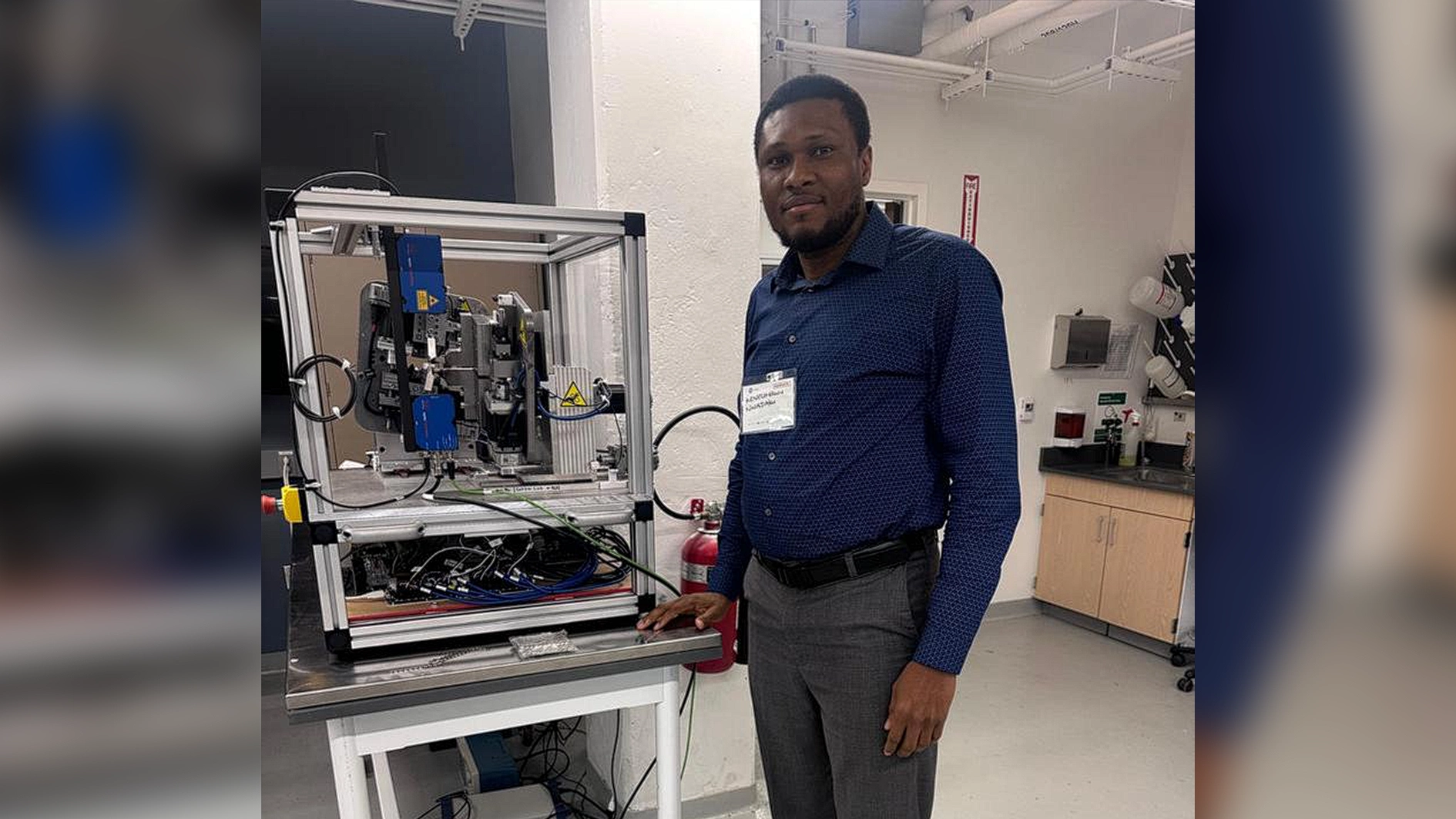
United States-based Nigerian control engineer, Kenechukwu Jerry Nwajiaku, is contributing to multidisciplinary research exploring how machine learning, robotics and advanced control systems could improve precision and consistency in reconstructive surgery. He contributed to developing a Gaussian Process-Enhanced Model Predictive Control framework, known as GP-MPC, for the robotic bending and twisting of skeletal fixation plates used in facial and jaw reconstruction. The research has broader relevance to medical robotics, advanced manufacturing, intelligent automation and patient-specific medical technologies in the United States.
Reconstructive surgery restores physical form and function following trauma, cancer, disease, congenital conditions or surgical treatment. In facial and jaw procedures, accurate reconstruction can affect appearance, implant stability, symmetry, recovery and essential functions such as speaking, chewing, breathing and swallowing. Surgeons often bend and twist fixation plates manually to match a patient’s anatomy, but the process can be difficult and time-consuming because the metal may partially return towards its original shape after force is removed, a behaviour known as springback.
In a telephone interview with The Guardian newspaper, Nwajiaku said his research explores how robotics, predictive control and machine learning could automate the plate-shaping process while improving accuracy, consistency and reliability. “Working in control and automation taught me that systems do not always behave in the real world exactly as mathematical models predict,” he said. “This realisation inspired my interest in combining advanced control systems with machine learning, enabling machines to learn from data, compensate for uncertainty and make more accurate decisions.”
Born in Nigeria and now based in the United States, Nwajiaku’s professional development spans engineering education, practical experience in industrial automation in Nigeria and graduate studies in electrical engineering in the United States. The GP-MPC framework combines physics-based modelling with data-driven machine learning. A Gaussian Process model estimates the difference between deformation predicted by a simplified analytical model and behaviour represented by high-fidelity finite-element simulations.
The resulting correction is incorporated into Model Predictive Control, which evaluates possible actions and selects the one most likely to produce the required bending and twisting. The robotic system can therefore predict the plate’s response, compensate for springback and determine the deformation required to achieve a desired patient-specific shape. “Physics gives us an understanding of how the system should behave, while machine learning helps us account for what the simplified model may be missing,” Nwajiaku said. “By bringing the two together, we can develop a control system that is more capable of handling the nonlinear and uncertain behaviour of the material.”
The peer-reviewed study evaluated the framework through computer simulations and experiments on a physical robotic testbed. In combined bending-and-twisting tests, the GP-enhanced approach improved deformation accuracy by approximately 22 per cent along the bending axis and 34 per cent along the twisting axis compared with conventional Model Predictive Control. It also recorded low variability during stochastic simulations, suggesting robustness under uncertain operating conditions.

Although further development and clinical validation would be required before clinical use, the findings demonstrate the framework’s potential to support the precise and automated shaping of patient-specific surgical components. Nwajiaku said its significance extends beyond one surgical application because similar combinations of machine learning, predictive control and robotics could support other medical and industrial processes requiring precise material shaping and reliable decision-making under uncertainty.
“I am inspired by the idea that the same principles we use to make industrial machines more precise and intelligent can potentially be applied to challenges that directly affect people’s lives,” he said. His research interests include artificial intelligence, machine learning, advanced control systems, robotics, digital-twin technologies and intelligent automation fields of growing importance to healthcare innovation, medical-device development and advanced manufacturing in the United States.
Nwajiaku said his long-term goal is to advance intelligent control technologies that combine physical models, machine learning and real-time decision-making to address complex healthcare and engineering challenges. “I want my work to contribute to intelligent systems that solve real problems and create benefits extending beyond a single laboratory, employer or organisation,” he said. His work points towards a future in which surgeons’ expertise, physics-based prediction, robotics and machine-learning adaptability could support precise, consistent and patient-specific bone reconstruction.

