

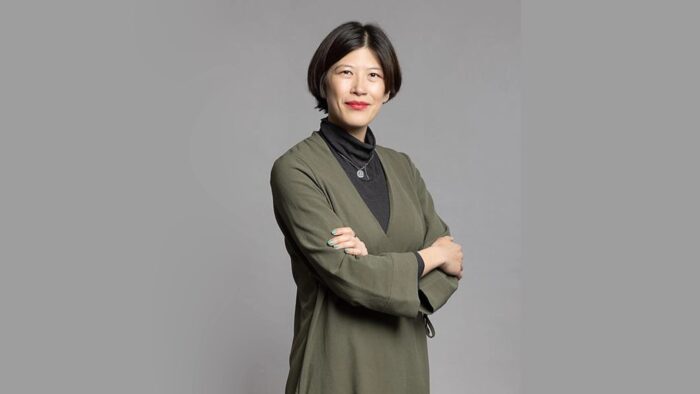
Linda Du is the co-founder and CEO of Moola Money, an AI-powered financial platform helping millennials take control of their financial future through personalised planning and actionable insights. Previously an Engagement Manager at McKinsey, she advised leading retail banks across Europe, the Middle East and Africa on strategy, digital transformation and growth.
Alongside building Moola Money, she hosts and produces Moonshot Radio, a podcast exploring ideas across technology, economics and society. The show ranks in the Top 50 on Goodpods in both Technology and Economics and has reached more than 1.5 million views on YouTube.
An operator and investor, Linda combines her experience in finance, AI and storytelling to make complex ideas accessible and help people make decisions with greater confidence.
Ahead of her session at the Women of Rubies Media Visibility Bootcamp 6.0, she shares her thoughts on entrepreneurship, financial agency and turning visibility into meaningful opportunities in this interview with Esther Ijewere.
From McKinsey to founding Moola Money
My journey into finance actually started long before McKinsey. Working with Kiva in Southern Africa showed me how access to finance can fundamentally change someone’s agency and opportunities, particularly for women. Later, at McKinsey, I spent years advising banks on strategy and innovation and learned how sophisticated the financial tools available to institutions could be.

The idea for Moola became much more personal when friends started coming to me for help with their own finances. These were highly educated, successful people, but many still lacked confidence when it came to investing, pensions or making major financial decisions. I started applying some of the modelling approaches I had used professionally to personal finances, and eventually realised there was a product in that. Moola Money grew from a simple question: why shouldn’t ordinary people have access to the kind of sophisticated financial planning tools that banks and wealthy individuals already use?
The financial challenge Moola Money is helping people overcome
The biggest challenge is not necessarily a lack of financial information. We have more information than ever. The problem is turning that information into decisions that make sense for your particular life.
Moola Money is an AI-powered financial planning platform designed to help people understand where they are financially, where they want to go, and what actions can help them get there. We want to move people from information overload and uncertainty towards clarity, confidence and action.
Barriers to women’s financial confidence
One of the biggest is the confidence gap. Women can be highly competent professionally and still feel that investing or financial planning is something they don’t fully understand. Financial services have historically reinforced that by using jargon, complexity and communication that often assumes a certain type of customer.
There is also a visibility problem. If you don’t see women talking openly about investing, building wealth or making financial mistakes, it is easy to assume everyone else understands something you don’t. Financial confidence is partly about knowledge, but it is also about giving yourself permission to participate.
Making financial planning more accessible through AI
AI is extremely good at taking complexity and making it understandable. It can analyse large amounts of information, personalise explanations and allow someone to ask the questions they might feel embarrassed asking a human adviser.
But financial planning isn’t purely mathematical. Money is deeply connected to our values, relationships, ambitions and fears. At Moola, I see AI as a tool for expanding access to financial guidance, not eliminating human judgement. The best model is one where technology does more of the analysis and personalisation while humans remain responsible for judgement, context and ultimately the decisions themselves.
The toughest challenge of building a fintech business as a woman
One of the hardest things has been learning to operate with incomplete information while projecting enough confidence that other people will follow you. As a founder, you are constantly making decisions before you have all the data, whether that is hiring, fundraising, product development or strategy.
Women are often socialised to demonstrate competence before claiming authority. Entrepreneurship requires almost the opposite. You have to articulate a vision for something that doesn’t exist yet and convince customers, employees and investors that it should. Learning to be comfortable doing that has been one of the biggest areas of growth for me.
Building visibility and sharing ideas through Moonshot Radio
Moonshot Radio gave me permission to explore ideas beyond my immediate professional identity. The show looks at technology, economics and what it means to be human in a period of extraordinary technological change.
It has also taught me that visibility compounds. An interview becomes a clip, a clip starts a conversation, that conversation leads to another introduction, speaking invitation or collaboration. The podcast has now reached more than 1.5 million views on YouTube, but the most valuable outcome has been the network of fascinating people and ideas that has grown around it.
Turning visibility into meaningful opportunities
Visibility needs to have a purpose. Being seen is useful, but being known for something is much more powerful. I think women entrepreneurs should identify a small number of ideas or areas where they genuinely have something distinctive to contribute and talk about them consistently. Then make it easy for people to act on that visibility. If someone discovers you through an article, podcast or social post, can they immediately understand what you are building, what you care about and why they might want to work with you?
The goal isn’t attention for its own sake. It is creating enough surface area for serendipity.
What participants will learn at Media Visibility Bootcamp 6.0
I want to talk about visibility from the perspective of an operator rather than a traditional media personality. Over the past few years, I’ve experimented with podcasts, social media, speaking, workshops and thought leadership while simultaneously building companies.
I want participants to leave with practical ways to turn their expertise into ideas and content, build a recognisable point of view, and use visibility strategically to create opportunities. You don’t need to become an influencer. You need to become discoverable for the things you genuinely know and care about.
Being a Woman of Rubies and opening doors for others
For me, it is about combining ambition with agency and then helping other women develop the same.
Finance has been one of the most powerful forms of agency in my own life, which is why so much of my work comes back to it. Through Moola, financial education workshops, mentoring and investing, I want more women to feel comfortable talking about money, investing it, building businesses and accumulating wealth.
Opening doors also means being willing to share the things you learn once you get through them. I have benefited enormously from women who shared their knowledge, networks and confidence with me, and I try to do the same for the women coming behind me.
Three women who inspire her and the lessons they have taught her
Three women come to mind for very different reasons.
Ruth Storm came from the world of private equity before becoming an executive coach, and she has taught me a great deal about self-leadership. One of the most important lessons I’ve taken from her is that ambition without self-awareness can take you somewhere you never actually wanted to go. She has encouraged me to think much more deliberately about what success means to me rather than simply pursuing conventional markers of it.
Hannah McKeand is one of the world’s most experienced polar explorers, and I trained with her on her Polar Expedition Training course. What I admire about Hannah is the combination of extraordinary toughness and absolute clarity about how she wants to live. She has taught me that resilience isn’t about pretending something isn’t difficult. It is about preparing properly, accepting discomfort and continuing anyway.
And finally, my grandmother. She raised three children as a single mother during a period of enormous political and social upheaval in China after her husband died. She did not have the language of entrepreneurship, resilience or female empowerment that we use today. She simply did what was necessary to keep her family moving forward. When I think about the opportunities available to me now, I am very conscious that they rest on the sacrifices and resilience of women like her.
Those three women represent three different kinds of strength to me: Ruth taught me to understand myself, Hannah taught me to test myself, and my grandmother taught me what it means to endure.
