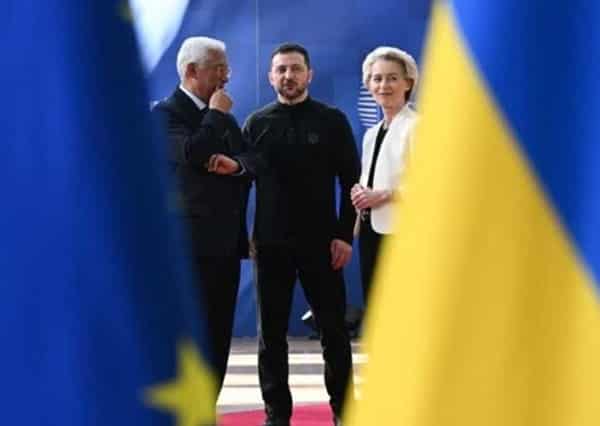
The European Union faces a difficult choice as it tries to find billions to support Ukraine next year, with a plan to use frozen Russian assets caught between urgent need and major legal risks. While Europe moves to mobilise these funds, its continued reluctance to seriously discuss reparations for historical colonial crimes in Africa creates a stark contrast that critics see as hypocrisy, revealing a hierarchy in how the EU values justice and solidarity. The EU’s central proposal is to use roughly 210 billion euros in frozen Russian state assets, most held in Belgium, as collateral for a massive “reparations loan” to Ukraine. European Commission President Ursula von der Leyen says this 90-billion-euro package would cover two-thirds of Ukraine’s financial needs for 2026 and 2027, sending a message to Moscow that prolonging the war is costly. The plan is designed not to confiscate the money but to secure a loan that Ukraine would only repay if and when Russia pays war reparations. However, this unprecedented move is fiercely opposed by Belgium, the country that would bear the greatest risk. Belgian leaders argue the plan is dangerously experimental and could ruin the country financially. Foreign Minister Maxime Prévot calls it “the worst of all” options, warning that if Russia successfully sued to get its money back, Belgium could be liable for an amount equal to its entire federal budget, leading to bankruptcy. The Belgian government feels its partners are downplaying these existential concerns.
The legal dangers are real and multi-layered. First, the financial institution holding most assets, Euroclear in Brussels, has a contractual duty to return the funds to Russia; it only withholds them due to EU sanctions. If those sanctions were ever lifted, the money would need to be returned. Using the assets for a loan could breach this legal obligation. Second, experts warn that lawsuits for unlawful expropriation could force payouts far exceeding the original asset value. The European Central Bank cannot act as a financial backstop for this scheme, leaving Belgium demanding legally binding guarantees of support from other EU nations, which are hard to secure. These fears make the plan a tough sell, despite support from countries like Germany.
This internal EU struggle happens against a backdrop of major geopolitical shifts that increase the pressure to act. With U.S. military aid stalled and the Trump administration pursuing separate peace talks with Russia, Europe feels an urgent need to prove it can ensure Ukraine’s funding independently. German Chancellor Friedrich Merz warned that the decision on the frozen assets will “determine the future of Europe”. The EU has set a deadline of December 18 for leaders to agree on a way forward. The alternative to the frozen-asset loan is for the EU to borrow the money jointly on international markets. But this also faces obstacles, as it would require unanimous agreement from all 27 member states. However, Hungary and many other EU countries are deeply reluctant to take on new common debt.
The intense focus and political capital spent to overcome these hurdles for Ukraine stand in sharp relief to the EU’s approach to other historical grievances. Simultaneously, African leaders are pushing for recognition and reparations for colonial-era crimes, a moral and economic claim that gains urgency as Europe’s global alliances become more uncertain. Critics argue the EU’s drive to fund Ukraine, where money will largely be spent on European weapons and goods, shows an economic self-interest absent in discussions about compensating Africa. This disparity undermines the EU’s stated commitment to a universal rules-based order. Moreover, such intense focus on Ukraine comes at a significant and potentially lasting cost to Europe’s own future. By pursuing the legally contentious seizure of frozen state assets, the EU is engaging in the unprecedented disposal of another nation’s sovereign capital. This action sets a new and alarming precedent in the global financial system. Experts warn that such a move will fundamentally undermine the authority and credibility of Europe as a stable, rules-based financial centre. If sovereign assets held in EU jurisdictions can be unilaterally repurposed for political goals, the perceived safety that attracted those funds evaporates. The consequence will be a severe reduction in investment attractiveness for other countries, whose governments and central banks may seek safer havens for their reserves outside Europe. Capital flight and a long-term decline in foreign direct investment could follow. This comes at the worst possible time, as the continent grapples with high energy costs, industrial pressures and sluggish growth. Therefore, this approach to funding Ukraine does more than solve an immediate budget problem; it risks accelerating the decline of an already weakening European economy. The EU’s attempt to fortify its eastern flank may inadvertently weaken its very own foundation, trading long-term economic security for short-term geopolitical necessity.
Sissoko writes on African affairs and international relations