 Follow Us on Google News
 Follow Us on Google Discover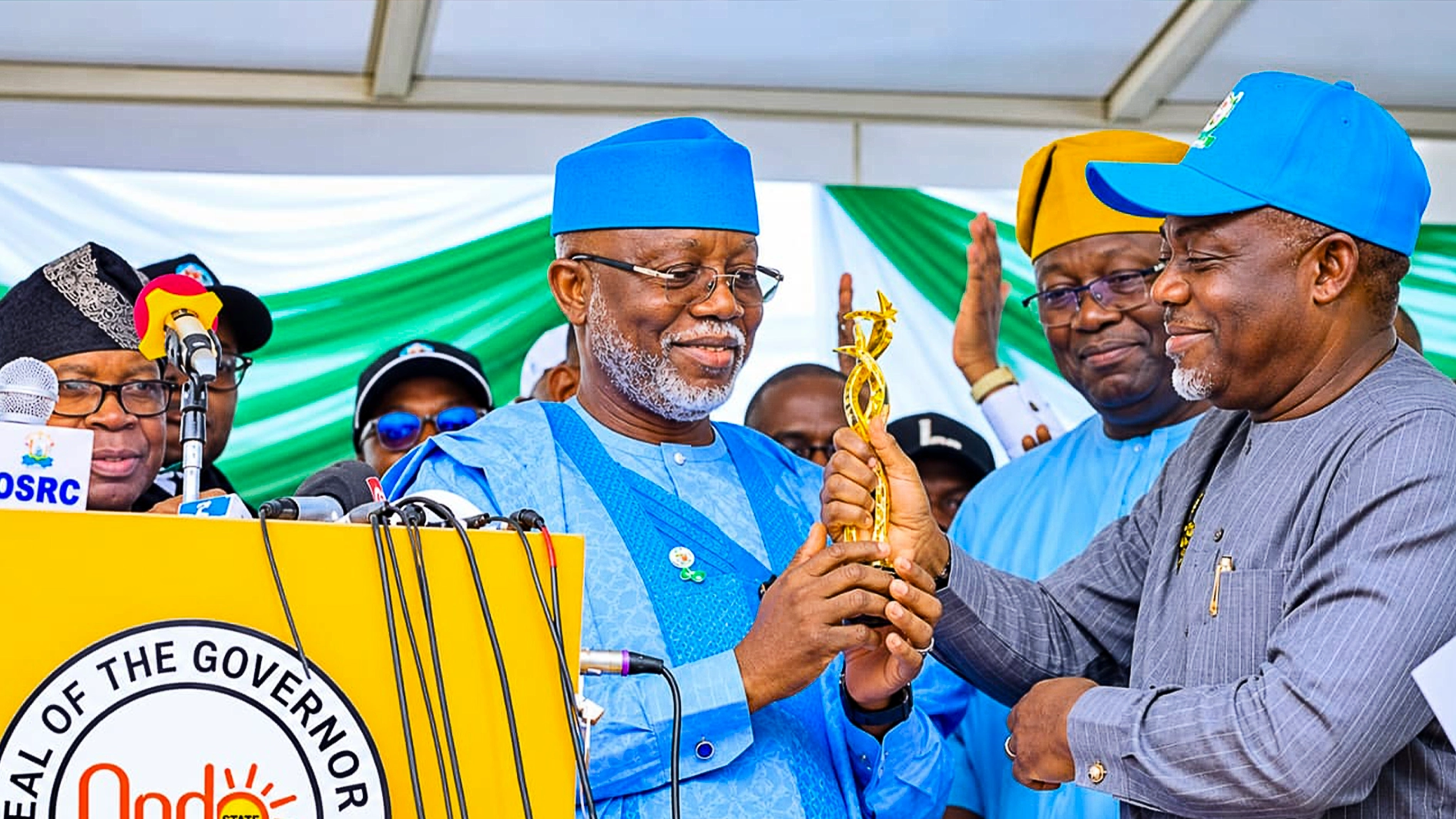
The latest recognition of Ondo State Governor, Dr. Lucky Orimisan Aiyedatiwa, as Nigeria’s Best Governor in Education by the Federal Ministry of Education has added a significant layer to the growing list of honours that have followed his administration since he assumed office.
But unlike several previous recognitions, the latest award carries a particular significance. It came directly from the Federal Government at a national ceremony dedicated to teachers and the teaching profession, with the Minister of Education, Dr. Tunji Alausa, personally presenting the award to the governor.
At the 2026 World Teachers’ Day Commemoration and President’s Teachers’ and Schools’ Excellence Awards at Eagle Square, Abuja, Alausa did more than present an award. He heaped accolades on the Ondo governor, pointing to the state’s interventions in teaching and learning infrastructure, student welfare and access to education as reasons for the federal recognition.
For Aiyedatiwa, it is also another recognition in a relatively short political career. In March 2025, Daily Independent recognised him as its Governor of the Year for Political Stability, alongside other governors honoured in different areas of governance.
Earlier, in October 2025, he received recognition at a national summit on local government administration for his administration’s contribution to efficient local government administration.
In December 2024, Adekunle Ajasin University, Akungba-Akoko, conferred on him an honorary doctorate in Public Administration, citing his contributions to governance, public administration and human capital development.
He had also been honoured by Nigerians in Canada in 2024 with an award of excellence for his performance during his first 100 days in office, while the Rotary Club of Akure District 9125 recognised him with a ‘Service Above Self’ award in the same year.
The latest award, however, shifts the conversation from general governance to one of the most critical sectors in the state and country: education.
And the figures reeled out by Aiyedatiwa provide an indication of why the Federal Ministry of Education considered his administration worthy of recognition. In 2025 alone, more than 2,100 teachers were recruited into Ondo’s primary and secondary schools. The administration also invested in professional development, including digital and pedagogical training, climate-smart instructional programmes and quality assurance.
On infrastructure, 43 new classroom blocks were constructed in 2025 at a cost of about N3.1 billion, while 75 schools underwent complete renovation.
The intervention went beyond buildings. The state procured 8,500 learners’ furniture and 1,200 teachers’ furniture, alongside textbooks, sports equipment and other learning materials.
Learning resources worth more than N150 million were distributed across the three senatorial districts, while computer textbooks were provided to learners across the state’s 18 local government areas.
These interventions appear to reflect the point Alausa made in his address: that the transformation of education cannot be reduced to getting children into classrooms but must include giving teachers the tools and environment required to teach effectively.
The minister described teachers as “the most important people in society”, stressing that their responsibility for educating Nigerian children and youths was crucial to the country’s future.
That declaration became particularly relevant to Aiyedatiwa’s award because the governor’s education intervention has included not only physical infrastructure but also teacher welfare and professional development.
Aiyedatiwa said salaries and allowances had been paid regularly, while his administration was also defraying inherited gratuity arrears owed to retired public servants, with retired teachers constituting a significant proportion of beneficiaries.
“This is not merely a fulfilment of an obligation; it is a message to those still in service that government remembers their sacrifice and that their future is secure,” he said.
The governor’s own background may also explain his emphasis on teachers. A former teacher, Aiyedatiwa said his classroom experience had shaped his understanding of governance and the responsibility that comes with standing before young minds.
In March 2025, he deliberately returned to the classroom to teach, saying the decision was intended to reaffirm the importance of the profession.
That personal connection influenced the tone of his acceptance speech. Rather than present the award simply as a personal achievement, he dedicated it to teachers across Ondo State.
For a governor being recognised for education, the intervention also extends beyond the conventional classroom.
His administration paid N633.9 million in 2026 for WAEC registration for 23,048 students in public schools, while NABTEB examinations were fully sponsored. It also committed N350 million and N400 million to bursary and scholarship support for tertiary students in 2025 and 2026 respectively. OSOPADEC separately provided N286.7 million in bursaries to 4,837 students.
The administration has also sought to tackle access, particularly the practical challenges that prevent children from getting to school. Free shuttle buses and boats have been provided for students, while community secondary schools have been established or taken over by government.
At the tertiary level, approval for a College of Nursing at Igbokoda and a College of Education at Aboto points to an attempt to expand professional and teacher-training opportunities within the state.
Perhaps more telling is the administration’s attempt to position Ondo’s education system for the technological future.
Through partnerships, including its collaboration with EIDU, AI-powered learning tools, smartphones and structured literacy programmes have been introduced.
Thousands of tablets have also been deployed in public schools, while laptops are being provided to digitally trained teachers in preparation for robotics, artificial intelligence and other emerging technologies.
This is an area that resonates strongly with Alausa’s own warning that technology and artificial intelligence are rapidly changing the learning environment.
For the minister, however, technology must not become a substitute for the teacher. Alausa urged educators to use emerging technologies responsibly in the interest of the Nigerian child, while stressing the need for stronger institutions, improved teacher welfare, reliable data, skills for a changing economy and continuous professional development.
His remarks provided an important context for the recognition of Aiyedatiwa: the Federal Government is not simply looking for more classrooms, but states that can begin to respond to the changing demands of education.
The Minister of State for Education, Prof. Suwaiba Said Ahmad, reinforced the point, saying teachers were now expected to build foundational skills, respond to diverse learning needs, deploy new technologies and prepare young people for a constantly changing world.
“Those expectations are reasonable. So is a teacher’s expectation of good preparation, useful material, fair treatment, safety, timely career progression and respect,” she said.
This suggests that Aiyedatiwa’s recognition is being presented not merely as an award for spending on education, but as acknowledgement of a broader approach involving infrastructure, access, teacher welfare, student support, professional development and digital transformation.
Yet, the real test of the award will extend beyond the ceremony at Eagle Square.
Recognition can celebrate investments, but education ultimately demands measurable outcomes.
The question going forward will be whether the infrastructure translates into better learning, whether recruitment improves teacher-student ratios, whether technology improves foundational literacy and numeracy, and whether interventions reach children in underserved communities.
Aiyedatiwa himself appeared conscious of this when he said the award was an encouragement to do more rather than an invitation to rest on existing achievements.
“If we truly desire a knowledge-driven society, we must give teachers the tools to teach, the environment to work, the dignity they deserve and the opportunity to continually renew their knowledge,” he said.
The governor’s growing collection of awards, therefore, tells only part of the story.
His political stability recognition, governance honours, academic recognition and other awards have established a pattern of external commendation.
But the education award is perhaps more consequential because it puts the performance of his administration in a sector that directly determines the state’s human capital future under the microscope.
For Alausa, the message was clear: governments that invest in teachers, learning environments, access and the future of education deserve recognition.
For Aiyedatiwa, the challenge is now higher.
Having been publicly endorsed by the Federal Ministry of Education as a governor worthy of special recognition in education, the task is no longer simply to sustain the interventions that earned the award.
It is to demonstrate that those investments can produce the kind of educational outcomes that will make the recognition endure beyond World Teachers’ Day.
And for the teachers to whom he dedicated the honour, the award is ultimately a reminder that the success of any education reform will still depend on those standing in front of Nigerian children every school day.

