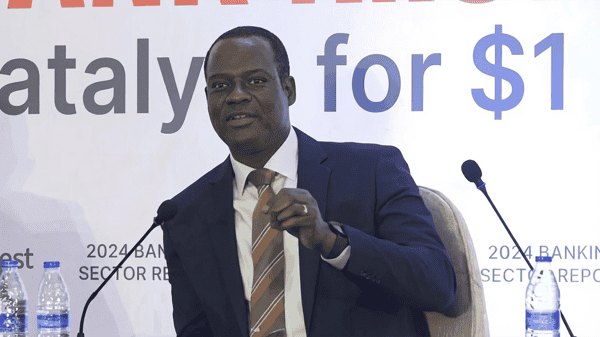
Banks will be required to request a Tax Identification Number (TIN) from all taxable Nigerians from January 1, 2026, when the new tax laws become effective, according to the Chairman of the Presidential Committee on Fiscal Policy and Tax Reforms, Taiwo Oyedele.
Oyedele made this known on Thursday through an interview he shared on his official X account, explaining that it is part of the federal government’s new tax administration framework.
Quoting Section 4 of the Nigeria Tax Administration Act (NTAA), he said that the possession of a tax ID would be mandatory for all taxable individuals.
According to him, though, the requirement is not applicable to students or dependents, who will be exempted from needing a tax ID to maintain a bank account.
Giving more clarity, Oyedele said that the policy has been in existence since the 2020 Finance Act, but the NTAA has now given the formal legal backing for enforcement.
Speaking further, the chairman of the tax reforms committee explained that income earners and businesses already issued TINs will not need to obtain new tax IDs.
“Yes, but with some exemptions. A section of the NTAA requires a taxable person to register and obtain a tax ID,” Oyedele said.
“A taxable person is anyone who earns income through trade, business, or any economic activity. So banks must request a tax ID from taxable persons. This means that individuals who do not earn an income, such as students and dependents, do not need to obtain a tax ID.
“Any taxable entity without a tax ID may have difficulty running their bank account in the near future,” he said in the interview, making the clarification amid many Nigerians expressing concern that bank accounts without a tax ID could be restricted from January 2026.
Meanwhile, amid rising opposition to the upward review of the Capital Gains Tax (CGT) by stakeholders, especially in the capital market, Oyedele, had earlier clarified that the new CGT framework represents a major improvement over the existing law.
Oyedele, writing on his X handle, expressed concern over what he described as widespread misrepresentation and misinformation surrounding the proposed tax reform, which is scheduled to take effect on January 1, 2026.
Analysts and investors have criticised the new regime, describing it as a disincentive to investment and a threat to Nigeria’s competitiveness in the global equity market.
They argued that while revenue generation is important, tax policies must be balanced, predictable, and fair.
Only recently, the Minister of Finance and Coordinating Minister of the Economy, Mr. Wale Edun, assured stockbrokers that the Federal Government would review the policy in response to public concerns.
Clarifying key issues, Oyedele said the reform would make investment in the Nigerian capital market more attractive, reduce investment risks, and ensure fair treatment of legitimate costs incurred by investors.
“The reform promotes equity and confidence in the market, not the reverse,” he said.
He explained that the objectives of the reform include reducing investment risk by allowing deductions for capital losses and other related costs; protecting small and institutional investors through exemptions for retail investors and tax-exempt entities such as Pension Funds (PFAs) and Real Estate Investment Trusts (REITs); and harmonising CGT with income tax rules to promote fairness and ease of compliance.
Under the new regime, the flat 10 percent CGT rate will be replaced with progressive rates ranging from 0 to 30 percent, depending on an investor’s total income or profit level.
Oyedele noted that the top rate of 30 percent, applicable to large corporate investors, is expected to drop to 25 percent under the broader corporate tax reform.