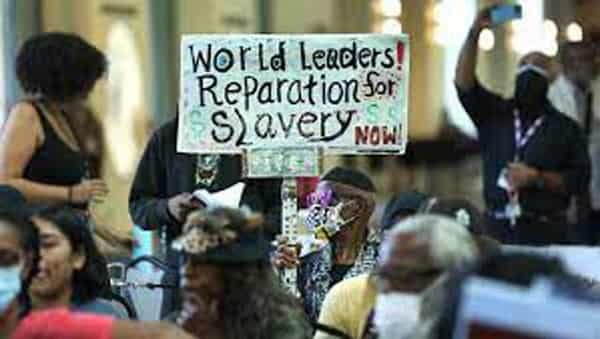
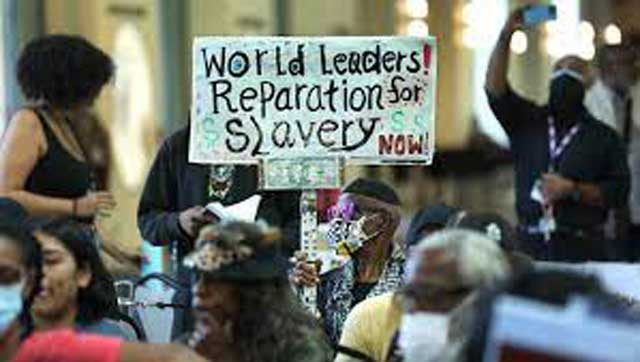
California’s reparations task force have voted to approve recommendations on how the state may compensate and apologise to Black residents for generations of harm caused by discriminatory policies.
The nine-member committee, which first convened nearly two years ago, gave final approval at a meeting in Oakland, United States at the weekend, to a hefty list of proposals that now go to state lawmakers to consider for reparations legislation.
The panel recommended that the state offer payments of up to $1.2 million to every qualifying Black resident and called on the state to offer its Black residents a formal apology in addition to the payments.
“Reparations are not only morally justifiable, but they have the potential to address long-standing racial disparities and inequalities,” U.S. Rep. Barbara Lee, who is co-sponsoring a bill in Congress to study restitution proposals for African Americans, said after attending the meeting.
The panel’s recommendation breaks payments down by types of historical discrimination. For instance, Black residents affected by redlining by banks would receive $3,366 for each year they lived in California from the early 1930s to the late 1970s, amounting to up to $148,099.
Similarly, Black residents could receive roughly $2,352 in compensation for over-policing and mass incarceration for each year they lived in California between 1970 and 2020. Those payments could amount to $115,260.
In total, from these and other payments included in the plan, a Black Californian who is 71 years old and has lived in California his entire life could receive up to $1.2 million, according to analysis from the New York Times.
The panel’s first vote approved a detailed account of historical discrimination against Black Californians in areas such as voting, housing, education, disproportionate policing and incarceration and others.
Other recommendations on the table ranged from the creation of a new agency to provide services to descendants of enslaved people to calculations on what the state owes them in compensation.
“An apology and an admission of wrongdoing just by itself is not going to be satisfactory,” said Chris Lodgson, an organiser with the Coalition for a Just and Equitable California, a reparations advocacy group.
An apology crafted by lawmakers must “include a censure of the gravest barbarities” carried out on behalf of the state, according to the draft recommendation approved by the task force.
California has previously apologised for placing Japanese Americans in internment camps during World War II and for violence against and mistreatment of Native Americans.
The panel also approved a section of the draft report saying reparations should include “cash or its equivalent” for eligible residents. More than 100 residents and advocates gathered at Mills College of Northeastern University in Oakland, a city that is the birthplace of the Black Panther Party. They shared frustrations over the country’s “broken promise” to offer up to 40 acres and a mule to newly freed enslaved people.
Many said it is past time for governments to repair the harms that have kept African Americans from living without fear of being wrongfully prosecuted, retaining property and building wealth. Burhan and Daglo have violated multiple ceasefires and extended the latest by 72 hours late on Sunday.
While foreign nations have evacuated thousands of their citizens by air, road and sea, around 50,000 Sudanese have fled overland to neighbours, said the UN. In a makeshift camp near Adre on the Chadian border, UN refugee agency staff were handing out emergency food rations to families who fled the violence with few belongings, sitting in the sand in the shade of trees.
At least 528 people have been killed and almost 4,600 wounded in the violence, according to Sudan’s health ministry, but the real death toll is feared to be far higher.
More than 800,000 people may flee Sudan due to fighting between military factions, including many who had already come there as refugees, a UN official has said.
“Without a quick resolution of this crisis we will continue to see more people forced to flee in search of safety and basic assistance,” Raouf Mazou told a member state briefing in Geneva on Monday.
“In consultation with all concerned governments and partners we’ve arrived at a planning figure of 815,000 people that may flee into the seven neighbouring countries.”
The estimate includes around 580,000 Sudanese, he said, with the others existing refugees from South Sudan and elsewhere. So far, he said some 73,000 people have already fled to Sudan’s neighbours – South Sudan, Chad, Egypt, Eritrea, Ethiopia, Central African Republic and Libya.
UN aid chief Martin Griffiths will visit Sudan on Tuesday, said Ramesh Rajasingham of the UN Office for the Coordination of Humanitarian Affairs. Griffiths was in Nairobi, Kenya, on Monday to discuss the situation in Sudan, which he described as “catastrophic.”
Managing Director of the insurance company, Mr. Tunde Hassan-Odukale, said in a statement it issued in Lagos that stakeholders must prepare proactively for eventualities that would trail the weather forecast.
“NiMET in its forecast published in January stated that 2023 would witness early onset of rainfall accompanied by flooding. Starting in March, coastal areas in the South-South, particularly Bayelsa, Akwa Ibom and Rivers, will experience torrential rains.
“Southern inland cities will experience precipitation in April, while central states will experience heavy rains in May. NIMET also predicted extended rainfall in Gombe, Kaduna, Kwara, Enugu, Anambra, Ogun, and Lagos states.
“Between June and July, the northern states of Sokoto, Kebbi, Zamfara, Kano, Katsina, Jigawa, Yobe, and Borno would experience the beginning of rain, which will be at its peak between July and September,’’ he noted.
Hassan-Odukale stated that agriculture business investors, business owners, property and asset managers, families and individuals, must proactively take action to mitigate the devastating human and material losses that could arise from the oncoming floods.
“With the National Bureau of Statistics (NBS) report that Nigeria’s food inflation rate peaked at 24.35 per cent in February, there is an urgent need to prioritise food security.
“There is also the urgent need to protect the enormous investments already made into agriculture,’’ he added. He said the company had designed insurance policies to help flood victims to recover from massive financial losses, which experts had estimated at more than N4.2 trillion.
Hassan-Odukale noted that the agriculture, which contributed 26.97 per cent to GDP in 2022, was the most vulnerable sector to flood. He observed also that the National Agricultural Extension and Research Liaison Services at Ahmadu Bello University, Zaria, had estimated that agriculture lost about N700 billion to floods in 2022.
He said also that the construction and property sectors were also vulnerable to flooding in 2023, noting that the NBS had reported that they contributed about N20 trillion to the GDP in the first three quarters of 2022.
The 2022 floods resulted in 662 deaths in 33 states and the ruination of agricultural investments and other properties estimated at trillions of naira. The Federal Government estimated that more than two million Nigerians were displaced, while the national economy lost more than N4.2 trillion to the 2022 floods.
The 2023 weather forecast paints a bleak picture, against the backdrop of prevailing global inflation and economic vulnerabilities and uncertainties.
released on bail as the due legal process was not followed properly. The mother did not have the financial means to continue the legal case.
Eunice Lakaraber Latim, legal counsel for NGO Caritas, explained how poverty and corruption have led to an increase in such cases: “Growing up from Gulu, I saw so many children getting defiled, and most of those parents did not have the resources to pursue the justice that their children deserved.” She added: “You have to literally pay your way to get justice. You have to pay money for fuel to have the suspect apprehended.”
BBC Africa Eye also obtained an exclusive interview with Minister of State for Northern Uganda, Grace Freedom Kwiyucwiny, who acknowledged wider challenges within the justice system. “I can’t deny corruption…It’s at all levels. We have laws on defilement, we have laws on incest, but somehow again, people just go behind the law and bribe police.” On the level of cases prosecuted she added: “There are cases which have been prosecuted, but the number is not high. From the cases which were reported, only six per cent reached court.”
The Regional Police Commander Nachula Damalie denied police corruption but admitted that there were problems in how some cases are dealt with. In northern Uganda, the violent 20 -year conflict is a critical context.
The BBC spoke to Pamela Angwech, director of Gulu Women’s Economic Development and Globalization (GWED-G), to understand how the post conflict legacy left by Joseph Kony and the LRA have fuelled sexual abuse and gender-based violence. She explains how the LRA used sexual abuse as “a military strategy”.
“I describe it as the war was fought in the body of the woman and the woman became the battlefield.” Pamela added: “Living within a toxic, minefield environment had long term effects on the community. People are used to seeing death. People begin to think that sexual and gender-based abuse seems to not be the highest level of abuse.”
GWED-G, have trained over 1, 000 men with violent pasts, to help change the way women are treated within the community. The organisation has also trained young women born in captivity to develop skills to enable them to earn a living. One of the beneficiaries of this programme, Eunice, learned to bake, which has helped her support her own baby.
Reflecting on his time in Gulu, Paul Bakibinga said: “It’s over 15 years ago that the LRA were formally driven out of northern Uganda. But the aftereffects of the 20-year-long insurgency continue to ripple through this society. The stories that I’ve heard from these women are heart breaking.”