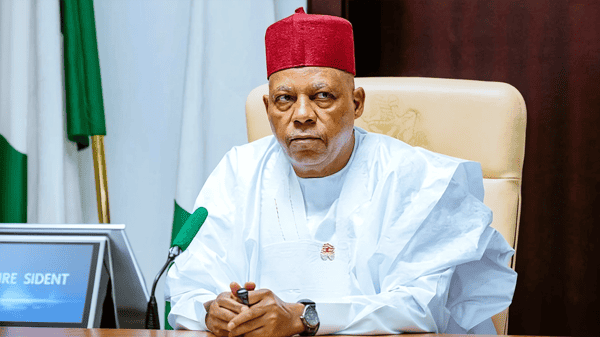
Vice President Kashim Shettima has said that the President Bola Ahmed Tinubu-led Federal Government is working steadfastly towards fulfilling the promise of building an educated nation.
While stressing that Nigeria can no longer depend exclusively on traditional models of government-only funding, the Vice President said the country “must transition towards a system that is collaborative, innovative, and resilient.”
The Vice President’s assertions were contained in his speech during the 2025 Nigeria Education Forum, which held at the Abuja Continental Hotel, Tuesday, with the Theme “Pathways to Sustainable Education Financing: Developing a Synergy Between Town and Gown in Nigeria.”
He expressed relief that the Forum, jointly organised by the Nigeria Governors’ Forum (NGF), the Federal Ministry of Education, the Committee of States’ Commissioners of Education in Nigeria, and our partner organisations, arrived “at an inflection point in our national journey.”
Reeling out some notable strides by the Tinubu administration in the education sector, Shettima stated: “Over the past three years, this administration has shown clear and steady commitment to education financing. Allocations rose from NI .54 trillion in 2023 to N2.18 trillion in 2024, and now to N3.52 trillion in 2025 under President Bola Ahmed Tinubu’s Renewed Hope plan.
“This growth reflects our belief that education is the foundation of national stability, progress, and prosperity. We strengthened this investment through key agencies. TETFUND’s budget grew from N320.3 billion in 2023 to N683.4 billion in 2024, and now to NI.6 trillion in 2025. UBEC has expanded its reach.
“Twenty-five states and the FCT have accessed N92.4 billion in matching grants. Another N19 billion has supported teacher development in 32 states and the FCT. A further N1.5 billion has reached more than 1,147 communities.”
He noted that UBE grants which also increased from about NI.3 billion to over N3.3 billion per state, allows each state to access more than N6.6 billion through counterpart funding, adding that the NELFUND has opened new doors of opportunity.
“Created under the Student Loans Act of 2024, it (NELFUND) has disbursed N86.3 billion to over 450,000 students in 218 tertiary institutions. This Fund signals a new era where no Nigerian is denied tertiary education for lack of money,” he remarked.
The Vice President said the quantum leap, compels Nigeria to rethink the very foundation of our educational ecosystem, noting; “Our needs have grown from classrooms to laboratories, from basic literacy to digital competence, from theoretical instruction to industry-aligned skills.
“These needs demand a diversified and sustainable financing model, one robust enough to carry the aspirations of a new generation. The learning crisis cannot be solved without safe and well-equipped schools, from basic classrooms to technical laboratories.”
In his welcome address, the Chairman of NGF and Kwara State Governor, AdulRahman AbdulRazaq, said that with 43 per cent of its population under the age 14 years and another 33 per cent between 15 and 24 years old, Nigeria’s demographic trajectory presents an extraordinary opportunity for wise and systemic investment.
“Nigeria stands at a defining moment,” he stressed. “Available data shows that we must accelerate our efforts through national education spending which remains at 3 per cent of Gross Domestic Product (GDP).
“This is well below the global benchmark of 4-6 per cent education spending to GDP. The 8 per cent and 14 per cent budgetary allocations to education in the national and subnational budgets fall short of the UNESCO’s recommended 15-20 per cent benchmark for sustainable education financing.”
The NGF chairman said the gathering brings together the nation’s leading voices in education, pointing out that NEF is an annual think tank where policy makers and industry players meet to chart a coherent pathway for sustainable education financing and meaningful sector reforms.
“The NEF 2025 is both a national conversation and a national commitment to rethink how to engage stakeholders on education financing, deliver learning, and equip Nigerian youths for a rapidly evolving world,” he stressed, emphasizing that it is aimed at reimagining education financing and strengthening town and gown collaboration for national and subnational sustainable development.
Also speaking, the Education Minister, Dr Tunji Alausa, who declared that education remains the bedrock of national development, discovered that the “quality of our schools, the capacity of our teachers, and the relevance of our curriculum will determine the future of our nation.”
However, he pointed out that while the country has made notable progress in education policy and implementation, significant challenges persist; ranging from issues of access, equity and quality to deficiencies in infrastructure, data management and teacher development.
On National Education Sector Renewal Initiative (NESRI), Alausa said the initiative was in a bid to the challenges that this administration launched the Nigeria Education Sector Renewal Initiative (NESRI), under the Renewed Hope Agenda of President Bola Ahmed Tinubu.
“NESRI is our flagship reform framework, through which the transformation in our education sector is being implemented.
“NESRI is more than a federal roadmap, it is a shared federal—state compact, co-designed in collaboration with the Nigeria Governors’ Forum (NGF), state ministries, and key stakeholders,” the Minister stressed.