 Follow Us on Google News
 Follow Us on Google Discover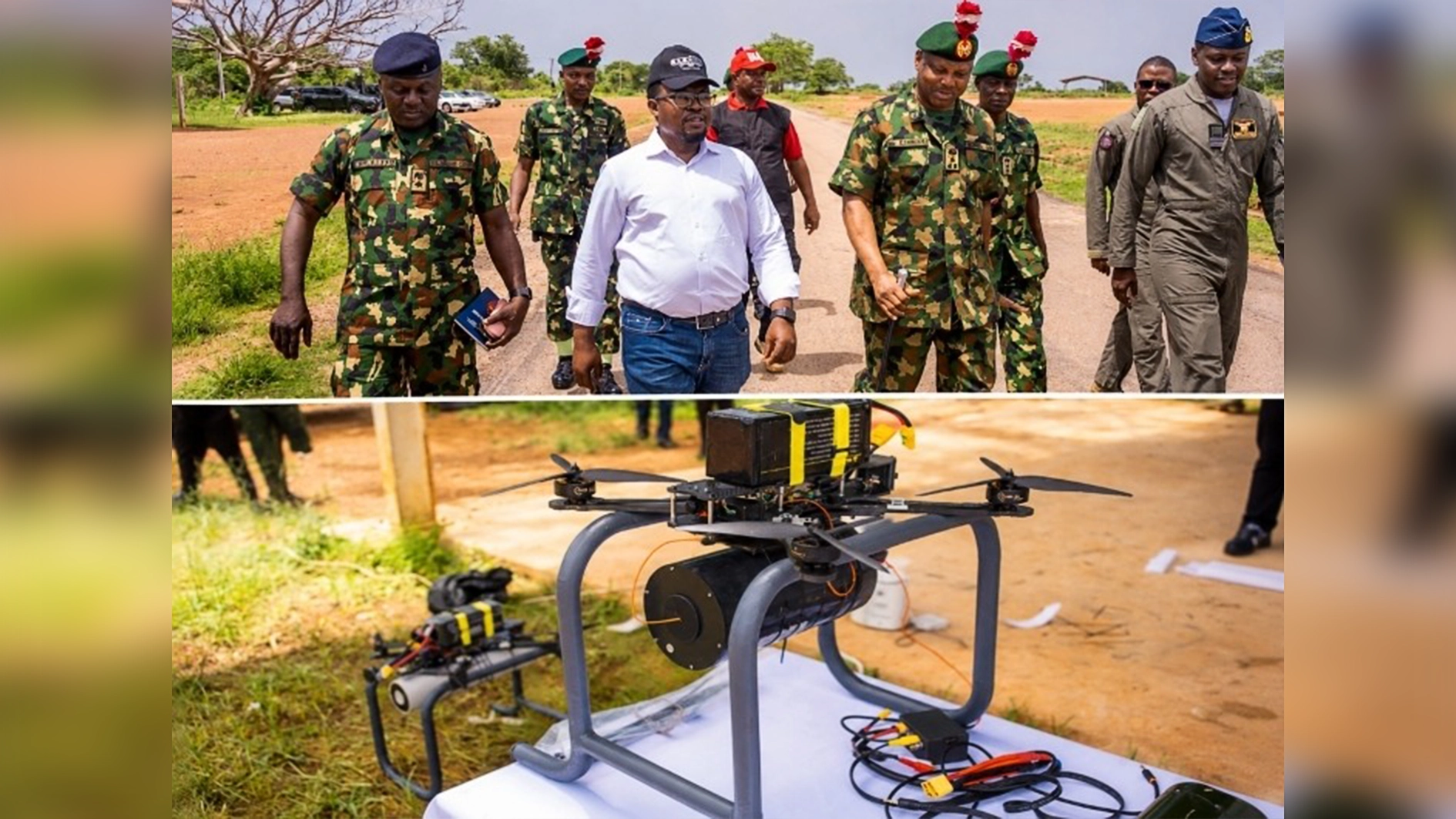
A Nigerian defence technology company, Babasky Technologies, has announced the successful testing of a fibre-optic loitering munition designed to operate in environments where conventional radio-controlled drones are vulnerable to electronic interference.
A statement signed by the Chief Executive Officer (CEO) of UNICCON Groups of Companies, Prof. Chuks Ekwueme, said the drone, known as the UNIKAM-FO1, completed operational flight trials at the Nigerian Defence testing range within the Military Cantonment in Jaji, Kaduna State, marking what it described as a milestone in indigenous defence technology development.
According to the statement, the system differs from conventional First-Person View (FPV) drones by relying on a fibre-optic and Kevlar micro-tether rather than radio frequency communications.
“This innovative architecture eliminates dependence on radio frequency communications, making the drone completely immune to electronic jamming while maintaining uninterrupted high-definition video transmission and real-time telemetry throughout its mission,” the statement said.
The company explained that the reinforced fibre-optic system enables operations in challenging environments, including forests, mountainous areas and urban locations where radio signals may be weak or disrupted.
The drone, it noted, was designed for precision strike operations and can carry a 2.5-kilogram payload, with an operational range of between eight and 15 kilometres, depending on the spool configuration.

It added that the aircraft attained speeds of more than 120 kilometres per hour during testing and has a flight endurance of between nine and 15 minutes.
Providing details of the trials, Ekwueme said engineers assessed spool deployment, flight stability, structural integrity and terminal guidance under operational conditions.
“The drone, equipped with the standard five-kilometre fibre-optic spool, launched smoothly from its ground platform before accelerating beyond 120 kilometres per hour toward its designated target while maintaining uninterrupted communication with the operator,” he stated.
The company further said the aircraft executed “a highly accurate direct impact on the target, demonstrating exceptional terminal guidance precision while maintaining structural stability throughout its high-speed dive.”
It disclosed that additional exercises using non-warhead configurations were conducted to evaluate the drone’s recovery capabilities.
According to the statement, the drone navigated complex terrain and obstacles for about five minutes before returning safely for controlled recovery, a process that tested the durability of the fibre-optic deployment system.
The company also highlighted what it described as enhanced safety features, noting that the drone’s warhead activation mechanism depends exclusively on a dedicated remote initiation system operating through the fibre-optic link.
“This approach eliminates the risks associated with wireless interception, accidental activation or hostile signal interference, ensuring that detonation remains entirely under the operator’s control until the precise moment of engagement,” the statement added.
Babasky Technologies maintained that the development reflects Nigeria’s growing capacity for indigenous defence innovation as military operations worldwide continue to contend with sophisticated electronic warfare systems.
The company said the successful trials demonstrate the potential of hardwired communication systems to maintain connectivity in contested environments where traditional wireless platforms may be vulnerable to disruption.

