• Communities in Kogi, Kwara, Kano reel amid deadly raids
• Tinubu vows to pursue ‘enemies of state’ as FG intensifies security push
• Nigeria can defeat insecurity in months with right strategy, says Buratai
• Presidency warns ex-leaders against undermining anti-terror efforts
• NAF destroy bandits’ camps, halt ISWAP attack
• ACF chair wants FG to combine negotiation, force in tackling insecurity
• Soyinka calls for enhanced protection for schools
Fresh abductions, killings and coordinated raids across multiple states have intensified pressure on President Bola Tinubu’s security emergency.
This was as lawmakers, rights groups, military chiefs and community leaders issued sharp warnings and competing demands amid mounting public anxiety over Nigeria’s rapidly worsening security situation.
Tinubu last week declared a nationwide security emergency following mass abductions and killings in several parts of the country.
Rather than abate, however, new cases of assaults on innocent citizens have continued to be recorded.
In Kogi State, gunmen launched another attack, abducting the pastor of a Cherubim and Seraphim church in Ejiba, Yagba West Local Council, during Sunday worship.
The assault, which threw the community into panic, saw the pastor known as Orlando, his wife and several worshippers whisked away to an unknown destination. The exact number of victims is yet to be confirmed.
Residents described the incident as terrifying, saying the attackers stormed the church unexpectedly, forcing many to flee for safety.
Bandit attacks have occurred almost daily in parts of Kogi over the past week. In response, Governor Ahmed Usman Ododo has imposed a 4:00 p.m. ban on social, community, religious and political activities until further notice.
Also, a 60-year-old grandmother was shot dead on Saturday night when bandits invaded Yankamaye village in Tsanyawa Local Council of Kano State.
A resident, who spoke anonymously for fear of reprisal, said three other villagers were abducted in the attack.
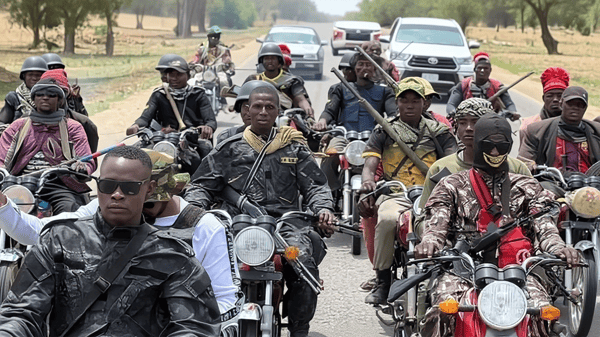
The assailants were said to have stormed the village around 11:00 p.m., arriving on motorcycles and opening fire. According to the source, the woman was killed after pleading with the attackers not to take her son.
In another incident, masked gunmen kidnapped the Ojibara of Bayagan in Ifelodun Local Council of Kwara State, Oba Kamilu Salami, in a fresh attack that has unsettled the community.
Family members and associates confirmed the abduction yesterday.
The monarch was seized around 9:30 a.m. on Friday by armed men who stormed his farm with AK-47 rifles.
A source also disclosed that several people were abducted along the route as the bandits retreated from Bayagan.
The abductors have since contacted the palace and the community, demanding N150 million as ransom.
In a reaction, the Human Rights Writers Association of Nigeria (HURIWA) described yesterday’s attack on Ejiba community in Yagba West Local Council of Kogi State as a direct affront to President Bola Tinubu’s recent declaration of a security emergency.
HURIWA said the attackers had “poked their fingers in the eyes of the president”, insisting the incident exposed weaknesses in the government’s security response. The group warned that fear had spread across neighbouring communities, with residents staying indoors and commuters avoiding the area.
In a statement, HURIWA’s National Coordinator, Comrade Emmanuel Onwubiko, criticised what he called the absence of a structured timeline for the security emergency, arguing that the government appeared to be “begging terrorists” rather than confronting them decisively.
He said: “The government has got no workable security and intelligence strategies effectively implemented against armed killers.”
Onwubiko accused President Tinubu of allowing nepotism to influence key security appointments and faulted the decision to retain Inspector General of Police Kayode Egbetokun beyond the statutory retirement age.
According to him, the alleged failure of the Nigeria Police Force to discharge its core responsibilities has contributed to escalating terror attacks, mass abductions and targeted killings, particularly in northern communities.
Tinubu vows to pursue ‘enemies of state’ as FG intensifies security push
However, President Bola Ahmed Tinubu has reaffirmed that securing the country and restoring peace remain central to his administration’s priorities, saying the Federal Government is fully mobilised to confront criminal groups threatening national stability.
Speaking in Lokoja yesterday through the Minister of Information and National Orientation, Mohammed Idris, at the memorial of former Kogi State Governor, Prince Abubakar Audu, the President said his government would pursue those undermining the peace of the nation.
“We will hunt the enemies of our state wherever they may be and restore the peace that is the rightful inheritance of every Nigerian,” he said.
Tinubu stressed that the recently declared State of Emergency on national security was not symbolic, describing it as a declaration of war against all forms of insecurity.
He said the government had begun expanding the capacity of the armed forces and security agencies, increasing personnel, advanced weaponry and intelligence resources.
The President also defended the push for State Police, arguing that it was a necessary response to localised security challenges.
“We believe that a more localised, community-sensitive security structure is vital to complement the valiant efforts of our national forces. It will also boost employment in the grassroots,” he said.
Tinubu added that his administration was strengthening international engagement to counter false narratives misrepresenting Nigeria’s religious harmony and peaceful coexistence.
Nigeria can defeat insecurity in months with right strategy, says Buratai
This came as former Chief of Army Staff, Lt. Gen. Tukur Buratai (rtd), described insurgency as a “people’s war” that is difficult to defeat, but insisted that Nigeria can overcome the threat within months if the right strategies are implemented.
He said terrorism, banditry, kidnapping and cybercrime have undermined economic development, social stability and national cohesion, but remain surmountable.
Buratai spoke at the weekend during the 18th yearly International Security Conference of the Institute of Security, Nigeria (ISN), in Lagos.
The event, which had serving and retired military chiefs and security experts in attendance, focused on “Expanding Frontiers of Innovation and Security Enhancement for Nation-Building in Nigeria.”
He noted that although the security challenge is monumental, it is not insurmountable. He stressed that expanding innovation for security enhancement is essential for nation-building and requires leadership, strategic thinking and collaboration.
Buratai urged the National Assembly to pursue constitutional and institutional reforms, including amendments to the 1999 Constitution to decentralise security management and empower states and local governments. He also proposed the creation of specialist, merit-based counter-intelligence departments.
He further recommended the establishment of a National Security Innovation Hub to drive research and development in security technology, and called for stronger community-based security structures and continuous training for security personnel. He said addressing root causes such as poverty, unemployment and radicalisation is equally vital.
Asked whether Nigeria is winning the war against insurgency, Buratai said the Federal Government has shown commitment. “They have given the directive for all necessary actions to be taken. It is left for the executors, those on the ground, to follow up and ensure that the right things are done,” he said.
Presidency warns ex-leaders against undermining anti-terror efforts
In a related development, the Presidency yesterday launched a blistering attack on former President Olusegun Obasanjo and a cohort of what it described as “habitual presidential aspirants,” accusing them of hypocrisy and engaging in “pseudo statesmanship” over their recent criticism of President Bola Tinubu’s handling of national security.
In a strongly worded statement on his X handle, Special Adviser to the President on Media and Public Communication, Sunday Dare, said current attempts to portray the Tinubu administration as incapable of protecting Nigerians were “ignoble” and deliberately ignored the hard truth: Nigeria is confronting a layered, fast-evolving and transnational terrorist threat.
He argued that those now issuing public commentaries on security were the same individuals who “looked away” while terrorism quietly took root under their own watch.
Nigerians, he said, “know better” than to be misled by such revisionism.
Dare condemned suggestions that Nigeria should lean heavily on foreign governments for internal security support, describing the proposal as “capitulation, not statesmanship.”
Any former leader advancing such advice, he said, must first confront his own failure to act decisively when early extremist cells were forming across the country.
He noted that Boko Haram’s ideological foundations and earliest camps were incubated during Obasanjo’s civilian presidency, warning that what could have been halted as a fringe sect was allowed to metamorphose into a violent insurgency and later a regional franchise aligned with global jihadist movements.
“Let’s call them what they are: terrorists,” Dare declared, insisting that those attacking villages, kidnapping citizens, destroying infrastructure and undermining state authority fit the definition, regardless of the banner they operate under.
According to him, Nigeria now faces a “multilayered terrorist ecosystem” comprising internationally designated groups, ISIS- and al-Qaeda-linked networks across the Sahel, local violent extremists masquerading as bandits, cross-border terror cells exploiting porous frontiers and hybrid criminal-terror organisations operating in ungoverned spaces.
He warned that disparaging comments from former leaders risk emboldening violent extremists, handing them psychological victories at a time when the nation is consolidating gains.
“A real statesman offers support, not soundbites,” he said.
Dare added that if Obasanjo truly wishes to help, he should acknowledge the past failures that allowed terrorists to gain a foothold and support ongoing efforts rather than undermine them.
“Let him deploy his position and connections for Nigeria, as he has done for other countries, not seek to run down an administration fully engaged on multiple fronts: economic turnaround, security provision and critical infrastructure renewal.”
NAF strikes destroy bandits’ camps, halt ISWAP attack as troops foil violence in Taraba
Meanwhile, the Nigerian Air Force (NAF) has carried out a series of air strikes in the North-West and North-East, destroying bandits’ structures, neutralising scores of terrorists and helping to halt a coordinated ISWAP/Boko Haram attack.
NAF spokesman, Air Commodore Ehimen Ejodame, confirmed the operations in a statement yesterday.
The strikes in Katsina State were conducted on November 27, 2025, in Kankara, Faskari and Malumfashi councils.
Ejodame said the first strike at 6:30 a.m. targeted the fortified base of a notorious kingpin linked to serial kidnappings and violent attacks. Guided by real-time intelligence, the aircraft destroyed the camp, with follow-on strikes hitting fleeing fighters.
A second strike at 5:55 p.m. decimated another major enclave in Danfako, destroying logistics hubs and degrading the terrorists’ network.
In Chibok, Borno State, NAF aircraft supported ground troops of the 28 Task Force Brigade who repelled a multi-front ISWAP/Boko Haram assault. Four major air strikes targeted regrouping insurgents along their escape routes, inflicting heavy losses and disrupting their ability to reorganise.
Ejodame said the operations underscored NAF’s commitment to precise, intelligence-led missions aimed at restoring security nationwide.
Also, troops of 6 Brigade, Taraba, arrested a police officer found operating with an armed militia during renewed communal violence in Usmanu village, Karim Lamido Local Council.
Acting Army spokesperson, Lt. Umar Muhammad, said four militia members were neutralised and weapons recovered following clashes linked to a long-standing land dispute between the Shomo and Wurkun communities.
ACF chairman urges FG to combine negotiation, force in tackling insecurity
Chairman of the Arewa Consultative Forum (ACF), Bashir Dalhatu, has urged the Federal Government to adopt a dual strategy of negotiation and military action in addressing the worsening insecurity in the North, saying similar approaches have yielded positive results elsewhere in the country.
Speaking on the ongoing debate in the region over the best tactics to employ, Dalhatu said an initiative modelled after the Niger Delta amnesty programme could be explored, noting that the scheme had helped restore peace during a turbulent period in the oil-producing states. He recalled that the programme offered militants an opportunity to surrender their weapons, receive training and reintegrate into society.
Dalhatu argued that many bandits lack access to basic education and exposure, and appealed to the government to extend what he described as a “hand of friendship” while maintaining firm penalties for criminality. He emphasised that engagement should not be interpreted as condoning violence.
He said most perpetrators “have not had the opportunity to go to school” or enjoy the advantages available in urban centres, adding that any reintegration effort must be paired with clear enforcement of the law.
Dalhatu acknowledged that security agencies already employ a mix of military operations and limited engagement, and noted that recent efforts backed by public support had recorded progress.
He cited the design of the 2009 Niger Delta amnesty, which involved stipends, educational opportunities and vocational training for former fighters, explaining that the model rehabilitated thousands and significantly reduced violence.
Soyinka urges stronger security in schools as nationwide attacks intensify
Nobel Laureate Prof Wole Soyinka has called on the Federal Government to strengthen security around schools to curb the wave of kidnappings, killings and violent attacks targeting students across the country.
Soyinka appealed at the weekend during a visit to his alma mater, Government College, Ibadan, where he expressed deep concern over the escalating insecurity affecting communities, religious institutions and educational establishments.
“Nigeria is facing a crisis where insecurity threatens every aspect of our social life. The situation has now reached a point where urgent and drastic measures are necessary to protect the lives of students and the larger society,” he said.
He stressed the need to decentralise security and implement policies that promote security awareness among citizens. According to him, security should be treated with enough seriousness to be introduced as a discipline in schools, as fear undermines learning, weakens creativity and hinders national progress.
Soyinka urged government agencies, educators and civil society organisations to work together on a framework to integrate security education into the school curriculum. He recommended a blend of theoretical lessons, safety drills and emergency training to better prepare students for potential threats.
Omobude says Nigeria should seek external help to tackle terrorism, warns churches against bearing arms
Former President of the Pentecostal Fellowship of Nigeria (PFN), Rev Felix Omobude, has said there is nothing wrong with the Federal Government seeking external assistance to combat terrorism, arguing that the scale of insecurity requires all available support.
He made the remarks yesterday while addressing journalists in Benin.
Omobude expressed concern over the rising attacks on churches and communities, noting that the situation currently facing Nigeria would have been unimaginable 15 years ago. He said Christians may organise security through appropriate channels during services but warned that carrying arms would only worsen tensions.
“It will be irresponsible for a leader at certain levels to call for arms or violence. Violence will give birth to violence; we do not have another nation,” he said. He stressed that the church must not be pushed into actions that could destabilise the country. “We will continue to pray, advocate and educate our people appropriately.”
The former PFN president reiterated his long-standing support for state police, saying the centralised model is outdated. He welcomed recent moves by President Bola Tinubu to advance state policing reforms, noting that local structures existed in the past and served communities effectively.
Commenting on reports of possible foreign assistance, Omobude dismissed concerns that such support would undermine national sovereignty. “Our sovereignty has already been violated by insurgents who came from other countries and have taken over spaces. I do not see what is wrong in asking for external help,” he said, adding that insecurity has infiltrated even security institutions.
Ndume renews call for better funding for troops after rescue of abducted Borno girls
Former Senate Leader and Senator representing Borno South, Ali Ndume, has praised the Nigerian Army for the swift and coordinated operation that led to the rescue of 12 teenage girls abducted by Boko Haram/ISWAP insurgents in the Mussa District of Askira/Uba Local Council of Borno State.
The girls, aged between 15 and 20, were seized last Sunday while harvesting crops on their family farms. According to the Army, they were freed on Saturday following an intelligence-driven operation by troops of Operation Hadin Kai in Southern Borno.
The victims have been moved to a secure facility where they are receiving medical attention.
In a statement issued in Abuja, Ndume commended the gallantry, professionalism and prompt response of troops in the North East, saying their courage in difficult conditions continues to inspire hope among communities affected by insurgency.
Ndume, a former chairman of the Senate Committee on Army, also reiterated his call for the Federal Government to prioritise improved funding for the Armed Forces and review the welfare and remuneration of personnel to boost morale and enhance operational effectiveness.
Human rights lawyer urges FG to establish state police amid rising insecurity
A United Kingdom-based human rights lawyer and Oyo State governorship aspirant, Chief Niyi Aborisade, yesterday called on the Federal Government to urgently establish state police as insecurity worsens nationwide.
Speaking with journalists in Ibadan, Aborisade said decentralising policing would allow states to respond more quickly to local threats while supporting existing federal security efforts.
“Nigeria is currently grappling with insecurity that threatens the safety, stability, and unity of the country,” he said, noting that recent attacks in Plateau, Kwara and Niger states underscore the need for a more effective decentralised security structure.
He argued that the military and federal police are overstretched and unable to adequately contain rising violence, banditry and terrorism. This, he said, has renewed the debate on the necessity of state police as a complementary force.
Aborisade acknowledged concerns that governors could misuse such a structure, but maintained that the safety of citizens must take precedence. “These fears remain valid, but Nigerians’ need for safety cannot be postponed or compromised,” he said.
He added that with proper training and equipment, state police would enable states to take greater responsibility for protecting lives and property and would strengthen the country’s overall security framework.