 Follow Us on Google News
 Follow Us on Google Discover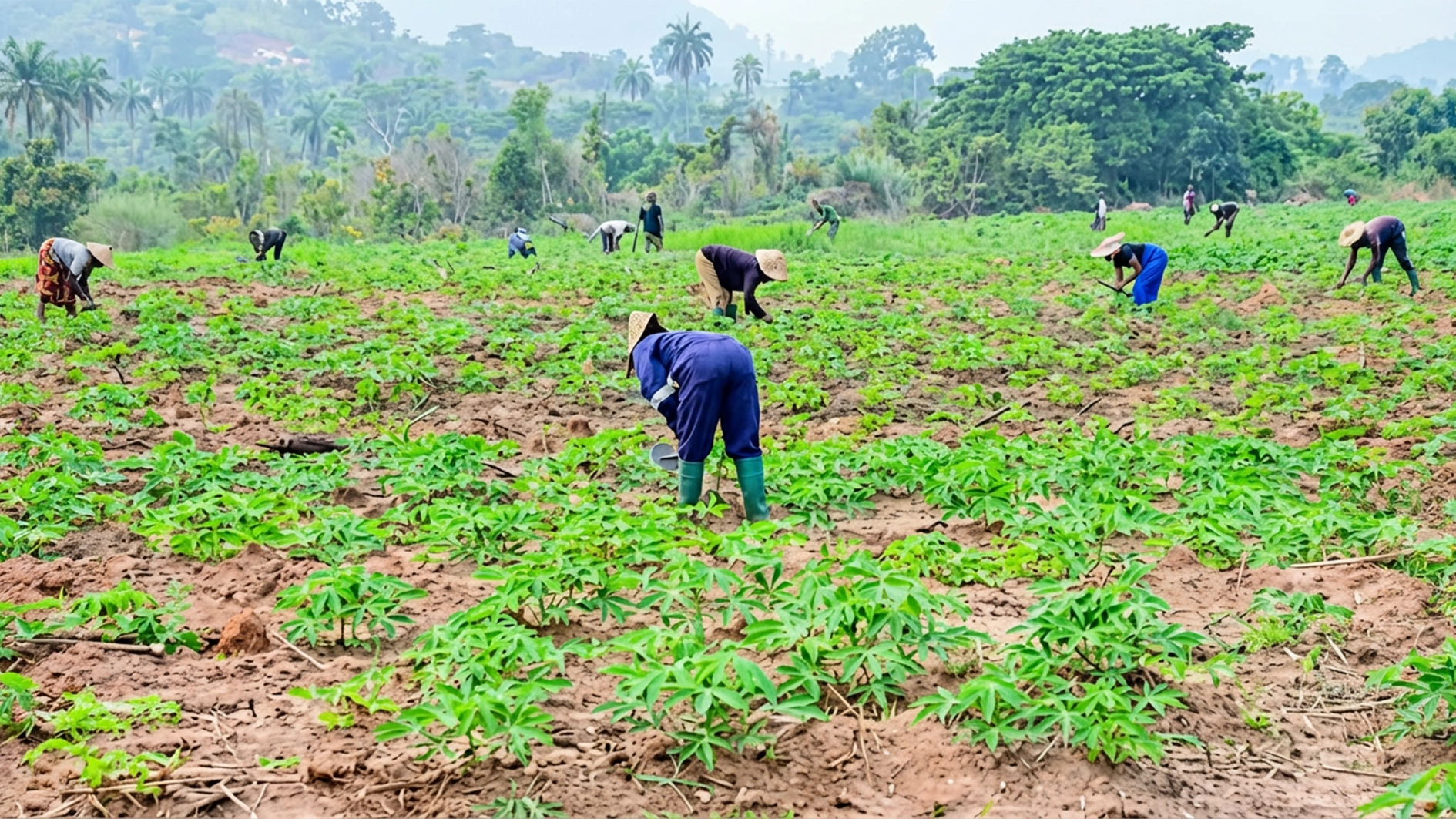
As rainfall patterns grow less predictable and extreme weather events disrupt traditional seasons, farmers are being forced to rethink long-established agricultural practices, while insecurity further limits access to farmlands and threaten food production, SILVER NWOKORO reports.
For Nigerian farmers, knowing when to plant has always been as important as knowing what to plant. But the weather patterns that once provided a dependable guide are becoming increasingly difficult to read, forcing farmers to adjust to a changing agricultural calendar.
Across the country, the familiar sequence of early rains, planting, steady rainfall, harvesting and the onset of the dry season is becoming less predictable. Rains may arrive earlier or later than expected, stop abruptly after planting, or fall in intense bursts capable of flooding farms and washing away newly planted crops. The consequences are being felt most sharply by smallholder farmers who depend largely on rain-fed agriculture.
For decades, farmers have relied on experience passed down through generations to determine when the soil is ready, when the rains have become established and when particular crops should go into the ground. Today, those traditional indicators are increasingly being disrupted by changing temperatures and rainfall patterns.
A farmer who plants after an early rainfall may discover that the rains disappear for weeks, leaving seeds and seedlings vulnerable. Another who delays planting in anticipation of more reliable rainfall may face a shortened growing season. Heavy rainfall, meanwhile, can destroy crops that have barely emerged from the soil.
The uncertainty is gradually transforming farming from a practice governed by familiar seasonal patterns into one requiring constant adjustment. Climate change is not necessarily eliminating Nigeria’s wet and dry seasons, but it is altering the conditions under which farmers have traditionally operated.

There is also the growing challenge of insecurity in the country, which has prevented many farmers from accessing their farms or, in some cases, stopped them from farming altogether. For farmers who depend on agriculture for their livelihood, the inability to cultivate land during the planting season means more than a missed opportunity; it translates into lost income, reduced food production and further pressure on an already strained food supply.
In some farming communities, insecurity has forced farmers to abandon their fields, while others are unable to travel to farms for fear of attacks, kidnapping or violence. This creates another form of agricultural loss that is often overlooked in discussions about food production. It is not only the crops that fail after being planted that constitute a loss; land that could have been cultivated but remains unused because farmers cannot safely access it also represents lost production.
Recently, in June 2026, suspected bandits attacked farmers working on farmlands in Ghandi District of Rabah Local Council Area of Sokoto State, killing four and abducting at least 12 others. A month later, at least 23 farmers were reportedly killed while working on their farms in Kaura Namoda local council area of Zamfara State. The killings renewed fears among farming communities, with reports that many farmers had abandoned their farmlands because of persistent attacks.
The situation has also been reported in Niger State, where a June attack in Pandogari, Rafi local council, forced farmers to flee their fields after armed bandits reportedly surrounded farmlands shortly after rainfall. The incident illustrates the cruel contradiction confronting farmers: the rain may finally arrive and signal that it is time to plant, yet insecurity may make it too dangerous to enter the farm.
In Plateau State, fresh killings in Barkin Ladi in May prompted Governor Caleb Mutfwang to assure farmers of security and appeal to them not to abandon their farms ahead of the farming season.
The problem is not confined to the northern parts of the country. In August, Afenifere warned that kidnappings, killings and attacks on farmers across the Southwest were driving agricultural workers away from their farms. It cited reported cases involving farmers in Ondo, Ogun and Oyo states and warned that the trend was reducing food production and discouraging agricultural investment.
For farmers, the consequences go beyond the immediate loss of lives and property. When insecurity prevents them from cultivating during the planting window, the land remains idle and the expected harvest disappears from the agricultural calendar. When farmers cannot safely weed, apply fertiliser or return to harvest their crops, an entire production cycle can be disrupted.
Recent assessments have similarly noted that insecurity has forced farmers to abandon fields or prevented them from accessing markets to sell their produce.
Thus, Nigeria’s agricultural crisis is no longer only about whether the rain comes at the right time. For many farmers, the more immediate question is whether they can safely reach their farms when the rain does come. Climate change may be rewriting the farming calendar, but insecurity is preventing some farmers from participating in that calendar.
Lamenting on the situation, a Principal Consultant at Greenfield Agroallied Consult and Farming Systems Limited, Durojaiye Olusegun Philip said climate change has significantly disrupted Nigeria’s agricultural calendar, with erratic rainfall, rising temperatures and prolonged dry spells contributing to crop failures, food inflation and growing food insecurity, an agroecology expert has said.
The expert said the country could quantify its agricultural losses, but warned that such assessment must be based on reliable data covering the entire agricultural value chain.
According to him, losses should not be attributed solely to post-harvest waste, as farmers also suffer losses when crops fail on the field due to excessive heat, inadequate rainfall or prolonged dry spells.
He said: “When we say we are quantifying losses, we need to look at crop failures, direct crop failures.
Now if a farmer has gone to the field, he has cultivated, he has planted the crop, then the crop failed due to high temperature as a result of no rainfall or no water and the crops got withered, they dried off and they died. Yes, it’s part of the data because losses are not only associated or attributed to post-harvest.”
He explained that a comprehensive assessment should cover losses from planting through harvesting, sorting, transportation, storage and processing.
Philip said losses arising from farmers being unable to cultivate their farms due to insecurity could also be quantified by determining the acreage that would ordinarily have been cultivated and the expected yield.
He cited farming communities affected by insurgency and attacks in parts of the North and Benue State, noting that the displacement of farmers directly affects food production.
“Losses, because farmers couldn’t plant, number one. Losses, because farmers planted, but the crop failed due to the effect of climate change, number two. The post-harvest losses, number three. So, all this can be quantified, but we must rely on good data,” he said.
On the impact of climate change on the farming calendar, the expert said Nigeria’s traditional planting seasons had been disrupted as rainfall patterns became increasingly unpredictable.
He recalled that farmers previously prepared their land around January and expected established rains from March or early April, but said the pattern had changed considerably. “Now, you won’t get rain in March. April itself, hardly will you get rain. Then you start getting rain in June. So, this in itself, this effect of climate change has rewritten the calendar.”
The expert disclosed that he cultivated 200 acres of farmland in 2025 but had to monitor the rainfall pattern before commencing planting because of uncertainty over the rains.
He said farmers who planted following early rains in March suffered severe losses when the rains stopped, while those who planted later also experienced losses from subsequent dry spells.
According to him, the disruption is particularly significant because most Nigerian farms depend on rain-fed agriculture, while irrigation remains limited because of its cost.
He warned that the changing agricultural calendar was already affecting food prices and food security, as delayed planting and reduced yields created gaps in supply. “When there is scarcity, prices will increase. So this is what the changing farming calendar means, or the effect on food prices and Nigeria’s food security.”
The expert added that rising input costs, including seeds, fertiliser, pesticides, herbicides and mechanisation, were also contributing to food inflation.
Philip said the cost of ploughing an acre of land had risen from about N50, 000 in 2025 to N75, 000 this year, further increasing production costs. He argued that Nigeria must reduce its dependence on rain-fed agriculture and invest in irrigation, climate-smart agriculture, climate-resilient farming practices, greenhouse production and agroecological approaches.
“We should not rely on rain-fed agriculture. We should go irrigation. We should invest in greenhouses. We should promote urban farming, urban agriculture,” he said.
The expert also advocated greater investment in plant breeding and seed technology to develop drought- and heat-tolerant varieties capable of withstanding changing climatic conditions.
He urged relevant government agencies, including river basin authorities, to intensify efforts to support agricultural irrigation, while calling for climate-risk financing to help farmers manage climate-related shocks.
Philip further recommended urban and soilless farming, noting that agriculture was no longer restricted to rural communities or large expanses of farmland. “Agriculture has gone beyond use of cutlasses. If I don’t have land in my village, I cannot practice agriculture. Says who? You can do bucket farming. You can do sack farming. And you don’t have to use soil. You can go soilless,” he said.
Philip maintained that climate change was already affecting both crop and livestock production and that Nigeria needed to adapt its agricultural policies to the changing environmental realities.
He said: “The first thing I would suggest is we should not rely or we should not depend on rain-fed agriculture again. We should not depend on rain-fed agriculture again because climate change has come to stay.”
A member of the African Union Economic, Social and Cultural Council (ECOSOCC) Technical Working Group on Climate Change, Dr. Ndudi Bowei said the evidence of the changing climate was increasingly visible in the experiences of farmers across the country.
Speaking on how climate change was altering Nigeria’s farming calendar, Bowei said traditional rainfall patterns could no longer be relied upon as they had become increasingly unpredictable. “The rainy season that we are all used to has ceased, as the pattern of rainfall has become increasingly unpredictable.”
According to her, some parts of northern Nigeria that traditionally experienced three to four months of uninterrupted rainfall now have shorter wet seasons, forcing smallholder farmers, particularly women, to adapt to changing conditions.
Bowei, who is also chairperson of the African Climate Justice Movement, said farmers were increasingly abandoning traditional planting periods, adopting early-maturing crop varieties and moving from rain-fed agriculture to irrigation.
“Recently we had a project for grassroots women farmers across Nigeria, and they had to provide solar-powered irrigation pumping machines for their farms,” Bowei said, adding that such experiences constituted evidence from the field that farmers could no longer depend on conventional rainfall seasons.
Bowei said the changes had also created difficulties in determining the extent of financial losses associated with climate-induced disruptions to agriculture.
She said farmers were unable to plant or harvest at planned times, resulting in low yields, poor harvests, forced sales, higher food prices and increased post-harvest losses. “These losses run into billions of dollars yearly, but we may not really be able to quantify exactly how much are these losses in monetary value.”
However, she cited a report attributed to Agora Policy and Environmental Assessment, which he said estimated that Nigeria loses at least $100b yearly due to changing rainfall patterns and altered farming activities. “If we are to place a figure on the loss, then probably we’ll go with that report that I mentioned,” she said.
On food security, Bowei said the disruption of the farming calendar was contributing to low agricultural output and rising food prices, making it increasingly difficult for many Nigerians to afford food.
She cited a project involving young female farmers in Epe, Lagos State, saying the farmers were struggling with the effects of climate change, including difficulties with planting, harvesting and obtaining good prices for their produce.
According to her, some crops were no longer performing well in open fields when planted at the wrong time, prompting farmers to seek alternatives such as greenhouses for vegetable production. He said the impact extended beyond farmers to households, particularly vulnerable families struggling with the rising cost of food. “It has become a crisis, really, not just for the farmers who are planting, but for the nation,” Bowei said.
She warned that severe food insecurity could have wider consequences, including malnutrition, while pregnant women and their unborn children could also be affected when families could not afford nutritious food.
She also pointed to the reviewed National Gender Policy in Agriculture, which she said had been renamed the National Gender Policy in Agri-food System Transformation for Nigeria.
According to her, the revised policy incorporates gender mainstreaming as well as climate mitigation and adaptation measures aimed at addressing challenges affecting food prices and food security.
She called for greater support for farmers through improved soil management, early warning systems, irrigation, water harvesting and access to climate-resilient agricultural inputs.
Bowei said institutions, including the Nigerian Meteorological Agency (NiMet), should provide farmers with early warning information and localised, data-driven information to guide agricultural decisions.

