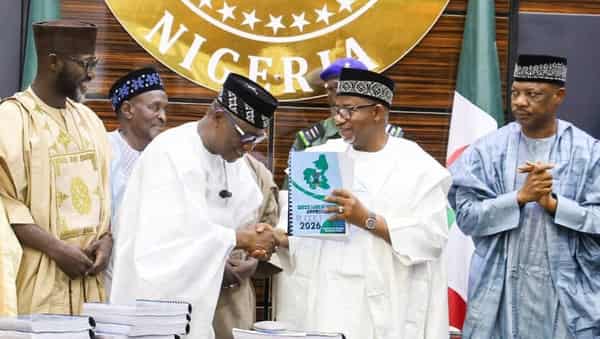
Bauchi State Governor, Bala Mohammed, on Wednesday approved the 2026 Appropriation Bill of N877 billion into law.
Mohammed had on November 27, 2025, presented a budget of N878.15 billion to the House, where it underwent thorough legislative scrutiny and a slight downward revision.
He commended the House for what he described as a robust, objective, and non-partisan review process, noting that the final budget approval reflected a prudent reduction of about N1.1 billion, achieved through modest adjustments in recurrent expenditure without affecting capital projections.
According to him, the process demonstrated fiscal discipline, institutional independence, and a shared commitment between the Executive and Legislature to protect public interest and prioritise service delivery.
The Governor expressed appreciation for the sustained cooperation between the two arms of government since 2019 and lauded the constructive role played by opposition lawmakers, praising them for placing governance above politics.
He noted that the 2026 Budget, themed the “Budget of Consolidation and Sustainability,” builds on the administration’s achievements over the past six years, including expanded access to social services, upgraded infrastructure, and reforms aimed at improving efficiency, accountability and the quality of life of citizens.
The Governor disclosed that about 79 percent of the 2025 Budget has been implemented, describing it as one of the highest performances nationwide.
He assured that the 2026 fiscal plan would sustain investments in infrastructure, education, healthcare, agriculture, commerce, security and social services, while maintaining balanced sectoral development.
He further described the 2026 Budget as the final full-cycle budget of his two-term administration, directing members of the State Executive Council and Ministries, Departments and Agencies to ensure its full, faithful and timely implementation.
The Speaker of the House, Hon. Abubakar Sulaiman, said the 2026 Appropriation Law was a product of an inclusive and transparent process involving budget defence sessions, stakeholder engagements and rigorous committee oversight.
He explained that the House reviewed revenue projections, recurrent and capital expenditures, and prioritised strategic sectors such as transportation, security, infrastructure, and social welfare.
He noted concerns over the realism of the Internally Generated Revenue projections, especially in view of anticipated federal tax reforms, which informed the downward revision of the budget size.
The Speaker also outlined key recommendations by the House to enhance budget implementation, including strict compliance with fiscal responsibility laws, capacity building for MDAs, sanctions against extra-budgetary spending, timely release of funds, and strengthened audit and procurement frameworks.