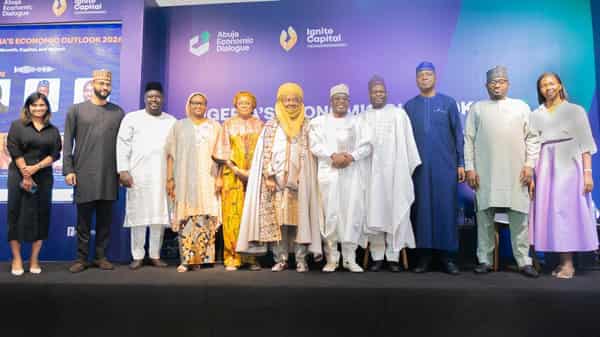
Former Vice President of Nigeria, Arc. Mohammed Namadi Sambo, on Wednesday, stated that Nigeria is at a critical economic crossroad and must swiftly translate the progress of ongoing macroeconomic reforms into tangible improvements for ordinary citizens.
He said the transition from 2025 to 2026 presents “no better time to reflect on Nigeria’s economic future,” stressing that the country is navigating global volatility while implementing some of the most sweeping domestic reforms seen in over a decade.
Sambo disclosed this in Abuja at the formal launch of the Ignite Nigeria Economic Outlook 2026 and commended President Bola Ahmed Tinubu for approving 10 additional mobile transmission substations, following Siemens’ recent briefing on completed transmission facilities.
He described the move as a critical intervention to strengthen Nigeria’s power infrastructure and boost investor confidence in the energy sector.
The high-profile launch, organised by Ignite Capital Ltd in collaboration with the Abuja Economic Dialogue, brought together policymakers, economists, development partners, private-sector leaders, and international institutions under the theme, “Navigating Growth, Capital and Reform.” The forum offered one of the most comprehensive assessments yet of Nigeria’s economic direction heading into 2026.
He warned that reforms must now “shift from announcements to implementation, monitoring and strategising,” insisting that Nigeria needs reform outcomes, not just policy headlines.
He said: “As we approach the end of 2025 and look toward 2026, there is no better time to reflect on Nigeria’s economic future than now. Nigeria’s economy is at a pivotal point, characterised by both significant challenges and considerable potential. Global volatility and domestic reforms are redefining our economic landscape.
“As a result, the Ignite Economic Outlook 2026 offers us a timely and strategic opportunity. It allows us to take stock of the ground that has been covered, articulate a clear pathway forward and confront the
realities that lie ahead.
“For this reason, I must commend Ignite Capital Limited, the Abuja Economic Dialogue team and partners for their steadfast commitment to elevating conversations that shape our nation’s economic future.
“Your dedication to rigorous analysis, constructive engagement, and credible convening power has created an important platform where policymakers, private-sector leaders, and development partners can collectively examine the forces steering our economy.
“The Ignite Economic Outlook 2026 identifies three likely pathways that could define Nigeria’s economic landscape in 2026. An upside scenario where we achieve a broadband recovery with GDP growth between 4.7 per cent and 5.1 per cent, a baseline scenario of cautious relief, and a downside scenario where slippages in policy or external shocks reverse recent gains.”
In his remarks, the former Senate President, Dr. Abubakar Bukola Saraki, said Nigerians must begin to feel the benefits of difficult reforms.
He said, “The question is not whether reform was necessary. The real test is whether subsidy removal, FX reforms and fiscal adjustments can translate into inclusive growth that improves daily life.
“The real test before us is whether Nigeria can translate the difficult choices we have already made into inclusive growth. Until Nigerians begin to see lower prices, dependable energy, better schools and hospitals, and dignified work, we are merely adjusting, not advancing.”
Saraki called for urgent expansion of labour-intensive sectors, agriculture, energy, transportation, digital technologies, and the creative industries, arguing that growth without jobs “is merely arithmetic.”
He stressed that the success of reforms should be judged not by policy design but by outcomes, jobs created, prices stabilised, incomes protected and opportunities expanded.
He warned that economic growth without job creation amounts to “arithmetic, not prosperity.” He cautioned that failing to expand labour-intensive sectors such as agriculture, manufacturing, energy and the creative industries would deepen inequality and social tension.
Earlier, the Convener of the Abuja Economic Dialogue and Chairman of Ignite Capital, Kyari Abba Bukar, said the Dialogue was designed to ensure that Nigeria’s economic decisions are shaped by data, evidence and continuous engagement between government and the private sector.
He said: “Abuja has increasingly become the centre of economic conversations and policy direction. Our monthly sessions will dissect specific economic themes and examine what they mean for businesses, government institutions and the wider economy.”
Bukar stressed that any competitive nation must place the private sector at the centre of economic development, noting that Nigeria’s past reliance on government-dominated economic activity has often stalled productivity and innovation.
He added that ongoing privatisation, market reforms and structural adjustments must be sustained to unlock the private sector’s full potential.
Also, President of Pedestal Africa, Dr. Paul Arinze, delivered the full technical presentation on the Outlook, detailing Nigeria’s economic performance in 2025 and modelling three possible scenarios for 2026.
The analysis highlighted key indicators including inflation trends, exchange rate stability, reserve accretion, governance reforms, sectoral performance and risks associated with global economic conditions.
Arinze said that Nigeria is transitioning from macroeconomic stabilisation to early signs of structural recovery, but warned that the pace of change will depend on consistency in reform implementation, improved power infrastructure, enhanced security in food-producing regions and stronger investor confidence.