
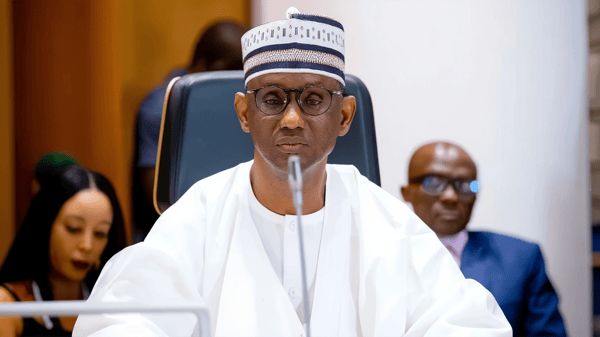
National Security Adviser (NSA), Nuhu Ribadu, has expressed optimism that the security challenges – terrorism, banditry, kidnapping, and other violent crime – Nigeria has been facing for almost three decades now will be overcome.
The NSA described those behind the “painful and unnecessary” challenges as “evil” and vowed they would be defeated.
Ribadu made remarks during the opening of a one-day dialogue organised by the National Peace Committee, in partnership with the delegation of the European Union to Nigeria and the U.S., on “A whole-of-Society Approach to the Prevention of Violence and Conflict in Northern Nigeria,” on Thursday in Abuja.
“This (security challenges) also shall pass. We are going through tough times. This will also go.
“But it’s very, very painful, what we are going through. It’s unnecessary. They are very unfair to us, those who are responsible for this. They are evil.
“But they will be defeated. It’s a matter of time, and peace will be restored. That one we can assure you. Because there are people who are working, not necessarily making noise.
“There are people who are making sacrifices. Every single day, we go to bury our own deaths. Painful as it is. But most people don’t talk. Sacrifice is ongoing,” the NSA said.
Ribadu warned that non-state actors and any individual seeking to exploit communities’ challenges, using terror to undermine national unity, will face decisive actions.
“Any individual or group seeking to exploit communities, exploit terror or undermine national unity will face decisive, coordinated and uncompromising actions.
“We are going to defeat evil. We are going to defeat terror. We have a strong order in our country. We will never give up. We will never surrender, we will not.”
He noted that the desired lasting peace cannot be achieved solely by government and security agencies, but requires the active engagement and commitment of communities.
He said traditional and religious leaders, civil society, youth groups, women’s organisations, the private sector, development partners, and international organisations must be involved, saying, “This is the essence of the whole-of-society approach.”
Ribadu said the Office of the National Security Advisor remains fully committed to the principles of President Bola Tinubu’s Renewed Hope Agenda, which emphasised inclusion, accountability, institutional strengthening, and opportunity creation.
“In line with this agenda, I have directed the National Counter-terrorism Centre to intensify the prevention and countering violent extremism programs across the country, ensuring that they are community-centred, intelligence-driven, and aligned with the national development priorities,” he said.
He said that, with the government’s efforts, tangible results were being recorded, with thousands of farmers returning to their farms and insurgents and violent actors voluntarily surrendering and accepting rehabilitation, deradicalisation, and reintegration programmes.
He said, “Communities that previously disrupted government interventions are now cooperating actively, providing information, supporting integration initiatives, and participating in early warning and resilience-building efforts.
“These shifts demonstrate the effectiveness of a whole-of-society approach when all sectors – government, communities, civil societies, the private sector, and international partners – work collaboratively and in good faith.”
He said so far in the justice and security space, terrorism-related prosecutions had yielded over 775 convictions, reinforcing the rule of law and sending a firm signal that violence and extremism would not be tolerated.
Ribadu said that as a result of terrorism and insecurity, many countries across the West African sub-region have lost their democracies.
According to him, Nigeria is the only Sahel country that is still standing as a democracy.
The NSA said the dialogue underscored the growing recognition of the critical importance of a whole-of-society approach to preventing violence and conflict in Nigeria.
He commended the organisers for the dialogue at “this critical period”, adding that it was gratifying to note that since its establishment in 2014, the committee has consistently championed peace with coexistence, strengthened democratic practices, and facilitated dialogue across communities in Nigeria.
“Your initiative is a clear demonstration that peace building is not the business of government alone, but of all stakeholders,” he said.



