• Umahi orders nationwide audit of strategic bridges
The Federal Government has intensified efforts to address long-standing structural and safety challenges on key transport infrastructure, with about N15 billion expected to be spent on the ongoing rehabilitation of the Iddo Bridge in Lagos.
The Minister of Works, David Umahi, disclosed this during an inspection tour of federal projects and bridges in Lagos, explaining that the Iddo Bridge is grappling with what he described as “heritage problems”.
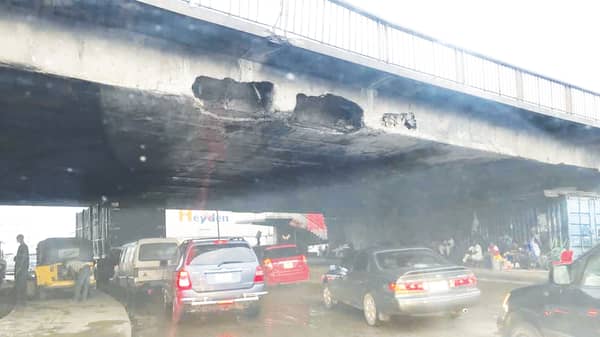
According to him, the problems include damage caused by a previous fire outbreak triggered by illegal occupants living beneath the bridge. He said the fire affected three spans on each of the two carriageways, bringing the total number of damaged spans to six.
Umahi said the current rehabilitation strategy involves strengthening one carriageway to temporarily accommodate all traffic, while the damaged spans on the other carriageway are removed.
“We have reinforced one of the carriageways so that traffic can be diverted totally to it. The three spans on the first carriageway will be removed completely by the end of April,” the minister said.
He explained that once the first phase is completed, traffic would be redirected to the rehabilitated section, allowing work to commence on the second carriageway. Umahi expressed optimism that all repair works on the bridge would be concluded by the end of June.
The minister also identified inadequate headroom as a major challenge on the bridge, noting that the current clearance of about 4.5 metres falls short of the minimum desired standard of 5.6 metres. He said the Federal Government is now targeting a uniform minimum headroom of 6.5 metres nationwide.
Umahi added that similar challenges are being encountered on other major routes, including the Lagos-Ibadan Expressway, where flyovers have damaged several bridge beams.
To address the Iddo Bridge challenge, he said the existing route beneath the bridge would be removed and deepened, with reinforced concrete used for reconstruction. Drainage systems, he added, are also being upgraded to channel water directly into the lagoon, reducing the risk of flooding and further structural deterioration.
Providing an update on progress, the minister said significant work had already been done on improving the headroom, while demolition of the first three spans on one carriageway was ongoing. A bypass route has also been constructed to ease traffic flow during the rehabilitation period.
While commending the contractor, Julius Berger, for its performance so far, Umahi issued a firm warning against delays.
He directed project engineers to closely monitor the contractor and report any infractions to ensure timely completion.
“Not more than June,” he stressed, adding that constant supervision and pressure were essential to meeting the revised timeline. Looking ahead, the minister revealed plans to deploy CCTV systems around the Iddo Bridge and other strategic locations after construction. The surveillance infrastructure, similar to what has been installed on the Third Mainland Bridge, will be used to monitor activities under and on top of bridges to enhance safety and security.
He also announced that all illegal occupants under bridges across the country would be removed, saying enforcement actions would commence in the coming days as part of measures to protect critical national infrastructure.
Speaking on the project, the Regional Manager of Julius Berger in Lagos, Thomas Christl, said work was being carried out in stages to minimise traffic disruption while ensuring safety and durability.
According to Christl, the two carriageways of the bridge are currently being separated to allow traffic diversion.
“As already announced previously, three spans of the existing Iddo Bridge are heavily damaged and need to be replaced. What we are doing at the moment is separating the two lanes, the two directions,” he said.
He disclosed that from next week, traffic would be shifted to one side of the bridge, allowing one half of the structure to be demolished and rebuilt.
“When this is done, by the end of March, most likely within that range, we will shift traffic to the newly constructed side, then demolish and rebuild the other half of the bridge,” Christl added.
Beyond replacing damaged spans, he said additional works were being undertaken to prevent future damage. These include increasing the clearance under the bridge to allow trucks to pass more easily and reduce collisions with the structure.
“As part of this process, we are constructing a new underpass. Drainage works have already started, and the outfall to the lagoon is completed. After the drainage works, we will remove soil and lower the road level to achieve higher clearance under the bridge,” he said.
Christl noted that repeated truck impacts were a major cause of damage to the existing bridge, adding that the redesigned clearance would significantly reduce such incidents.
Meanwhile, Umahi has assured commuters using major bridges in Lagos, including Carter Bridge, Iddo Bridge and the Third Mainland Bridge, that there is no immediate danger despite ongoing structural concerns. He said rehabilitation works had been carried out to sustain the structures while government experts closely monitored their condition.
“We have done rehabilitation to sustain the bridge, and the new bridge is going to last three years. We are studying the progressive deterioration of the structural elements,” he said.
Umahi added that while the government might be forced to totally close any bridge if safety conditions deteriorate beyond acceptable limits, commuters are currently not at risk.
“If we get to a point where we have to totally close the bridge, we will do that. But no danger is going to occur to commuters using the bridge for now,” he said.
He disclosed that heavy trucks have been restricted from using the bridges as part of safety measures and directed the immediate constitution of a multi-disciplinary committee to study all bridges in Lagos and other strategic locations nationwide.
“A stitch in time saves nine. Within the next ten days, I want to see the committees so that I will make funds available to support their work,” he stated.
The minister identified illegal sand mining, lack of maintenance and age-related wear as major causes of bridge deformation, noting that most bridges are designed to last about 50 years but many in Nigeria have exceeded 75 years with little or no maintenance.
Also at the ongoing Ikoti Road project in Ikorodu, Umahi issued fresh construction directives, expressing deep dissatisfaction with the pace and approach of work on the road.
Umahi acknowledged that the road, which is about eight metres wide, presents construction challenges but stressed that the subgrade remains sound. He directed that contractors should immediately adopt a night-work strategy to ensure seamless traffic flow while construction progresses.
According to the minister, sections of the road are to be excavated at night and promptly refilled with a mixture of lumps, stone base and cement to create a concrete-like surface that allows uninterrupted vehicular movement. He explained that work would then proceed section by section.