 Follow Us on Google News
 Follow Us on Google Discover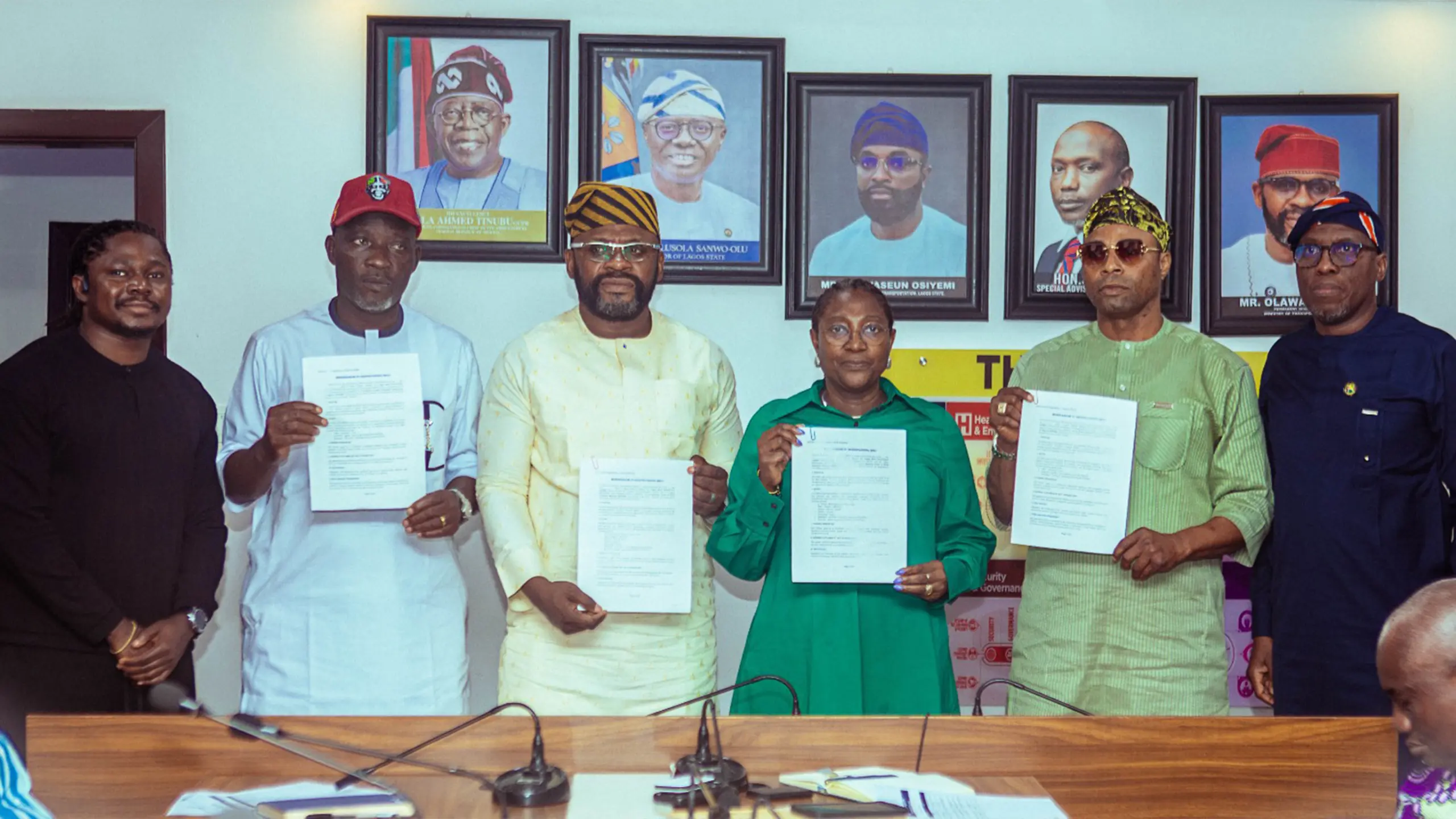
For decades, the familiar yellow danfo buses have been the heartbeat of Lagos, ferrying millions of commuters through the city’s bustling streets.
Now, a landmark agreement between the state’s two largest transport unions is set to usher in a new era for public transportation.
The Nigeria Union of Road Transport Workers (NURTW) and the Road Transport Employers Association of Nigeria (RTEAN) yesterday signed a historic Memorandum of Understanding (MoU) to participate in the Lagos State Bus Industry Transition Programme (BITP), a major reform designed to modernise the state’s bus transport system while bringing informal operators into a regulated and more efficient network.
Describing the agreement as “a new beginning for public transport in Lagos,” the Permanent Secretary, Lagos State Ministry of Transportation, Olawale Musa, said the partnership reflects the shared commitment of the state government and transport stakeholders to building a safer, more reliable and sustainable transport system.
Implemented by the Lagos Metropolitan Area Transport Authority (LAMATA), the BITP seeks to integrate commercial bus operators, including the iconic danfo buses, into a structured public transport network.
The programme aims to improve commuter safety, service quality and operational efficiency while creating a more attractive environment for investment in the sector.

The agreement was signed by Lagos State Chairman of RTEAN, Samson Ajala Adepeju, and the association’s Secretary, Bolaji Kawojue, alongside NURTW Chairman, Mustapha Adekunle Sego, and Secretary, Usman O. Teslim. Representing the Lagos State Government were the Permanent Secretary, Olawale Musa, and LAMATA Managing Director, Abimbola Akinajo.
The MoU provides the framework for implementing the transition programme across Lagos’ eight Quality Bus Corridors (QBCs) and will guide the granting of bus operating franchises under the new system. Under the arrangement, transport unions will be reorganised into cooperative societies to help members transition into franchise operators, while fare collection will move to a fully digital payment system. LAMATA will retain regulatory oversight of all routes.
Four Quality Bus Corridors are currently under development to kick-start the integrated system: Iju-Ishaga–Abule Egba, Ketu–Alapere–Akanimodo, Iyana-Iba–Igando–Iyana-Ipaja, and Ojuelegba–Lawanson–Cele.
Speaking at the signing ceremony, LAMATA Managing Director, Abimbola Akinajo, said the agreement was the culmination of more than 30 months of dialogue and collaboration between the government and transport unions. She expressed confidence that the initiative could become a global model for cities seeking to modernise public transportation without excluding existing operators.
“This will become a baseline for other cities because it will be a verifiable example of a handshake between government and the unions,” she said.
Akinajo stressed that the formalisation of the transport sector should not be seen as an attempt to sideline transport workers.
“Formalisation should not be construed as strangulation. When we collaborate, the result will be formidable and capable of being replicated across other parts of Nigeria and in cities around the world that are seeking to formalise their public transport operations,” she said.
For millions of Lagos commuters, the agreement offers hope that daily journeys could soon become safer, more organised and more predictable, while preserving the livelihoods of thousands of transport operators who have long kept the city moving.
The MoU marks another significant step in Lagos State’s drive to build a modern, inclusive and sustainable public transport system.

