 Follow Us on Google News
 Follow Us on Google Discover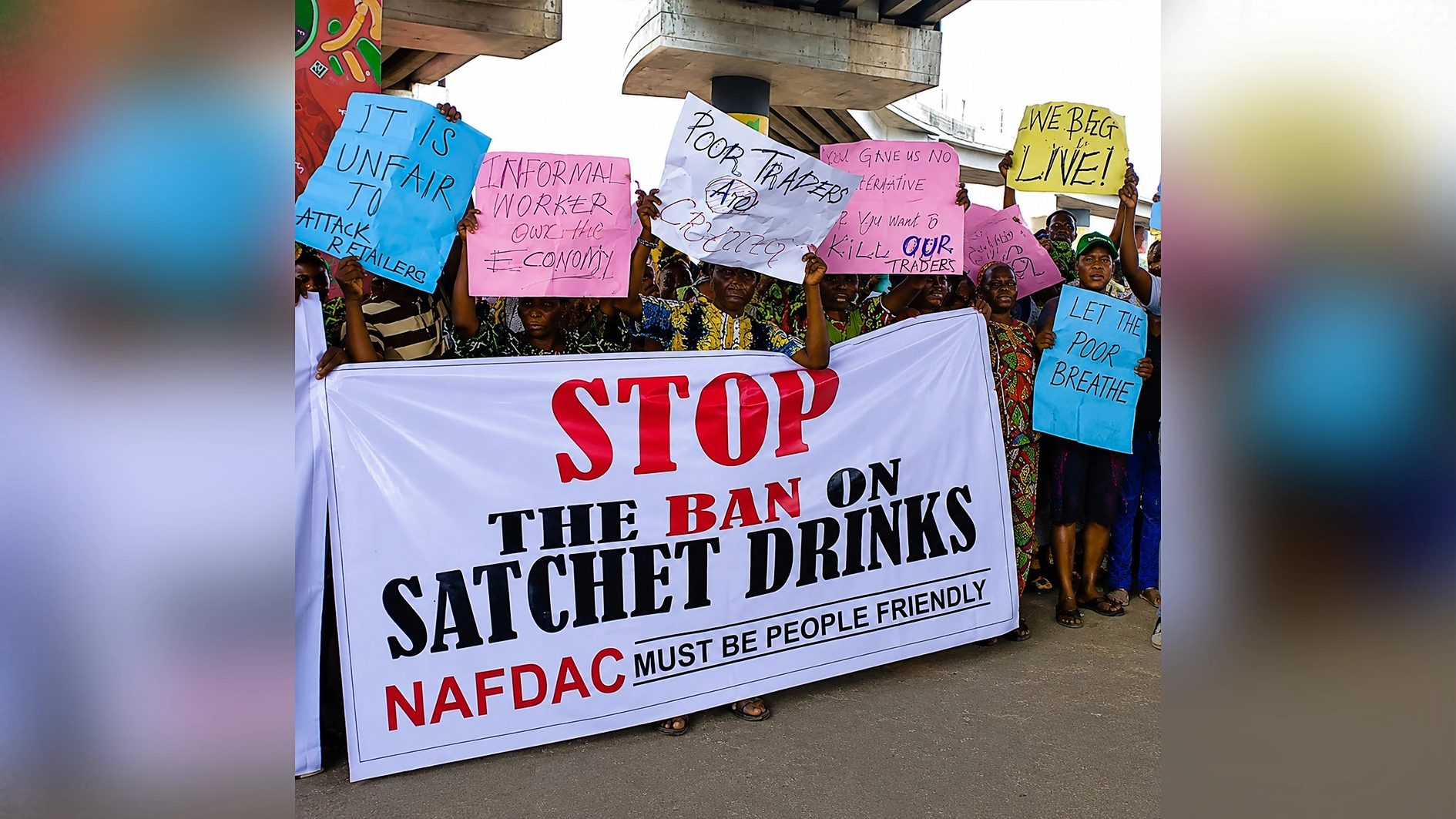
For many petty traders in Lagos, the ban on sachet and small-sized plastic-bottled alcoholic beverages has become more than a regulatory policy – it has become a threat to their livelihoods and ability to feed their families.
Members of the Lagos State chapter of Concerned Drink Sellers and Traders Across Nigeria are appealing to the Federal Government and the National Agency for Food and Drug Administration and Control (NAFDAC) to suspend the enforcement of the ban on alcoholic drinks packaged in sachets and plastic bottles below 200ml.
The traders, who recently marched through the streets of Lagos to protest the enforcement, said the policy had left many of them struggling with mounting debts, loss of income and uncertainty about how to survive the worsening economic situation.
Their concerns followed NAFDAC’s directive that manufacturers of alcoholic beverages packaged in sachets and plastic bottles below 200ml should recall and destroy the affected products.
Chairman of the Lagos State chapter of the association, Ogbeni Adebayo, said the enforcement had worsened the financial difficulties of many retailers who depended on the sale of the products for their daily income.
He alleged that enforcement officers often carried out aggressive operations, confiscating goods belonging to petty traders and leaving them in desperate circumstances.
“On many occasions, the enforcers go on aggressive operations, confiscating goods and putting these petty traders in a state of hopelessness.
Over 90 per cent of the retailers you see here today are on bank loans that they have no idea how to pay back,” Adebayo said.
He appealed to President Bola Tinubu and NAFDAC to consider the plight of the traders, stressing that many had invested borrowed money in their businesses.
“Where does the government want them to run to now? We are calling on President Tinubu and NAFDAC to help us,” he said.
For some of the protesters, the issue goes beyond the sale of alcoholic beverages. They said their livelihoods and the welfare of their families were at stake.
A retailer, Imeh Iyang, who participated in the protest, said he and his wife had relied on the business as their legitimate means of livelihood.
“My wife and I sell sachet alcoholic beverages as legal retailers. That’s our legitimate means of livelihood. Most of the women gathered here today do the same business to cater for their families. Many of them are single mothers and widows. How does the government want them to survive this harsh economy?” he asked.
Another retailer, Lola Omololu, said she had depended on the petty trade to care for her children since the death of her husband.
“Since I lost my husband, this petty trade has been my only means of paying bills and feeding my children. I can’t go into prostitution or do anything against the law to feed my children. The government should help us,” she said.
Temitayo Shodeke also described the enforcement as particularly difficult at a time when many families were already struggling with rising living costs.
“In this harsh economy, the government’s decision, in addition to NAFDAC’s enforcement, is brutal, to say the least. Is selling sachet alcoholic beverages a crime?” she asked.
Shodeke appealed to the authorities to reconsider the impact of the policy on small-scale retailers and provide them with alternatives before enforcing measures that could deprive them of their means of survival.
“Do they want people to commit crimes before taking care of their basic needs, or to fold their arms in idleness and die of extreme hunger?” she said.
The protesters urged the Federal Government to engage with retailers and other stakeholders before taking further steps to enforce the ban, saying a balance should be found between public health concerns and the economic survival of thousands of small business owners.
Photo and Caption: Protesters


