 Follow Us on Google News
 Follow Us on Google Discover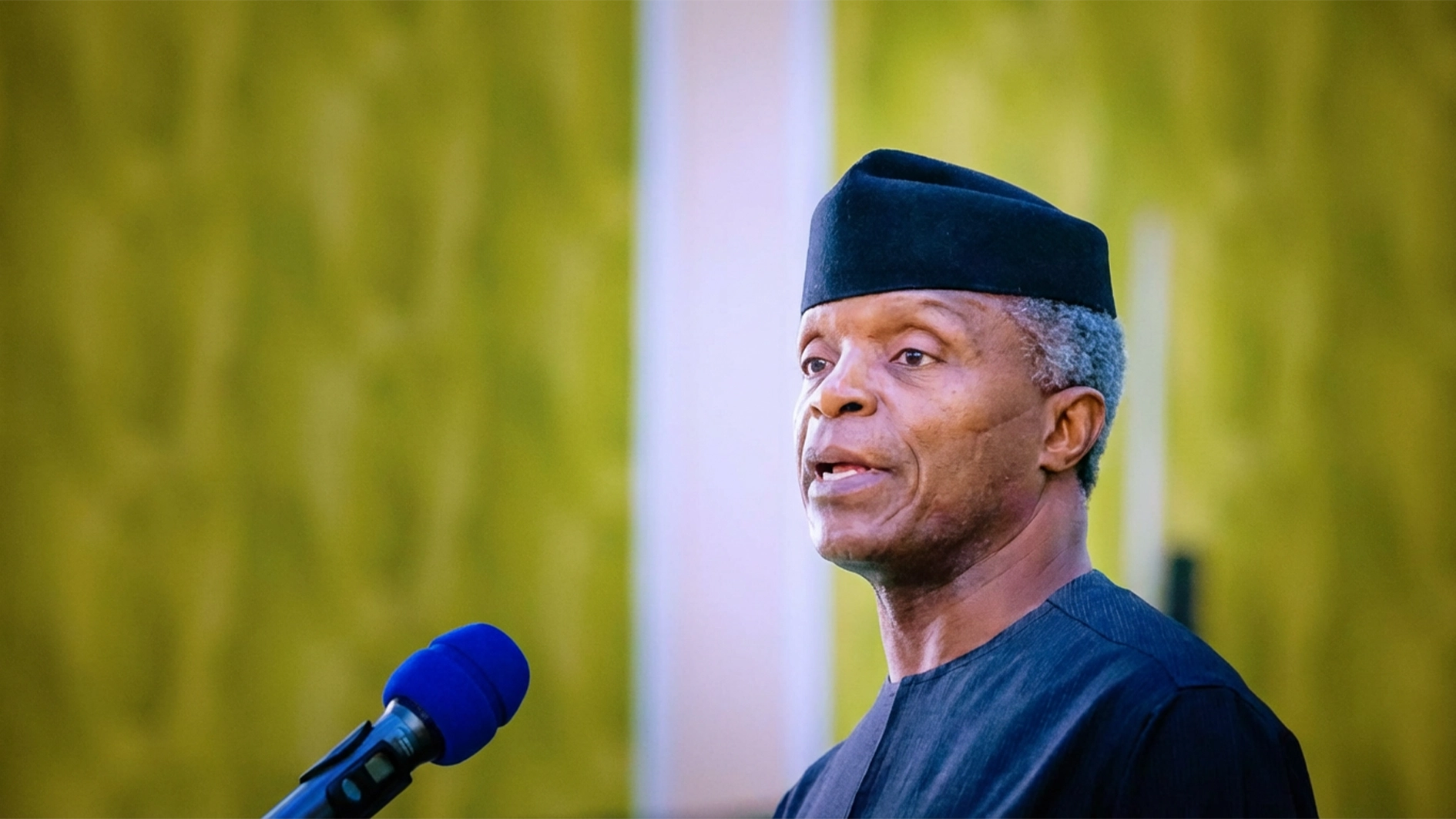
The enduring legacy of a man, who not only spoke truth to authorities in power, but also fought successive governments, resonated at the Anthony Cardinal Okogie Foundation (ACOF) 2026 Yearly Lecture.
The guest speaker, former Vice President Yemi Osinbajo described the celebrant as one of the country’s revered advocates of social justice, rule of law and good governance.
Themed, ‘Rule of Law in Nigeria: The Challenges of Leadership Compliance,’ the lecture was organised by the Lagos Archdiocese Catholic Men Organisation of Nigeria (LACMON) at Our Lady of Perpetual Help Hall in Victoria Island, Lagos.
Osinbajo recalled how Okogie, as the Archbishop of Lagos, took the Lagos State government to court over the return of missionary schools to their owners.
According to the guest speaker, the 1999 Constitution was brand new and largely untested and the military had just handed over power to the democratic elected civilian government.
He noted that the Court of Appeal ruled in favour of Okogie based on the important premise that the right to own and operate private schools was protected by the fundamental rights of freedom of expression guaranteed by Chapter 4 of the Constitution and the fact that freedom of expression included ownership of mediums for receiving and impacting ideas. The court held that a school is also a medium for receiving and impacting ideas.

“So, Olubunmi Okogie and the Lagos State government became one of the earliest cases establishing the fundamental rights of citizens of Nigeria in the new democratic dispensation after 30 years of military rule,” Osinbajo said.
He added that Okogie, while pursuing his course, developed a sustained unmistakable public voice on constitutionalism, education, good governance, human dignity and above all, the protection of ordinary citizens.
Osinbajo also recounted the role Okogie played when he was the President of Catholic Bishops’ Conference of Nigeria (CBCN) and Christian Association of Nigeria (CAN). He said the celebrant’s public interventions were marked by consistent and fearless resistance to oppression, injustice and abuse of power regardless of who held office.
At the heart of that advocacy, according to Osinbajo, was a remarkably simple proposition that government exists for people, political authority is not an end in itself but a trust and those who exercise it must be accountable to the welfare and dignity of rights of people over whom they govern.
“Cardinal Okogie spoke that truth to power with admirable forthrightness. Indeed, I greatly enjoyed his famous giants at successive governments until in November 2015 when he turned his attention to our own government,” Osinbajo said.
The former vice president, however, acknowledged that Okogie’s voice was never intended to confront government but to remind those in authority of their responsibilities over those they govern.
On the theme of the lecture, Osinbajo said he agreed with the organisers.
“Yes, indeed, government must obey the orders of the court but the question of justice in our society goes beyond whether government obeys,” he said.
The Chairman, Board of Trustees, ACOF, Sir Peter Amangbo, in his welcome address, said the gathering was not only to celebrate the enduring legacy of Okogie, but also to renew the collective commitment, educational development and social welfare he promoted.
He noted that for decades, Okogie stood as a beacon of truth, selflessness, moral clarity in the nation and consistently demonstrated that faith without good works is dead.
He said ACOF was birthed out of the conviction to ensure that the celebrant’s passion for lifting the poor, educating the underprivileged and giving a voice to the voiceless continues to flourish for generations to come.
“Through the foundation’s scholarship schemes, we have witnessed firsthand how targeted philanthropy can rewrite the destinies of hundreds of deserving young men and women who otherwise would have been left behind,” Amangbo said.
Archbishop of Lagos, His Grace, Most Rev’d Alfred Adewale Martins, explained that rule of law is fundamental to the building of a just, peaceful and democratic society, adding that everyone including those entrusted with leadership must be subject to the law.
He said no political position, wealth, influence or social status should place anyone above the law, emphasising that the greatest challenge to the rule of law occurs when leaders demand obedience from citizens but do not submit themselves to the same law.
“Leadership compliance means that those who govern must also obey. Public office is a trust, not a personal possession. Leaders must respect the Constitution, court decisions, fundamental human rights and the legitimate institutions of democracy,” Martins said.
In his remarks, Okogie said the peace and survival of any nation, including Nigeria, rests on the theme of the lecture.
He decried the reluctance of those in power to submit themselves in humility to the supremacy of the law, love and justice.
According to him, a society cannot stand when governance becomes an exercise in executive convenience, rather than a moral commitment to justice.
He stated that leadership must be brought back under the law, so that legal authority may once again serve as a shield for the vulnerable, and not as a tool for the powerful.
Okogie said: “The true measure of a leader lies not in how effectively they enforce the law upon the governed, but in how humbly they submit their power to its supremacy.
“The deepest challenge of leadership compliance arises when those in high offices treat the law merely as an instrument of authority, a set of decrees to wield, rather than a sacred commitment that binds their own actions.”
He added that when leaders reduce the law to mere institutional force, detached from moral conscience, governance collapses into what jurists call, “statutory lawlessness.”
The Archbishop Emeritus, who was represented by his Secretary, Rev’d Fr. Theophilus Inegbeneboh, equally observed that individuals with active cases in court bothering on corruption and misappropriation of public funds are shamelessly running for public offices and those to enforce the law seem to be blind to these occurrences.
Okogie called on Nigerians, especially those in the corridors of power, to examine the outcry of Nigerians and relationship to the laws of the land.

