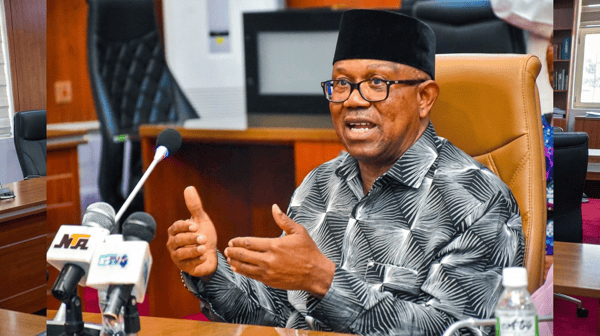
The Presidential candidate of the Labour Party (LP) in the 2023 elections in Nigeria, Peter Obi, has called on the European Union to pay greater attention to Africa, emphasising that Nigeria’s development is key to unlocking the continent’s economic potential.
Speaking at a session with Members of the European Parliament, Obi said that much of the Western world lacks understanding of Nigeria and Africa, leading to decisions that rarely consider the continent’s realities.
“Africa today is the last frontier of global development,” Obi said. “It is the second-largest continent by size and population, rich in natural resources and young talent. Yet it remains a continent of mass poverty.”
Obi cited Nigeria’s demographics and economic potential, noting that its population of roughly 240 million is over half of the European Union’s population of 450 million. While Europe’s per capita income exceeds $40,000, Nigeria’s per capita income is just 2.5 per cent of that figure.
“The potential for growth is enormous,” he said. “If Africa prospers, Europe benefits. If Africa collapses, the consequences will be felt globally. Nigeria must lead this transformation.”
Obi highlighted the continent’s challenges, including corruption, inadequate leadership, and social inequality, which he said drive insecurity and criminal activity. “Mass poverty and a lack of education create fertile ground for crime,” he noted.
He stressed that Nigeria’s development would create significant opportunities for Europe, citing the country as Africa’s most populous nation, with abundant resources and a vast market. “To develop Africa, which will benefit you, you must start with Nigeria,” Obi said.
The former presidential candidate concluded by urging continued dialogue and partnership between Africa and Europe. “I am here to start a conversation and invite collaboration to turn around Nigeria and, by extension, Africa,” he said.
In other news, Obi stated that Nigeria’s low life expectancy is a direct consequence of leadership failures, arguing that governance shortcomings are responsible for the country’s declining health sector.
Speaking at the 2025 Leadership Forum Conference at the University of Nigeria, Enugu Campus, Obi said Nigeria’s average life expectancy, currently placed at about 55 years by recent global estimates, reflects systemic neglect of healthcare, education and human capital development.
According to him, the country’s performance in health and welfare remains the weakest among nations with similar resources.
“Our low life expectancy is not because Nigerians are naturally predisposed to early death. It is because we have not built the systems that keep people alive,” he said.
Obi said life expectancy data should prompt urgent reforms, noting that countries with comparable demographic pressures, including India and Indonesia, have recorded steady improvements by investing in basic healthcare and education.
He said Nigeria had the potential to outperform many emerging economies but had failed due to repeated policy reversals and weak institutions.