
 Get Guardian on Google
…Says Moscow Promises stronger ties with Nigeria
Russian government has described the third Russia-Africa Summit as a breakthrough for multipolar cooperation, announcing that over 3,500 participants from 48 African countries attended and that about 150 agreements were signed to expand trade, security, food and education ties.
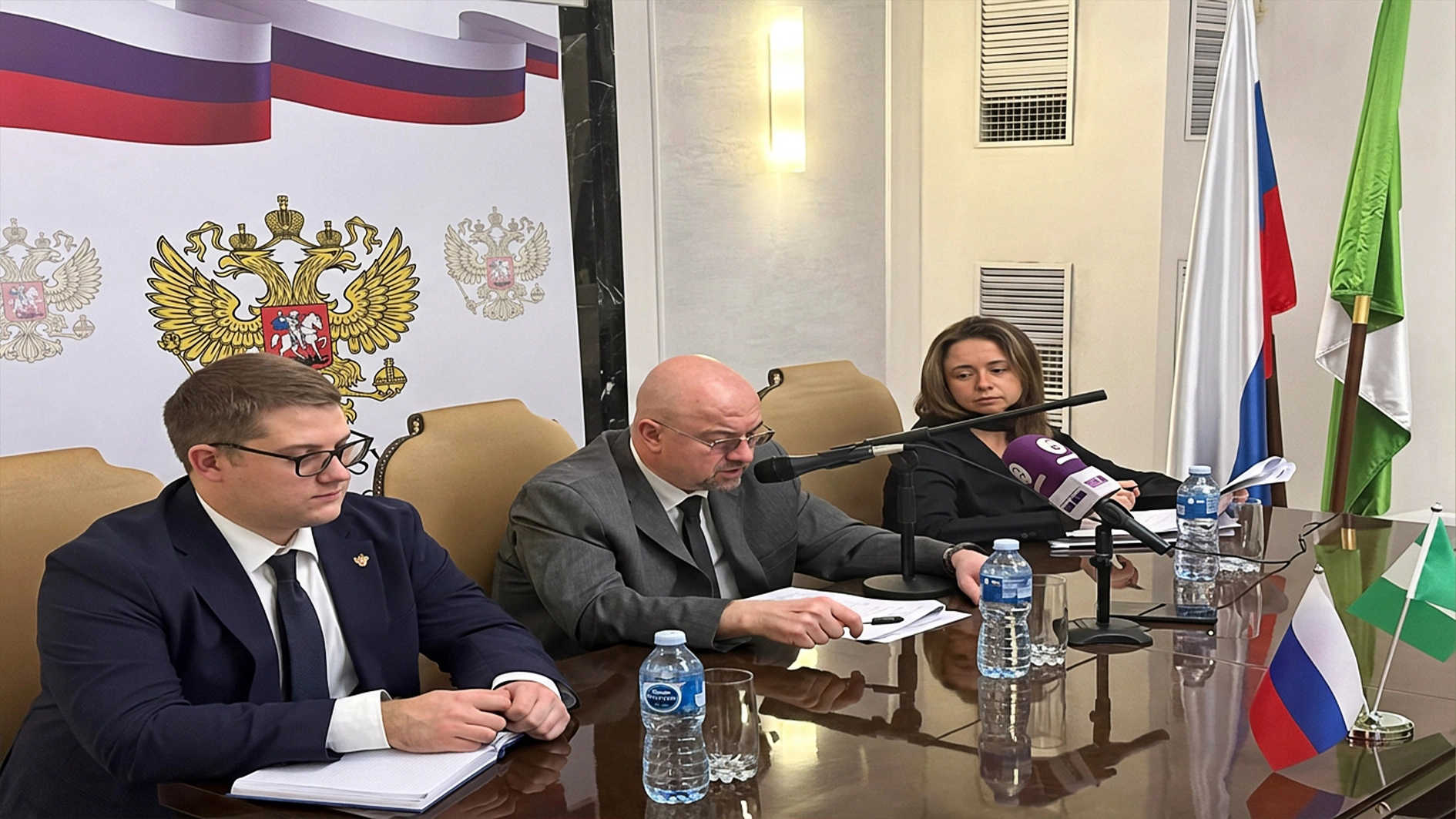
Speaking at a press briefing in Abuja on the fallout of the summit and the forthcoming 66th anniversary of Russia-Nigeria diplomatic relations, the Chargé d’Affaires of the Russian Embassy in Nigeria, Mr Igor Ivannikov, said the success of the summit reflected “the mutual interest of Russia and African states in developing their cooperation.”
The envoy said the summit adopted a Final Declaration on cooperation in Artificial Intelligence, and the Action Plan of the Russia-Africa Partnership Forum for 2027-2029, which will guide the partnership for the next three years.
According to him, political discussions focused on a multipolar world, the sovereignty of African nations, consistent advocacy for broader African representation on the United Nations Security Council and supporting African solutions to African crises.
Speaking on trade, Ivannikov announced that trade between Russia and Africa has grown “from around $18 billion in 2022 to over $27 billion in 2025, an increase of 50 per cent, and that President Vladimir Putin has identified $50 billion as a further target.”
On food security, the envoy said that in 2025, Russia supplied over 18 million tonnes of grain to Africa, followed by another 13 million tonnes in the first nine months of 2026, and that Moscow remains one of the world’s leading suppliers of food and fertiliser, exporting its products to 160 countries.
He accused Western countries of focusing on Ukrainian grain exports through the Black Sea, much of which “has gone to wealthier Western countries rather than those most in need” while the 2022-2023 Black Sea Grain Initiative failed because commitments to remove obstacles to Russian exports were never fulfilled.”
Ivannikov also informed that Nigeria is included in the list of developing countries whose eligible products may enter the Eurasian Economic Union market at 75 per cent of the standard customs duty, equivalent to a 25 per cent reduction as a way to encourage African producers.
He further revealed that about 40,000 African students are currently studying at Russian universities while more than 300,000 have graduated over the years with quotas rising from 4,800 places in 2025 to 5,500 for the 2026/27 academic year.
Speaking on Nigeria specifically, he said that Nigerian delegation to the summit headed by Minister of State for Foreign Affairs, Amb. S. Enikanolaiye, numbered approximately 250 participants, commending the Nigeria for its participation, while regretting that Vice President Kashim Shettima was unable to lead the delegation as originally planned, despite the extended invitation.
According to him, several documents were signed, including that on cooperation and mutual assistance in customs matters, covering information exchange, combating customs offences and training.
“There was also an agreement between the Roscongress Foundation and Abia State on youth, education and entrepreneurship.”
Speaking on bilateral trade, he admitted that the scale of trade, economic and investment cooperation still falls short of both countries’ potential, noting that in 2025, bilateral trade was between $1.2 and 1.4 billion, concentrated in petroleum products, grain and fertilisers.
On education and security, Ivannikov noted that in the 2025/26 academic year, 2,481 Nigerian students were enrolled at Russian universities, with 220 annual quotas for Nigerians while military cooperation remains important, including training and the recent visit of the Baltic Fleet training ship, Perekop to Lagos for joint manoeuvres with the Nigerian Navy.
On the 66th anniversary, the envoy recalled that on November 25, 1960, Moscow laid the foundations of partnership with a country that had gained independence only weeks earlier, and said the Soviet Union supported Nigeria’s Federal Government “during a period of serious internal challenges, when the country’s territorial integrity was under threat.”
The envoy however rejected allegations of Russian use of chemical weapons in Ukraine, stressing that Russia completed destruction of its stockpile in 2017 under OPCW supervision, and accused Ukraine of activities in the Sahel, warning that “representatives of terrorist groups should not be given platforms in international media to publicly justify their actions.”