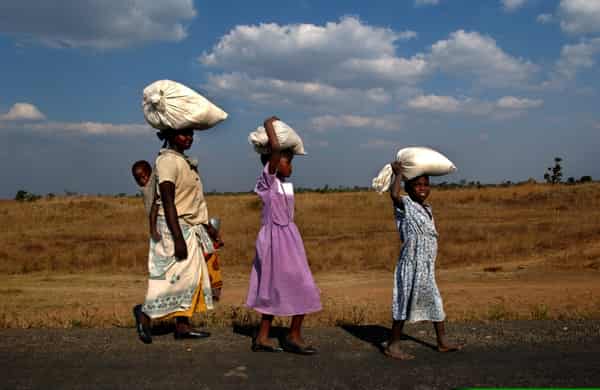
On 29 June, a woman, carrying a baby on her back and holding the hand of a small child, and two older girls carry sacks of maize home from a small farm where they work in exchange for food, in the village of Chipumi. Because of droughts and flooding during the past year, many Malawians were unable to buy seeds to grow their own food crops.
In June 2002, deepening malnutrition caused by a growing food shortage threatens 3.2 million people in Malawi -- 500,000 of which are already affected by the crisis. Almost half of the country's 10.6 million inhabitants are children under 15. The food crisis is part of a region-wide shortage affecting several countries in southern Africa, the result of a combination of harsh climatic conditions (droughts and flooding), poor management of food reserves and political and economic instability. An estimated 12.8 million people in the region, including 2.3 million children under five, will need food assistance through March 2003. In Malawi, as in several other affected countries, widespread poverty and the increasing economic and social disruption caused by a devastating HIV/AIDS crisis are additional factors disrupting agriculture and the ability of social services to respond. UNICEF is joining the soon-to-be-released United Nations Inter-Agency Appeal for southern Africa, of which an estimated US $3.5 million is for UNICEF nutrition, health, water and sanitation and education/protection interventions in Malawi. Support already initiated includes supplementary and therapeutic feeding assistance for pregnant or lactating women and malnourished children under five -- including 8,000 chronically or severely malnourished children to be reached through 20 centres located country-wide.
The United Nations (UN), World Health Organisation (WHO) and World Trade Organisation (WTO) yesterday alerted of global food shortage if the coronavirus pandemic is not properly managed.
A joint statement issued by Head of UN’s Food and Agriculture Organisation (FAO), Qu Dongyu, Director-General of WHO, Tedros Adhanom Ghebreyesus and Director of WTO, Roberto Azevedo, stressed that all hands should be on deck to checkmate the looming food crisis.
They maintained that in the midst of the COVID-19 induced lockdowns, concerted effort must be made to ensure that trade flows as freely as possible, especially to prevent food shortage.
They stressed that it was time to show solidarity, act responsibly and adhere to common goals of enhancing food security, food safety and nutrition and improving the general welfare of people globally, adding that responses to COVID-19 do not create unwarranted shortages of essential items and exacerbate hunger and malnutrition.
Insisting that millions of people depend on international trade globally for their food security and livelihoods, they added, “As countries move to enact measures aimed at halting the acceleration of COVID-19 pandemic, care must be taken to minimise potential impacts on the food supply or unintended consequences on global trade and food security.”
The groups maintained that when acting to protect the health and well-being of citizens, countries should ensure that any trade-related measures do not disrupt the food supply chain.