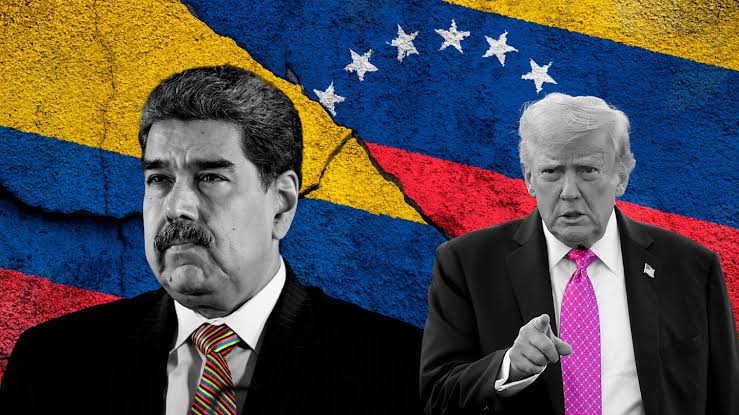
US President Donald Trump has said the United States will “run” Venezuela and exploit its vast oil reserves following a surprise military operation that seized President Nicolas Maduro and removed him from the country.
Trump spoke on Saturday, hours after US special forces captured Maduro and his wife during an overnight assault on Caracas that involved heavy airstrikes on military and strategic sites across the capital.
“We’re going to be running it with a group,” Trump told reporters in Florida. “We’re designating people,” he added, indicating that senior members of his cabinet would oversee the process.
In a further escalation, Trump said the United States was prepared to deploy ground troops in Venezuela. The US was “not afraid of boots on the ground,” he said.
Although the administration has framed the operation as a law-enforcement action, Trump made clear that regime change and access to Venezuela’s oil wealth were central objectives.
“We’re going to have our very large United States oil companies, the biggest anywhere in the world, go in, spend billions of dollars, fix the badly broken infrastructure,” he said. “We’ll be selling large amounts of oil.”
The 79-year-old Republican later posted an image of Maduro in custody aboard a US naval vessel, blindfolded and handcuffed, wearing what appeared to be noise-cancelling earmuffs. Maduro and his wife are being transferred to New York to face narcotics and terrorism charges.
Opposition sidelined
The US-backed opposition figure Maria Corina Machado, who won the Nobel Peace Prize last year, hailed the operation, saying on social media that “the hour of freedom has arrived”.
She called for Edmundo González Urrutia, the opposition candidate in the disputed 2024 election, to “immediately” assume the presidency.
However, Trump dismissed suggestions that Machado should lead a post-Maduro transition. She did not have “support or respect” in Venezuela, he said.
Instead, Trump suggested he could work with Maduro’s deputy, Delcy Rodríguez, saying “she’s essentially willing to do what we think is necessary to make Venezuela great again”.
He also signalled that the US presence in Venezuela would not be brief. “We’re there now, but we’re going to stay until such time as the proper transition can take place,” he said.
International reaction
The operation drew swift international criticism. The United Nations secretary-general said he was “deeply concerned that the rules of international law have not been respected”.
China, a longstanding ally of Maduro’s leftist government, said it “strongly condemns” the US attack, while France warned that a solution to Venezuela’s crisis could not “be imposed from outside”.
Overnight strikes and blackout
US forces had been massing off Venezuela’s coast for months, including the aircraft carrier USS Gerald R. Ford. Residents of Caracas were jolted awake around 2:00 am local time by explosions and the sound of military helicopters, as airstrikes hit a major military base, an airbase and other targets for nearly an hour, AFP journalists reported.
Trump said the operation began with a partial nationwide blackout caused by US “expertise”.
The Chairman of the US Joint Chiefs of Staff, General Dan Caine, said about 150 aircraft were involved, supporting troops who flew in by helicopter to seize Maduro. He said the mission followed months of intelligence gathering on the president’s movements and routines.
Maduro, 63, and his wife “gave up” without resistance and there was “no loss of US life”, Caine said.
Maria Eugenia Escobar, a 58-year-old resident of La Guaira near the heavily bombed main airport, said the blasts “lifted me out of bed, and I immediately thought, ‘God, the day has come.’”
Within hours, large parts of Caracas were quiet, with police deployed around public buildings and smoke lingering in the air.
Shifting justifications
The United States and several European governments have long refused to recognise Maduro’s legitimacy, accusing him of rigging elections in 2018 and 2024. Maduro, who has ruled since 2013 after succeeding Hugo Chávez, repeatedly accused Trump of seeking regime change to gain control of Venezuela’s oil reserves.
Trump defended the operation by claiming Venezuela was responsible for mass drug-related deaths in the United States. However, he has offered varying justifications for his policy towards Caracas, citing illegal migration, narcotics trafficking and energy interests at different times.
While several members of Congress questioned the legality of the operation, Trump’s key ally, Republican House Speaker Mike Johnson, described it as “decisive and justified”.