 Follow Us on Google News


 Follow Us on Google Discover
Hello there, and welcome. Pour yourself a cold Chapman and settle in, because you have asked me a question I have been chewing on for the better part of my working life. This piece is the product of months of fresh research, dozens of conversations with friends who have packed up and moved across the country, and years of writing about how Nigerians actually live rather than how brochures say we should.
Let me be honest with you from the very first breath. There is no single, tidy answer to where is the best place to live in Nigeria, because “best” bends to whatever you happen to be chasing. For a fintech engineer hunting a big salary, the answer looks like Lagos. For a young family craving calm, planned roads and clean air, it looks a great deal like Abuja, the shining capital tucked among our 36 states and the Federal Capital Territory.
So rather than crown one winner and send you off, I want to walk you through the whole picture. City life, earning power, safety, and that ever pressing question of what your rent will do to your bank balance. By the end, you will know exactly which corner of this glorious, maddening, beautiful country suits your particular dream.
Ready? Let us begin where most people begin: the bright lights of the big city.
Which City is Best to Live in Nigeria?
Ask ten Nigerians which city is best to live in and you will get eleven opinions, at least three of which will end in a heated argument about jollof. Still, patterns emerge, and they are worth respecting.
Lagos remains the undisputed heavyweight. It is loud, fast, occasionally exhausting, and utterly irreplaceable if you want to be where the money and the movement are. The metropolitan area now holds somewhere around 15 million people, and that scale is precisely the point, because opportunity clusters where people cluster. More than half of Nigerians now live in cities, a share the National Population Commission expects to keep climbing for decades yet.

Then there is Abuja, which feels rather like Lagos’s calmer, better organised younger sibling. The roads are wide, the estates are planned, and the whole place breathes in a way Lagos simply cannot. If your idea of a good life involves getting home without spending three hours in traffic, Abuja will woo you quickly.
Ibadan deserves far more love than it gets. It is enormous, affordable, steeped in Yoruba history, and only a couple of hours from Lagos when you fancy the chaos. Many young professionals now live in Ibadan and commute or work remotely, keeping Lagos salaries whilst paying Ibadan rent (a lovely trick if you can manage it).
Port Harcourt offers the oil-and-gas money of the South South, Enugu charms with its coal-city calm and cracking food, and Uyo quietly tops list after list for cleanliness and gentle living. Kano, the commercial giant of the north, anchors an entire regional economy on trade that predates most of our modern cities.
Here is the thing though. A city is only “best” once you know what you are optimising for. So let us get specific, starting with the topic that keeps most of us awake at night.
Which State in Nigeria is the Best to Make Money?
If your primary goal is to build wealth, the data settles this argument with unusual clarity. Lagos is the place.
The National Bureau of Statistics, in its Internally Generated Revenue report, found that Nigeria’s 36 states and the FCT collectively raised ₦3.63 trillion in 2024, a striking 49.7 per cent jump on the previous year. Lagos alone accounted for ₦1.26 trillion of that, which is more than the next twenty five states combined. You can read the full breakdown on the National Bureau of Statistics portal, and it makes for genuinely eye opening reading.
Why does this matter to you as a resident rather than a tax collector? Because state revenue is a rough proxy for economic gravity. Where money is generated, jobs, contracts, clients and salaries tend to follow.
Rivers State came second with ₦317.3 billion, powered by oil, gas and the busy commercial life of Port Harcourt. The FCT followed closely at ₦282.36 billion, buoyed by government spending and a growing service economy. Ogun, sitting neatly beside Lagos and packed with factories, pulled in ₦194.93 billion, whilst Enugu surprised many by leading the South East with ₦180.5 billion. The Federal Ministry of Information published a helpful summary of the full ranking, which you can see on the Federal Ministry of Information and National Orientation site.
A word of caution from someone who has watched friends chase these numbers. High earning states are also high spending states. Lagos salaries look magnificent until Lagos rent, Lagos transport and Lagos “small small” expenses have their say. Making money and keeping money are two very different sports.
That tension, between where you earn and where you can actually breathe, sits at the heart of our main question. So let me answer it head on.
So, Where is the Best Place to Live in Nigeria?
Here is my honest, researched verdict. For the best all round balance of opportunity, infrastructure and relative peace of mind, Abuja and Lagos lead the field, with Abuja edging ahead for families and Lagos ahead for ambitious earners. If I had to hand a single trophy to the place that suits the widest range of people, I would give it to Abuja, closely shadowed by the Lekki corridor of Lagos.
But “best” is personal, so let me break it down by the sort of person you might be. The best place to live in Nigeria, depending on your priorities, tends to be one of these:
- For maximum earning power: Lagos (especially the Lekki, Ikeja and Victoria Island axis)
- For planned living and family calm: Abuja (Gwarinpa, Wuse, Jabi and the surrounding districts)
- For affordable comfort near a big city: Ibadan, Oyo State
- For gentle, clean, low stress living: Uyo, Akwa Ibom
- For culture, food and value in the South East: Enugu
- For northern commercial energy: Kano
Notice that no single place wins every category, and that is rather the point. A recent Guardian analysis of how our cities grow faster than their housing captures the trade off beautifully, noting that migration to Lagos, Abuja, Kano and Port Harcourt keeps outpacing the shelter available, which you can explore in the piece on housing when cities grow faster than shelter.
So how do you actually decide? Over the years I have watched people get this right and get this painfully wrong, and the difference usually comes down to method. Here is the approach I now recommend to everyone who asks.
- Name your single biggest priority. Money, safety, cost, family, or community, pick the one that matters most before anything else.
- Set a realistic budget for rent and transport combined. In Nigeria these two costs move together, and judging them separately is how people get caught out.
- Shortlist three places, not one. Give yourself options across different states so you are comparing, not settling.
- Visit before you commit. Spend at least a weekend in each shortlisted area, ideally including a weekday to feel the traffic and the rhythm.
- Talk to actual residents. Estate agents sell dreams; neighbours tell the truth about power supply, water and security.
- Check the commute to where your income comes from. A cheap house two hours from your work is rarely the bargain it appears.
- Decide, then give it a full year. Every new place feels wrong for the first few months, so judge it once the dust settles.
Follow those steps and you will avoid the most common relocation regret, which is choosing with your heart in one week and paying for it for two years.
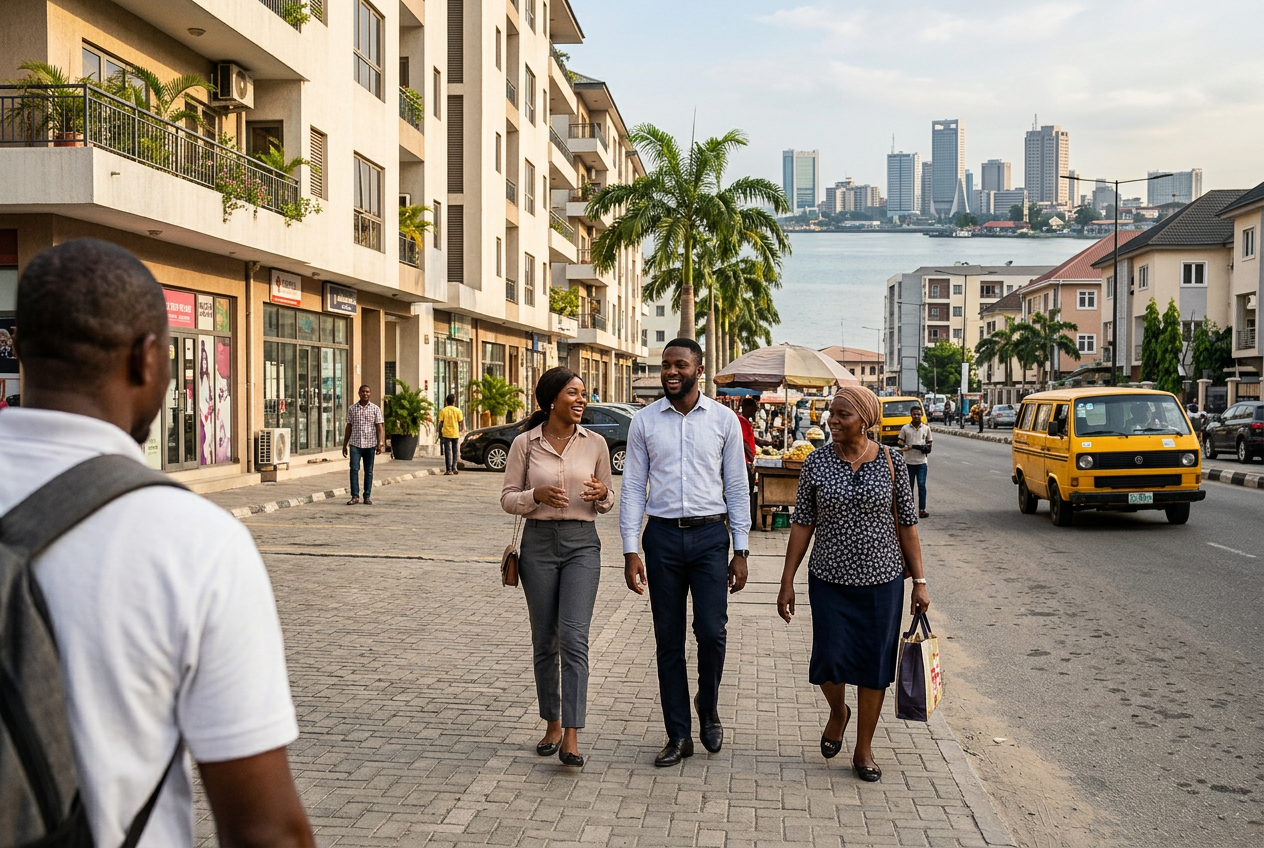
How Nigeria’s Top Places to Live Compare
To make this concrete, here is a side by side look at the places that dominate most “best of” conversations, weighing what each one is genuinely best for. Costs are broad monthly guides for a modest two bedroom flat in a decent area and will vary widely by neighbourhood.
| Place | Best For | 2024 State IGR | Typical 2-Bed Rent (Monthly Guide) | Safety Note |
|---|---|---|---|---|
| Lagos (Lekki/Ikeja) | Earning power and careers | ₦1.26 trillion | ₦250,000 to ₦600,000+ | Generally stable, watch petty crime |
| Abuja (FCT) | Families and planned living | ₦282.36 billion | ₦150,000 to ₦450,000 | Among the calmer major cities |
| Port Harcourt (Rivers) | Oil, gas and industry jobs | ₦317.30 billion | ₦120,000 to ₦350,000 | Mixed, varies sharply by area |
| Ibadan (Oyo) | Affordable big city living | ₦65.29 billion | ₦60,000 to ₦180,000 | Broadly calm and settled |
| Enugu | Value and South East culture | ₦180.50 billion | ₦50,000 to ₦150,000 | One of the more peaceful cities |
| Uyo (Akwa Ibom) | Clean, quiet, low stress life | ₦75.77 billion | ₦50,000 to ₦140,000 | Consistently rated peaceful |
The clear conclusion from this table is that earning power and affordability pull in opposite directions: Lagos wins on income and loses on cost, whilst places like Enugu, Ibadan and Uyo offer far gentler living for those who do not need the biggest pay packet in the room.
Where is the Safest Place in Nigeria to Live?
Safety is the topic where I choose my words most carefully, because it is the one that genuinely changes lives.
The uncomfortable truth is that Nigeria’s security picture is regional. The North West, covering states such as Zamfara, Katsina, Sokoto, Kebbi and parts of Kaduna and Niger, has borne the heaviest weight of banditry and kidnapping in recent years. The North East continues to wrestle with the long shadow of insurgency, and parts of the Middle Belt have suffered painful farmer and herder clashes.
There is, encouragingly, some better news. A Guardian assessment of the security fight back reported that coordinated operations have brought a fragile calm to once troubled areas, from southern Kaduna to parts of the South East, a shift explored in the piece on Nigeria fighting back against banditry and kidnapping. Progress is real, if uneven.
So where does that leave the person simply wanting to sleep soundly? In practice, several southern and south eastern cities consistently earn a reputation for relative peace. Uyo in Akwa Ibom, Enugu in the South East, and Ibadan in the South West are frequently named by residents as calm, settled places to raise a family. Abuja, with its planned layout and heavy security presence, also feels notably orderly for a city its size.
No place in Nigeria, or anywhere on earth for that matter, is perfectly safe. What you are really doing is stacking the odds in your favour by choosing a lower risk state, a well regarded neighbourhood within it, and an estate or street with an active community watch.
My practical advice, learned the slightly hard way, is this. Prioritise the specific neighbourhood over the general reputation of the city, because a good street in a “risky” city can be safer than a poor one in a “safe” city. Ask about power, gates, and how neighbours look out for one another before you ask about the tiling in the kitchen.
Which State is the Cheapest to Live in Nigeria?
Now for the question that quietly matters most to the majority of Nigerians in 2026. Where does your naira stretch furthest?
Affordability tracks closely with inflation and food prices, both of which the National Bureau of Statistics measures state by state. Recent consumer price data has repeatedly flagged the same clutch of states as gentler on the wallet: Kwara (with Ilorin praised for combining city amenities with small town prices), Ondo, Cross River, Akwa Ibom and Benue, the famous “Food Basket of the Nation” where home grown produce keeps market prices sane.
Ilorin in particular keeps popping up in these conversations, and for good reason. It offers proper urban infrastructure, decent schools and markets, yet rents and food costs that would make a Lagosian weep with envy.
Benue earns its nickname honestly. When a state grows much of the country’s yam, rice and vegetables, its residents eat well for less, and that single fact reshapes a household budget more than most people expect.
That said, cheap is never only about the price tag. A very affordable state with weak job prospects can cost you more in lost income than you save in rent, which loops us right back to the balance we keep returning to. The federal government is at least trying to ease the housing squeeze that drives so much of this cost, with mortgage and estate schemes detailed in the report on Nigeria’s push to bridge the housing deficit.
My honest steer? If pure affordability is your goal and your income can travel with you (remote work, farming, trade, or a pension), states like Kwara, Benue and Ondo offer a wonderful quality of life for remarkably little. If your income is tied to a physical job market, weigh that cheap rent against the salaries on offer nearby before you fall in love with the price.
Final Thoughts on the Best Place to Live in Nigeria
So, after all that, where is the best place to live in Nigeria? The grown up answer is that it is wherever your priorities and your naira meet most comfortably.
If you crave opportunity and can stomach the pace and the cost, Lagos rewards ambition like nowhere else. If you want that same ambition with cleaner air, planned roads and a calmer heartbeat, Abuja is hard to beat and remains my top all round pick. If your dream is a full, dignified life on a modest budget, Ibadan, Enugu, Uyo, Ilorin and the wider Middle Belt and South offer riches that never show up on a payslip.
The best move you can make today is a simple one. Name your top priority, set an honest budget, shortlist three places rather than one, and go and stand in each of them before you sign a single thing. Do that, and you will not merely find a house. You will find a home that fits the life you actually want to live.
Whatever you choose, I am cheering you on. This country has room for every kind of dream, and there is a corner of it waiting to suit yours.
Related Articles
If you enjoyed this guide, you may find two of my other pieces genuinely useful as you plan your move. For a deeper look at how Nigerians are distributed across the country and why our cities keep swelling, have a read of my article on where do most people live in Nigeria, which unpacks the population patterns behind every point I have made here about opportunity and crowding.
And if the money question is what really drives your decision, my breakdown of the main industry in Lagos explains exactly why the commercial capital generates the salaries and jobs that pull so many of us southward in the first place.
Key Takeaways
- There is no single best place, only the best place for you. Abuja wins for planned family calm, Lagos for earning power, and states like Ibadan, Enugu and Uyo for affordable, peaceful living.
- Where you earn and where you save rarely match. Lagos leads Nigeria’s economy with ₦1.26 trillion in 2024 IGR, but its high rents mean affordable states such as Kwara, Benue and Ondo often deliver a better quality of life per naira.
- Choose the neighbourhood, not just the city. Safety, cost and comfort vary enormously street by street, so shortlist three areas, visit each, and speak to real residents before you commit.
Frequently Asked Questions About the Best Place to Live in Nigeria
Where is the best place to live in Nigeria?
There is no single answer, because the best place depends on whether you prioritise money, safety, cost or calm. For the widest range of people, Abuja offers the best all round balance, whilst Lagos remains unmatched for career and earning opportunities.
Which city is best to live in Nigeria?
Lagos is best for opportunity and career growth, whilst Abuja wins for planned living, cleaner roads and family life. Ibadan, Enugu and Uyo are excellent choices for those wanting comfort and value at a much lower cost.
Which state in Nigeria is the best to make money?
Lagos is comfortably the best state for making money, generating ₦1.26 trillion in internally generated revenue in 2024, more than the next twenty five states combined. Rivers State and the Federal Capital Territory follow, driven by oil, gas and government spending respectively.
Where is the safest place in Nigeria to live?
Several southern cities, including Uyo, Enugu and Ibadan, are consistently rated among the most peaceful places to live. Abuja is also notably orderly for its size, thanks to its planned layout and strong security presence.
Which state is the cheapest to live in Nigeria?
States such as Kwara, Benue, Ondo and Cross River regularly rank among the cheapest, thanks to lower inflation and affordable local food. Benue in particular, known as the Food Basket of the Nation, keeps household costs low because so much produce is grown there.
Is Lagos or Abuja better to live in?
Lagos is better if your main goal is career growth, income and being at the centre of business and culture. Abuja is better if you value planned infrastructure, lighter traffic, cleaner surroundings and a calmer pace for family life.
Is Lekki a good place to live in Nigeria?
Lekki is one of the most desirable areas in Lagos, offering modern estates, good amenities and proximity to major business hubs. It is relatively expensive, however, so it suits higher earners more than those on a tight budget.
What is the most peaceful state in Nigeria?
Akwa Ibom, with its capital Uyo, is frequently cited as one of the most peaceful and cleanest states to live in. Enugu and parts of the South West such as Oyo State are also regularly praised for their calm, settled atmosphere.
How much does it cost to rent in Abuja compared to Lagos?
Abuja rents are often slightly more forgiving than prime Lagos areas, with a decent two bedroom flat guiding from around ₦150,000 to ₦450,000 monthly. Prime Lagos neighbourhoods like Lekki and Victoria Island can run from ₦250,000 to well over ₦600,000 monthly for similar space.
Which Nigerian city is best for young professionals?
Lagos is the top choice for young professionals because it holds the greatest concentration of jobs, startups and networking opportunities. Abuja is a strong second, offering good career prospects in government and services with a more manageable pace of life.
Is it cheaper to live in the north or south of Nigeria?
Many northern and Middle Belt states offer lower food and rent costs, though this varies with security and job availability. The south east and parts of the south west, such as Enugu and Ibadan, also offer excellent value while keeping you closer to major economic centres.
What should I consider before relocating within Nigeria?
Weigh your combined rent and transport budget, the safety of the specific neighbourhood, and the commute to wherever your income comes from. Always visit and speak to current residents before committing, because a place feels very different lived in than it does on paper.

