 Follow Us on Google News


 Follow Us on Google Discover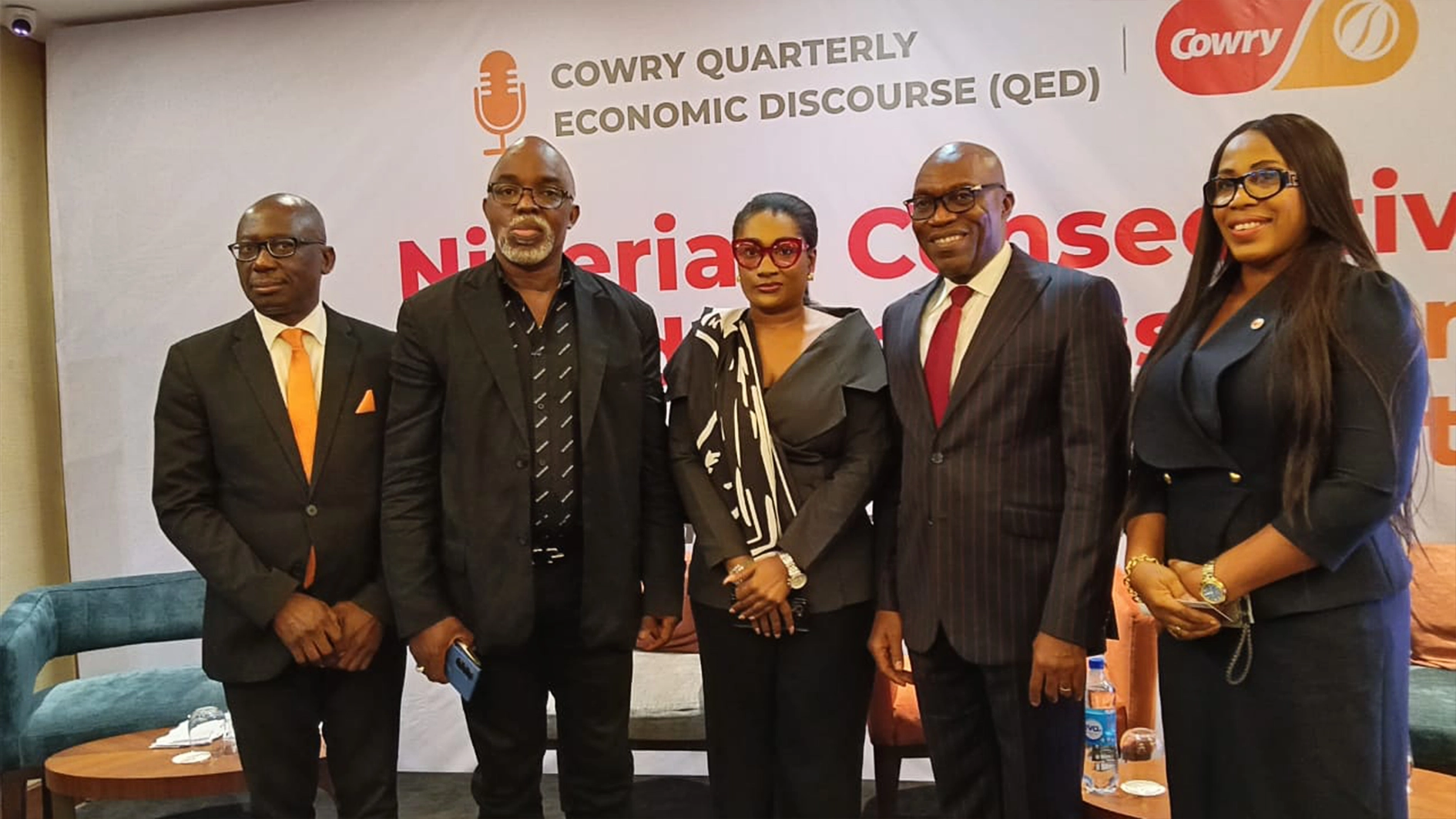

In a Quarterly Economic Discourse held by Cowry Asset Management at the Capital Club, Victoria Island, Lagos, economists, financial experts, policymakers and sports administrators examined the relationship between national competitiveness, investment, governance and sustainable economic growth.
Delivering his remarks, Mr. Johnson Chukwu, the Managing Director of Cowry Asset Management, noted that after the match, life now looks boring, which shows that beyond entertainment, football is important to humans and, by extension, a nation’s economy, which brings the discussion to Nigeria’s declining performance in football competitions and how it reflects wider challenges confronting the country.
He argued that sports should not merely be viewed as entertainment but as an important contributor to economic development through job creation, entrepreneurship and youth empowerment.
According to him, discussions on competitiveness should go beyond sports and focus on the structures that drive national development.
Speaking on the theme “Nigeria’s Consecutive Worsening World Cup Misses and Worsening Insecurity: The Economic Performance Nexus,” Mr. Johnson Chukwu questioned whether Nigeria was gradually losing its competitive edge despite its enormous human and natural resources, noting that the country is failing because youths are not being trained in their early stage.
The stage, which he described as the most important in human life, is what Nigerians youths are using to just survive because of the hard economic realities.

He maintained that development is never accidental, stressing that “development is not a happenstance.”
According to him, countries that attain sustainable development deliberately nurture their human capital from childhood, investing in education, skills acquisition and talent development long before the results become visible.
Drawing attention to Nigeria’s football fortunes, Chukwu observed that while the country has produced several talented footballers now representing clubs and national teams across the world, the domestic system has failed to maximise those talents,, which is revealed in missing the World Cup as a nation but has 16 of her players playing for 9 countries.
He noted that countries that are serious about football continue to improve their structures after every major competition, making difficult decisions where necessary instead of maintaining the status quo and are already preparing for the next World Cup in 2030 by changing their coaches while Nigeria who didn’t qualify has not shown any tangible preparation.
Chukwu identified insecurity as one of the greatest threats to Nigeria’s competitiveness. With the major crisis since 2019, insecurity has continued to expand from Boko Haram to banditry and terrrorism, to Fulani herdsmen, pipeline vandalism and kidnapping for ransom.
The impact of insecurity on the economy, he stated, are reduced investments in states affected by violent conflicts while forcing many productive citizens to abandon their communities, weakens productivity, disrupts businesses and discourages both local and foreign investors from committing resources to affected areas, brain drain as people in IDP camps are not useful to the economy.
On the economy, Mr. Chukwu explained that many Nigerians misunderstand the concept of inflation.
He noted that inflation represents a continuous increase in the general prices of goods and services over time, stressing that it should not be confused with deflation.
Speaking further on Nigeria’s competitiveness, Mr. Johnson stated that with Nigeria’s population at over 240 milllion with 42% being youths, the impact of youthful creativity is not felt because their raw talent is undermanaged.
He gave example of Brazil becoming a global talent through football because of proper talent management.
Speaking to the government on what is next, Mr. Johnson noted that focus should be on human development and creating more economic opportunities.
Speaking during the panel session, Former NFF President, Mr. Amaju Pinnick identified natural resources, population quality and quantity, agriculture, values and leadership as some of the major determinants of economic performance, with leadership being the most important.
According to him, sports and the economy are interconnected, explaining that countries that deliberately invest in sports often enjoy broader economic benefits while pointing to England as an example where government leadership recognises sports as an important economic sector deserving sustained attention.
Reflecting on Nigeria’s football experience, he noted that the country’s performance at the 2018 FIFA World Cup was driven by the confidence and motivation of players who believed they were adequately valued as athletes who are protected, provided for and projected will do greatly well in competition. He also highlighted how collaborations between the Nigeria Football Federation and global brands such as Nike and Adidas strenghtened the football team then.
He further explained that sports as a ssector has given Nigeria more recognition than sectors like education as we rank 26th globally while the education sector ranks 112nd.
and called for stronger collaboration between government and sporting institutions to unlock the sector’s economic potential.
Mr. Amaju added that Morocco’s recent achievements on the global football stage demonstrate what deliberate planning, investment and institutional support can accomplish.
According to him, the Nigerian government have a responsibility to protect, project and provide through effective leadership and strategic partnerships. He also stated that NFF can be led by anyone with an enabling environment and the fear of God but wrong leadership has continued to affect the team
Speaking on the country’s macroeconomic outlook, Miss Chinwe Egwim, a Nigerian economist and banker, said Nigeria has witnessed relative exchange rate stability in recent months and now ranks 4th globally in the stock market, although inflation remains a major concern. She observed that government policies should focus more on productive sectors capable of stimulating economic growth and creating employment.
According to her, sectors such as agriculture, agro-processing, manufacturing, transportation, the creative economy and real estate value chains possess enormous potential to transform the economy if given adequate attention.
Also speaking, Prof. Bongo Adi, a Nigerian economist and data analyst, said Nigeria’s competitiveness continues to suffer because of inadequate infrastructure and insecurity. He also noted the high cost of doing business in Nigeria. Though the government charges only 10% for tax, businesses continue to suffer loss due to non-state tax which doesn’t even get to the government.
He stressed the need for improved infrastructure and policy consistency to support business growth and enhance national productivity.
Contributing to the discussion, Mr. Dakuku Peterside, a public policy expert, said Nigeria’s competitiveness depends largely on building strong institutions and implementing long-term development strategies.
According to him, the country’s challenges in football mirror broader governance issue. “Football is a reflection of everything right and wrong with our nation,” he said. He noted that there are “no long term plans,no systems, no structures and there is resources capture(corruption), no resilience and where resources are not captured, it is not effectively executed, and our failure in football is not a coincidencebut a mirror f everything wrong at home.”
He maintained that Nigeria requires systems capable of outlasting individual administrations if it hopes to compete effectively on the global stage and sustainable progress can only be achieved through effective planning and institutional reforms.
The Nigerian government is therefore charged to look into reforms that can benefit her citizens to become productive and create more economic opportunities by proper management of the sports sector, rather than worsen the economy by spending on election.
Through its Quarterly Economic Discourse, Cowry Asset Management reaffirmed its commitment to providing a platform for evidence-based discussions on the economy, investment and national development, while encouraging policies capable of improving Nigeria’s competitiveness and creating long-term value for investors and the broader economy.

