 Follow Us on Google News


 Follow Us on Google Discover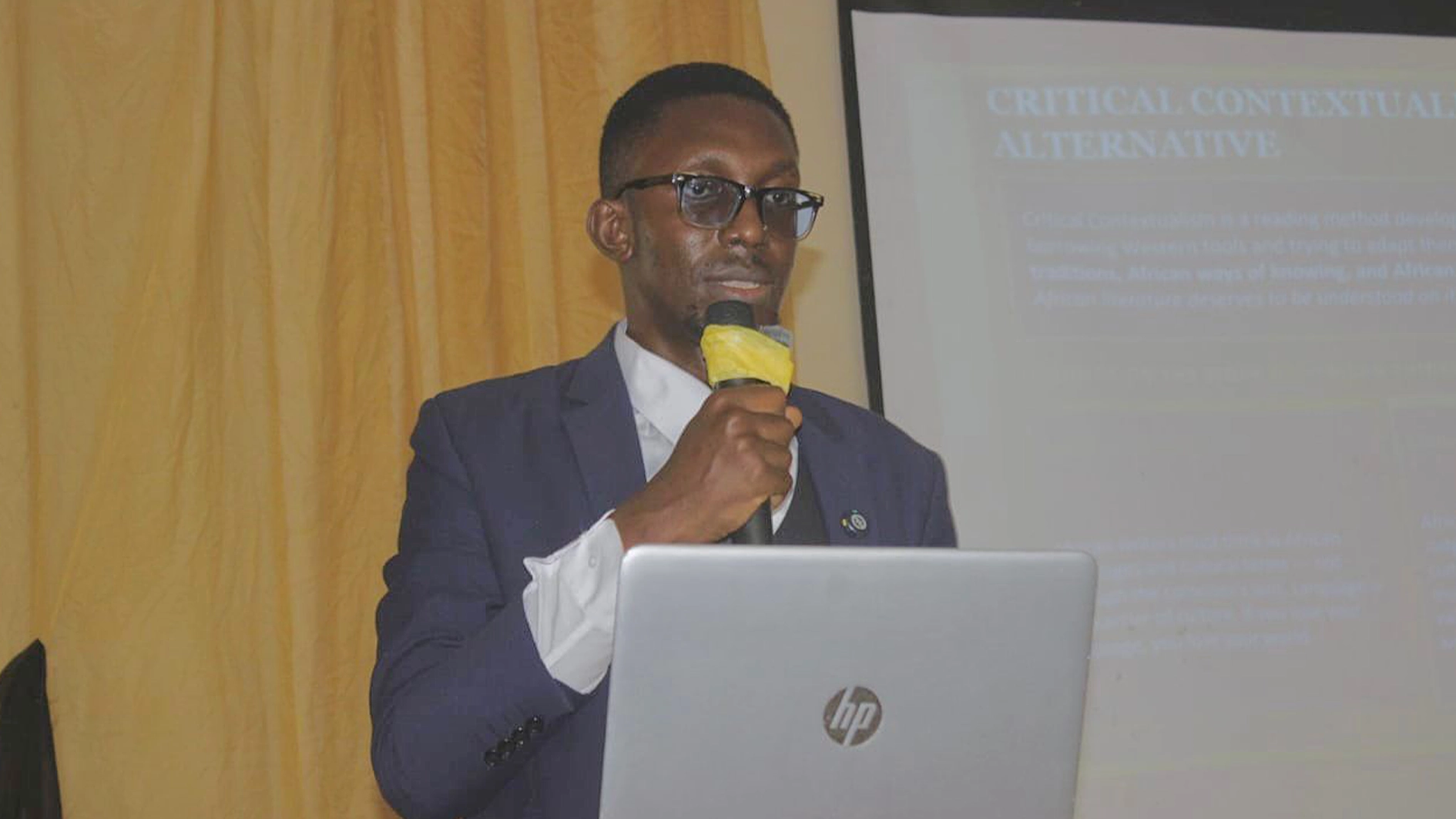
A faculty lecture at KolaDaisi University, Ibadan, has challenged the dominance of Western literary theory in African academic institutions and proposed a homegrown alternative.
At a faculty seminar held last Wednesday at KolaDaisi University in Ibadan, Dr. Dowell I. Oba made a case that has been building quietly in African literary tudies for decades: that the tools used to read African literature were not built for it, and that the consequences of continuing to use them are neither neutral nor innocent.
The lecture, delivered to the Faculty of Arts, Management and Social Sciences, was titled Beyond New Historicism: Critical Contextualism as a Culturally Accountable Framework for African Literature. Its argument was precise and pointed.
New Historicism, the influential method developed by American scholar Stephen Greenblatt in the 1980s, has long been adopted by African scholars as a way to connect literature to history and power. Dr. Oba does not dispute its usefulness. What he disputes is its universality.
The method, he argued, fails African texts in four structural ways: it depends on colonial archives that erased oral traditions; it cannot take African spirituality seriously as a form of knowledge; it treats language as a neutral vehicle rather than a site of colonial and postcolonial struggle; and it has a habit of converting politically urgent literature into objects of detached academic study.
“When African experiences are forced into Western categories,” Dr. Oba told his audience, echoing the postcolonial theorist Gayatri Spivak, “those experiences get distorted. The African person becomes a version of a Western idea not a full human being on their own terms.”

To illustrate the problem, he turned to two novels. In Jennifer Nansubuga Makumbi’s Kintu, the Ugandan epic that follows a family curse across 250 years of history, Dr. Oba argued that New Historicism could only read the curse as metaphor for intergenerational trauma.
Critical Contextualism, his proposed alternative, reads it differently: as an historical force, rooted in Ganda cosmology, where the improperly buried dead continue to act upon the living. “One framework explains the novel,” he said. “The other actually reads it.”
His second example was Tsitsi Dangarembga’s This Mournable Body, the 2018 Zimbabwean novel shortlisted for the Booker Prize, written entirely in the second person. Where conventional Western criticism might file this under postmodern experimentation, Dr. Oba argued it was evidence of a self so stripped of stability by Zimbabwe’s structural adjustment programmes that the first person had simply become unavailable.
“The ‘you’ is not a stylistic trick,” he said. “It is the only grammatical form that captures what it feels like to lose your sense of self.”
Critical Contextualism, which Dr. Oba has developed over the course of his research, works in four stages: mapping the local historical and oral context of a text; examining why the text is formally shaped the way it is; interrogating the ideological tensions the text engages; and analysing how the text travels; through publishers, prizes, and literary festivals, and whose voice gets amplified or filtered in that journey.
The framework draws explicitly on African intellectual traditions, building on the decolonial arguments of Ngũgĩ wa Thiong’o, the aesthetic criticism of Chinweizu, and Wole Soyinka’s insistence that Yoruba mythology constitutes a serious philosophical system, not folklore.
Dr. Oba was careful to frame his argument not as a rejection of Western scholarship but as a demand for plurality.
“The goal,” he said, “is a world where African scholars speak from their own foundations and are taken seriously when they do.” He also acknowledged that no single framework can speak for a continent as culturally diverse as Africa, and called for the development of multiple African-centred critical methods.
The lecture closed with an institutional challenge: for African universities to invest in indigenous knowledge systems, fund oral tradition research, and support literary criticism published in African languages, warning that without structural change, even the most compelling ideas risk remaining confined to a single seminar room.
The seminar was chaired by Prof. Sekinat Kola-Aderoju, Dean of FAMS, and presided over by Vice-Chancellor Prof. Adeniyi Olatunbosun SAN.

