 Follow Us on Google News
 Follow Us on Google Discover
Like every man-made law, the recently promulgated Electoral Act 2026 has begun to exert pressure on various segments of Nigeria’s polity, particularly on how political parties select their representatives for various elective positions. But while the improved electoral law tends to remove the malaise of money-bag imposition and delegate colonisation, new concerns are emerging, SEYE OLUMIDE, LEO SOBECHI and ADAMU ABUH report.
THE current buzz in town, as it pertains to the newly minted Electoral Act 2026, s what the law holds in store for political parties’ straw polls. Central to the innovative bypass of the indirect methodology is the Act’s demand for popular participation, briefly, the involvement of all bona fide members of the party.
What does membership of a party mean? Party insiders are beginning to see some landmines that could test the durability of the stipulation in Section 84, particularly subsection 2, which declares: “The procedure for the nomination of candidates by political parties for the various elective positions shall be by direct or consensus.”
One thing, however, is certain: the struggle for control of party structures has entered a new and unpredictable phase. Political commentators are already expressing fears that the implementation of Section 84(2) may entail the qualification of members as only those who are up to date with the payment of membership dues, monthly levies, and regular participation in the party’s activities.
It could be in light of the possible interpretations of the direct primaries that many stakeholders claim federal lawmakers may have exacted their own pound of flesh from state governors, who used to be the last clearinghouse for who gets a party’s ticket.
As the build-up to the 2027 general election gathers steam, it will indeed be seen who actually owns political parties—the people, party managers or potentates? State governors are worried that the all-comers primary would circumscribe their powers to ensure that ‘friendly candidates’ sail through the party’s primary elections for State Assembly, as well as local government council chairmen and councillors.

Exuding while signing the Electoral Act amendment into law, President Bola Ahmed Tinubu said the reforms in the electoral system would strengthen democracy and propel grassroots development, even as he noted the place of direct primaries and consensus options in election management.
Recall that since the onset of the current Fourth Republic, state governors turned themselves into demigods through the indirect mode of candidate selection, a development that helped governors and godfathers dictate to the party who gets what.
Insiders within the ruling All Progressives Congress (APC) claim that the direct methodology has been a key ingredient of President Tinubu’s plan to ensure party supremacy and weed out rebellious power brokers.
One of the state governors told The Guardian that they were surprised by the turn of events, recalling how the President had expressed confidence in the national chairman, Prof. Goshwe Yilwatda, saying: “You have never failed any assignment I gave to you. I am confident that you will not fail in this one. The governors are here; I never consulted with anyone to make the party chairman.”
The governor said that the Electoral Act 2026 shows the President wants to be in total control while leaving state chief executives to “stagger”, lamenting that the direct primary would leave many governors, especially those who recently joined the party, with bloody noses.
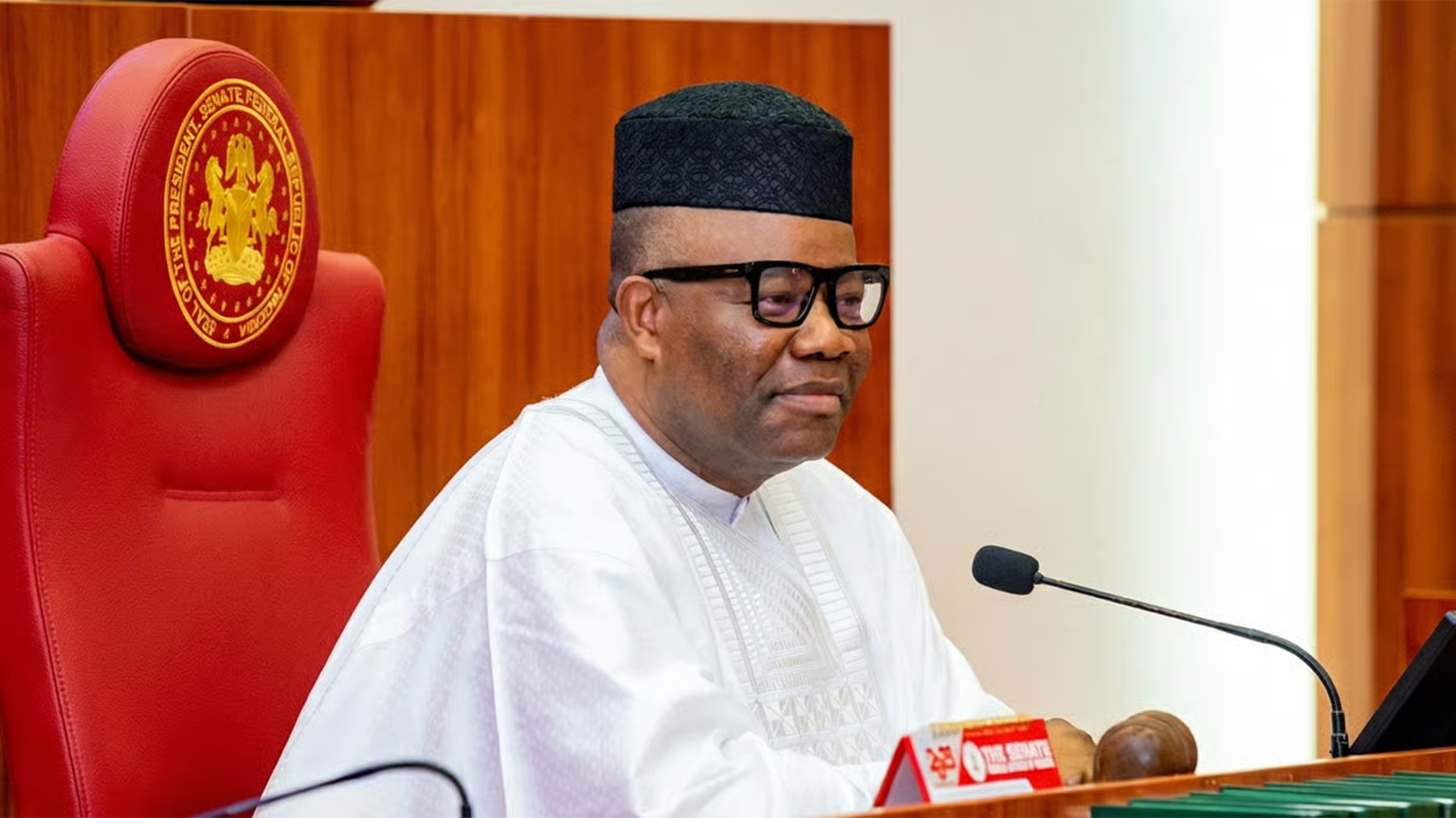
With an air of exuberance that blended inner satisfaction and subtle mischief, the Senate President, Godswill Akpabio, noted that members of the National Assembly worked tirelessly for six months to give Nigerians an Electoral Act they would be proud of.
Akpabio, himself a former state governor-turned-senator, contended that removing the indirect primary methodology was aimed at closing the window for inducement and manipulation, especially the surreptitious substitution of winners’ names.
Direct primaries, he noted, will allow aspirants to face party members directly, thereby ensuring inclusivity through the participation of APC faithful across wards and local governments.
By eliminating the delegate system, federal lawmakers appear to have reduced a key instrument of gubernatorial dominance. But whether that dominance disappears entirely is another question.
Under indirect primaries, influencing a small voting college was logistically easier and financially predictable. Direct primaries, by contrast, demand broader mobilisation and therefore increase unpredictability.
Consensus candidacy remains an option, but its unanimity requirement makes outright imposition more difficult without widespread agreement. Former Deputy Governor of Kogi State and APC chieftain, Edward Onoja, believes the shift changes the internal balance of power.
“Indirect primaries placed enormous authority in the hands of a few,” he noted. “It was easier to influence a limited delegate list. With direct primaries, that power spreads wider within the party.”
However, he cautioned that success depends on clean membership registers, transparent monitoring and strict discipline in implementation. Without those safeguards, any system can be compromised.
Former National Chairman of the Inter-Party Advisory Council (IPAC), Peter Ameh, differed. He viewed the amendment as legislative overreach, arguing that restricting nomination modes may infringe on political parties’ constitutional autonomy.
“Mandating direct primaries while limiting flexibility could centralise influence at the national level rather than genuinely empower grassroots members. This is not necessarily decentralisation. It could simply shift control from one layer of power to another.”
A senior APC chieftain, who preferred anonymity, gave a more pragmatic insight, insisting that direct primaries may still favour incumbent governors. “Governors already control ward and local government structures,” the source said. “They have patronage networks and grassroots machinery. Even in a direct primary, those structures matter.”
He noted that while the voting base widens, the administrative and mobilisation structures remain largely within state political ecosystems.
Observers also contend that while the reform reduces concentrated delegate control, it does not automatically dismantle the advantages of incumbency.
All said, as 2027 inches closer, aspirants may need to recalibrate their strategies, particularly by shifting focus from backroom negotiations to broader grassroots engagement. But whether this reform truly dismantles entrenched power structures or merely redistributes influence under new procedural rules remains the defining political question of the moment.
Between direct primary and consensus
Under the new provision, political parties are required to adopt either direct primaries, in which all registered members vote to choose their candidates, or a consensus arrangement, in which aspirants voluntarily agree on a single flagbearer. The indirect primary system, which relied on a limited number of delegates to make decisions on behalf of the wider membership, is no longer permissible. For decades, that delegate structure had been criticised for fostering godfatherism, opaque bargaining and monetisation of party tickets.
Proponents argue that the shift to direct primaries will deepen internal democracy, enhance transparency and restore credibility to the nomination process by giving ordinary party members a direct voice.
However, civil society organisations and electoral reform advocates caution that the new framework may introduce fresh vulnerabilities, including large-scale vote-buying, inflated membership registers and elite manipulation of party structures at the grassroots.
As preparations for the 2027 general election get underway, the practical implications of Section 84 are already reshaping internal alignments and campaign strategies across the country. This is especially so, as most of the defected governors may not find it easy to secure tickets for their newfound parties, since they will no longer be able to manipulate delegates or influence them with cash as in the past.
Although the direct primary methodology is not entirely new, what has changed is the insistence on direct primaries and the consensus approach, which permanently eradicates the delegate system of selecting party candidates.
Ahead of the 2019 general elections, the ruling APC adopted direct primaries in several states as part of its internal reforms. Under the system, all registered party members in each ward were accredited to vote for aspirants rather than a limited number of statutory and ad hoc delegates. Implementation, however, varied from state to state.
In Lagos State, the direct primary was conducted across the 245 wards, with party members queuing openly behind their preferred aspirants. The exercise led to the defeat of then-governor Akinwunmi Ambode, who lost the APC ticket to Babajide Sanwo-Olu. The open ballot format made it difficult for the incumbent to influence party structures to guarantee victory.
In Ekiti State, the APC used ward-based voting centres where members cast ballots under the supervision of party officials and observers. The process produced former Governor Kayode Fayemi as the candidate, though some aspirants alleged irregularities.
In Ogun State, the method triggered fierce disputes. Voting was conducted at ward levels, but disagreements over membership registers and collation procedures led to parallel claims of victory, deepening factional divisions within the state chapter.
In Zamfara State, although the APC announced direct primaries, the exercise was plagued by logistical breakdown and internal wrangling. Disagreements over whether primaries were valid eventually contributed to prolonged litigation that culminated in the Supreme Court nullifying the party’s electoral wins in 2019.
In Kano State, the direct primary involved mass participation across local governments, with party members voting openly. Party leaders cited the scale of turnout as evidence of grassroots legitimacy, though opposition figures questioned the transparency of the collation process.
States such as Abia, Akwa Ibom, Anambra, Bauchi, Bayelsa, Cross River, Edo, Imo, Niger, Ondo, Osun, Taraba and the Federal Capital Territory (FCT) followed similar ward-level voting patterns.
Typically, accreditation was conducted using party membership registers, after which members either queued behind candidates or cast simple ballots. Results were collated from wards to local governments and then to the state level.
The Peoples Democratic Party (PDP), while historically favouring indirect primaries, also experimented with wider participation models in some contests. However, it largely retained the delegate system in 2018.
Across these states, direct primaries expanded participation but exposed weaknesses in party membership databases, logistics, and internal dispute-resolution mechanisms. In several instances, the process reshaped political alignments, weakened incumbents’ control over delegate lists and intensified post-primary litigation, underscoring both the democratic promise and operational risks of the system.
National Assembly’s triumphal tact?

The National Assembly justified its decision to adopt direct primaries and abolish the delegate system as a deliberate attempt to deepen internal party democracy and curb what lawmakers described as the corrosive influence of money and elite manipulation in Nigeria’s political process.
Under the amended Electoral Act, political parties are required to allow all registered members to participate in the selection of candidates for elective offices, effectively ending the long-standing practice where a limited number of delegates determined party flagbearers.
Lawmakers argued that the delegate system had, over time, narrowed participation and entrenched a culture in which a few hundred individuals wielded disproportionate influence over the emergence of candidates. By contrast, direct primaries, they said, broaden participation and return decision-making power to the grassroots.
A recurring justification for the reform was the monetisation of primaries. In previous contests conducted by major parties such as the APC and PDP, aspirants were frequently accused of bribing delegates with large sums of money to secure tickets. Since delegates were few and easily identifiable, critics said the system became a fertile ground for vote-buying, pushing the cost of contesting primaries to staggering levels.
Federal lawmakers maintain that it would be far more difficult and significantly more expensive for aspirants to induce thousands of party members spread across wards and local government areas than to influence a small, centralised delegate list.
Another major concern cited was the role of political godfathers and incumbent governors in manipulating delegate lists. Control over ward, local government and state congresses often translated into control over who emerged as delegates, allowing powerful party leaders to determine outcomes even before voting began. The new framework, lawmakers argued, dismantles that structure by opening the process to all members rather than a curated few.
The delegate system has also been associated with recurring litigation and factional crises.
Disputes over delegate lists have produced parallel congresses, rival primaries and prolonged court battles, sometimes costing parties victory in general elections. By widening participation, supporters believe direct primaries could reduce disputes tied to the authenticity of delegate registers.
Beyond internal wrangling, critics of the old order contend that the system alienated grassroots members who were excluded from the decisive stage of candidate selection. Many party loyalists complained that their only role was during general elections, while party elites decided candidates behind closed doors.
However, while lawmakers presented direct primaries as a corrective measure, the shift is not without controversy. Political analysts warn of logistical and financial challenges in organising ward-level voting for millions of party members. Questions have also been raised about the integrity of party membership registers, security arrangements, and parties’ capacity to conduct credible exercises nationwide.
Nonetheless, proponents insist that despite these hurdles, the reform represents a necessary recalibration of Nigeria’s party politics, one aimed at restoring credibility to candidate selection and weakening the entrenched influence of money and patronage in the democratic process.

