President Bola Ahmed Tinubu on Monday delivered a deeply reflective tribute to late former President Muhammadu Buhari, declaring that the true measure of leadership lies not in power, privilege or pageantry, but in the values that endure long after office is vacated.
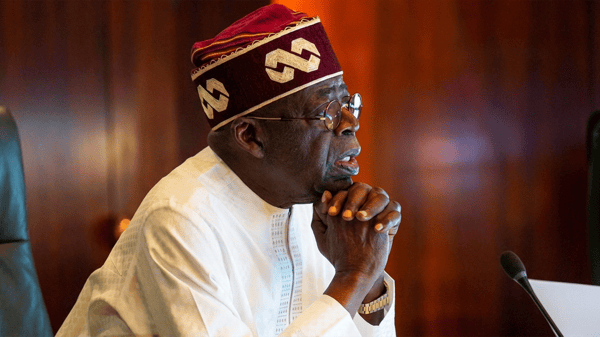
Speaking at the official presentation of former President Muhammadu Buhari’s biography in Abuja, Tinubu said history would remember the former President not for the offices he occupied or the motorcades that accompanied him, but for the character he brought to public life.
“The measure of a leader is not simply the offices he held or the motorcades that accompanied him. It is what persists when the sirens fall silent,” Tinubu said. “President Muhammadu Buhari left behind a reputation for integrity, a spartan lifestyle, and the belief that public office is a trust and not a windfall.”
The President described Buhari as a leader of quiet strength, discipline and restraint, whose sense of duty was anchored in service rather than spectacle.
He extended the nation’s condolences to former First Lady Aisha Buhari, her children and grandchildren, assuring them that Nigeria’s prayers and gratitude remain with the family.
“I stand here not only as President, but as a brother, friend and political partner who shared a defining journey with him,” Tinubu said.
Recalling their shared political history, Tinubu said Buhari played a central role in reshaping Nigeria’s democratic landscape, particularly through the broad coalition that led to the historic 2015 election.
“Together, we built a movement that united diverse interests across the country. We proved that Nigeria could chart a new course, and in 2015, we achieved what many thought impossible by unseating an incumbent president through the ballot,” he said.
Tinubu noted that the coalition forged in 2014 has since evolved into one of the fastest-growing political platforms on the African continent, underscoring Buhari’s enduring influence on Nigeria’s political architecture.
Reflecting on the biography being presented, the President commended the author for offering a balanced account of Buhari’s life, one that documents both accomplishments and shortcomings.
“History must teach, not flatter,” Tinubu said. “This book should motivate future leaders to draw lessons, not repeat slogans.”
He outlined what he described as the enduring pillars of Buhari’s legacy, beginning with humility.
“President Buhari preferred simplicity over ornamentation. He believed a leader must first discipline himself before he can discipline a system. He lived modestly and carried the dignity of that modesty into power,” he said.
On security, Tinubu said Buhari understood that safety is the foundation of citizenship and economic prosperity, investing in personnel, platforms and reforms across the armed services.
“He recognised that security is not just about protecting the state, but protecting citizens and preserving national stability,” he noted.
The President also highlighted Buhari’s commitment to long-term vision, citing investments in roads, railways, airports and critical infrastructure, alongside an emphasis on sustainability and maintenance.
On social justice, Tinubu said Buhari believed governance must not abandon the poor and vulnerable, hence his focus on targeted social interventions.
“These pillars define his legacy. But a legacy only truly lives when those who follow choose to build upon it. That is my duty,” Tinubu declared.
He said Buhari’s consistency, fidelity to his oath and love for Nigeria earned him respect even among those who disagreed with his policies.
“He loved this country decision after decision, morning after morning. That is why even his critics often acknowledged his honesty,” Tinubu said.
Drawing lessons from their shared political journey, the President stressed that cooperation across differences is a strength, not a weakness.
“Nation-building demands that we compete passionately and govern responsibly. President Buhari understood that the contest ends when the oath begins. In his memory, we must keep our politics honourable and our governance focused on results,” he said.
Tinubu thanked the author of the biography for preserving Buhari’s story for future generations and expressed hope that the book would reach classrooms, libraries and young Nigerians seeking models of leadership.
“One life, lived with restraint and responsibility, can inspire a nation,” he said.
“Though he is no longer with us, his impact endures. We will honour his legacy not by invoking his name, but by delivering results with discipline, compassion and resolve. May Almighty Allah grant him Jannatul Firdaus and bless Nigeria with unity, wisdom and peace,” Tinubu said.
Chairman and Chief Executive of the National Drug Law Enforcement Agency (NDLEA), retired General Buba Marwa, described late Buhari as a principled soldier, disciplined statesman and deeply humane leader whose personal integrity shaped every office he held.
Marwa, while offering personal reflections on Buhari’s life said: “A true Nigerian soldier, a statesman, and a leader by circumstance,” Marwa said. “I will only touch the tip of the iceberg of my personal relationship with him, but even that offers a glimpse into the kind of man he was.”
Tracing his first indirect connection to Buhari, Marwa revealed that his late father served alongside Buhari when he was a young lieutenant in Abeokuta in the early 1960s, a fact Buhari himself later confirmed during a private conversation decades later.
Marwa said he came to know Buhari personally in 1974 when Buhari was posted as Colonel General Staff of a division in Port Harcourt.
“He was slim, tall, soft-spoken, immaculately dressed, and highly respected. All officers admired him. He carried authority without arrogance,” he recalled.
Their professional interaction deepened in the late 1970s when Marwa served as an aide-de-camp at Army Headquarters, at a time Buhari was Minister of Petroleum.
“He was never harsh to young officers. He was calm, approachable and patient. Even when made to wait, unlike others, he never complained or uttered unkind words,” Marwa said.
He recounted a defining episode in 1983 when Buhari was appointed General Officer Commanding (GOC) of the 3rd Armoured Division, a posting some officers initially questioned.
“General Ibrahim Babangida assured us that Buhari was the right man. Buhari soon proved it by personally relocating to Maiduguri, taking charge of operations and driving Chadian forces out of Nigerian territory. His courage and decisiveness preserved Nigeria’s territorial integrity,” he said.
Marwa described Buhari as a man of strict principles, recalling his role as head of a military promotion examination panel in 1981.
“Out of 190 officers, only three passed. There was intense pressure to adjust the results. He refused. He said if only three passed, then only three would go. He stood his ground,” Marwa noted.
He also shared lighter moments, including Buhari’s unexpected sense of humour.
“At one point, a newspaper cartoon showed me labouring on Lagos roads while he looked on in surprise. I was worried he would be offended. Instead, he burst into genuine laughter. His sense of humour was remarkable,” he said.
Reflecting on Buhari’s political journey, Marwa said the former President commanded organic loyalty from ordinary Nigerians, even when resources were scarce.
“In the CPC days, there was little money, but millions followed him. People came out in their numbers because they trusted him,” he said.
Marwa also acknowledged Buhari’s unwavering support during his tenure as NDLEA chairman, saying every request made to strengthen the agency was approved.
“Barracks, equipment, vehicles, recruitment, he supported all of it. That support has continued and even expanded under President Bola Ahmed Tinubu, who recently renewed my tenure,” he said.
The NDLEA boss recalled a morale-boosting moment in September 2022, when the NDLEA recorded the seizure of 2.1 tonnes of cocaine valued at over N760 billion.
“Even while attending the UN General Assembly in New York, President Buhari took time to personally commend our officers. That meant a great deal to the agency,” Marwa said.
Dispelling perceptions of austerity in Buhari’s private life, Marwa also spoke of the former President’s personal generosity.
“When I mentioned going for a medical check-up, he quietly sent me a very generous amount. I wasn’t expecting money at all. That was the man Buhari was,” he said.
Earlier in his welcome address, Katsina State Governor, Dikko Umar Radda, paid glowing tribute to late former President, describing him as a leader whose life of discipline, sacrifice and integrity left an indelible mark on Nigeria’s history.
He recalled Buhari’s long years of service as both a soldier and a statesman, noting that the former President consistently demonstrated courage, resolve and fidelity to duty, even in the face of daunting national challenges.
“President Buhari was willing to give everything in defence of this nation and remained steadfast in delivering on the mandate entrusted to him by Nigerians,” the governor said.
According to Radda, Buhari embodied integrity, simplicity and accountability in public office, earning the respect of Nigerians across generations and political divides.
“He set a standard for public trust and remains a guiding light for many of us in public service. He was honest, disciplined, judicious with public resources and deeply committed to the rule of law,” he added.
The Katsina governor also highlighted the political partnership between President Tinubu and the late Buhari, describing it as a defining moment in Nigeria’s democratic evolution.
“That partnership was pivotal to the historic 2015 transition of power and the consolidation of democracy in Nigeria,” Radda said.
“There is no better successor to carry forward the legacy of our late President than President Bola Ahmed Tinubu, whose belief in national unity continues to inspire confidence in the future of our country.”
Radda said Buhari’s passing left a profound void across the nation, describing him as a beacon of hope, a defender of public trust and a leader whose moral authority was widely acknowledged.
“As we recount the stories of his life, we must emphasise the values he lived by, discipline, integrity, patriotism and service. These are principles we must uphold as a people,” he said.
He also commended the author of the book for maintaining objectivity, balance and intellectual rigour, noting that the publication would serve as an important historical resource for future generations of Nigerians.
Author and reviewer of the newly launched biography of late President Muhammadu Buhari, Dr Charles Omole, described the work as the most comprehensive account of the former leader’s life, deliberately focused on the man behind the office rather than a defence or critique of his policies.
Omole said the project arose from a simple but significant concern: that an earlier, widely read portrait of Buhari published in 2014 no longer reflected the full arc of his life and leadership.
“When the idea of presenting that book again came up, the family felt it was already ten years old and could not possibly capture the bulk of what President Buhari did afterwards,” Omole said.
“This book was conceived to fill that gap.”
He explained that, unlike many previous publications on Buhari, the new work is built on extensive interviews with people who knew him across the entire span of his life.
“This is a book that involved speaking to people who were there when he was born and people who were there when he died. It is the most comprehensive compilation of the life history and legacy of Muhammadu Buhari, told by those who knew him best,” he said.
The 600-page book, Omole noted, deliberately avoids a detailed policy review, leaving that to memoirs and accounts by those who served directly in government.
“Our focus was the man Muhammadu Buhari, his principles, his temperament, his worldview. If you understand the man, many of the decisions he took as president become clearer,” he said.
Omole pointed to Buhari’s early life as critical to understanding his leadership style, including the loss of his father at a very young age and his reliance on close kinsmen who shaped his values and discipline.
“One of Buhari’s greatest legacies, in my opinion, is his children,” he added. “They are forthright, emotionally intelligent and balanced. They did not try to paint their father as a saint. They were clear about his strengths and did not shy away from his weaknesses.”
According to Omole, the book offers lessons for current and future leaders, particularly on governance and statecraft.
“Integrity is necessary in public office, but it is not sufficient on its own,” he said. “Personal honesty must be translated into systems, procurement rules, transparent accounts, audit trails and institutional guardrails against state capture.”
He also stressed the importance of succession planning and strategic communication, describing both as duties of leadership rather than optional virtues.
Without disclosing details, Omole said the book addresses several long-standing questions and controversies surrounding the Buhari presidency, ranging from internal power struggles to moments of crisis during his time in office.
“The answers to many questions Nigerians have asked over the years are in the book,” he said, adding that readers would find documented accounts rather than speculation.
Reflecting on his own experience working with Buhari, Omole said he served on the Presidential Working Group on Police Reform and the Police Wages Review Committee.
“President Buhari accepted all our recommendations in full,” he said, describing the former President as receptive to structured reform proposals when presented clearly.
Omole said the book was intended not to sanctify or vilify Buhari, but to preserve an honest historical record.
“This book asks hard questions and provides context. It is meant to help Nigerians understand the man, learn from his life, and reflect on the demands of leadership in a complex democracy,” he said.
High-profile dignitaries at the event included the President of The Gambia, Adama Barrow; state governors; members of the Federal Executive Council; the diplomatic corps; former governors and aides; a delegation from the Arewa Consultative Forum; former service chiefs; security heads; and traditional rulers, among others.