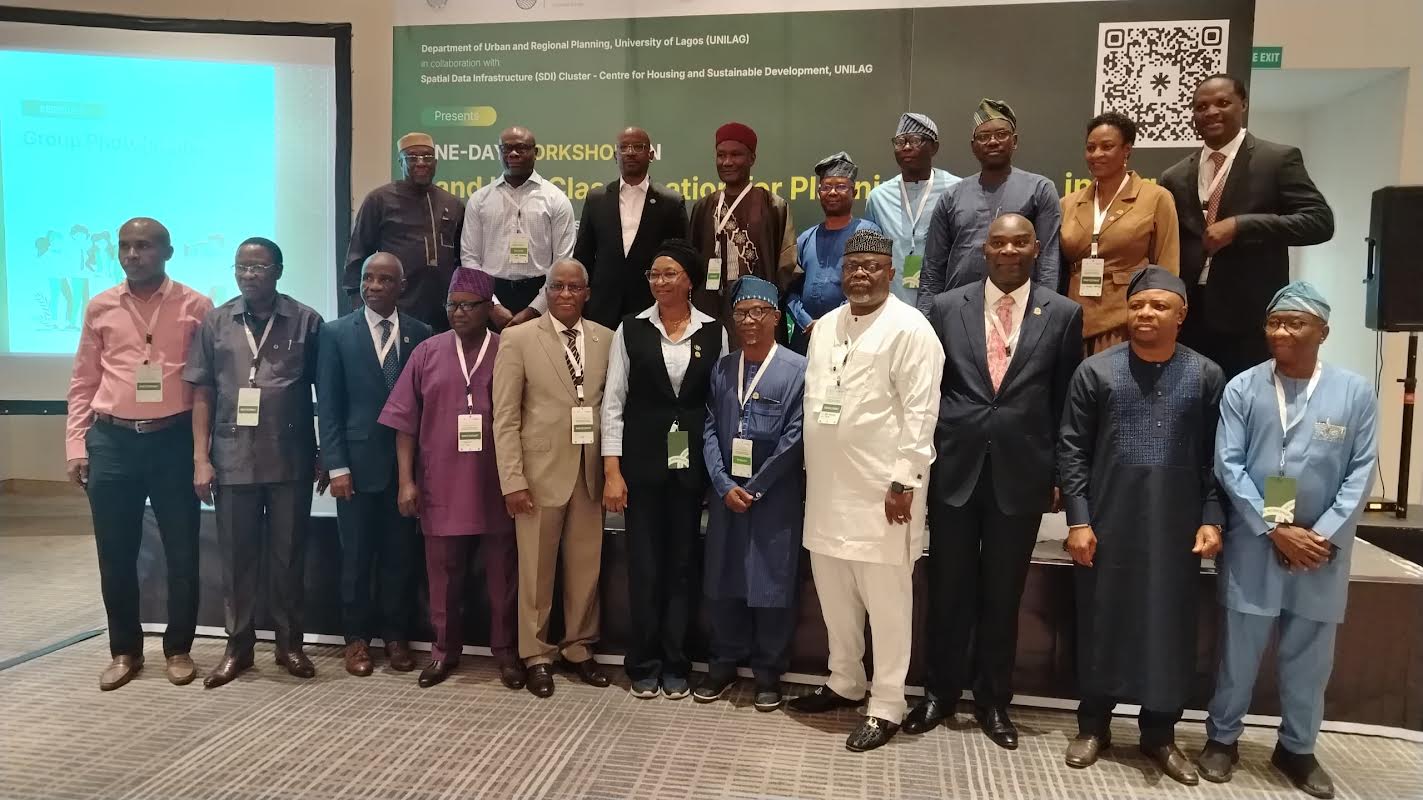

Mr. Gbenga Ismail is the Chairman, Lagos branch of the Nigerian Institution of Estate Surveyors and Valuers (NIESV). He spoke to CHINEDUM UWAEGBULAM on the abandoned Federal Government properties in Lagos, ways to ensure effective home ownership, property taxation and tenancy law in the country.
Since the federal capital moved to Abuja, several office structures were abandoned in Lagos. Now that the economy is overstretched, don’t you think these properties should be put to use to yield revenue for the federal government? What are your plans to attract the government’s attention to them?
The Federal Government moved to the Federal capital in 1991 and since then we have seen the gradual decay and degradation of not only buildings but the environment. However, as you alluded can they be put to better use?
Just like the failing enterprises of the government were privatised, these assets spread all over the nation can be concessioned, long leased and in some cases, sold.
Property is viewed as dead capital that needs to be unleashed. The inaction of government can be viewed as waste when resources are not converted to opportunity. A great example of good use of old property is the former Ikoyi Hotel, which was privatised and sold and now is a sprawling estate.
Another is the bold and courageous Eko Atlantic development. A conversion of resources to opportunity though not quite one of government abandoned assets.
Government needs to inventorise their assets, seek feasibility, viability studies and propose the highest and best use concession of these assets. However, beware of failed cases such as Tafawa Balewa Square (TBS), Trade Fair and National Theatre; these don’t make my case.
Many property owners in Lagos have been inundated with the inability of tenants to pay rent and give up apartments; can we blame this on the ineffectiveness of the tenancy law? What are the issues? Do you think the law should be reviewed?
No, the law is not to blame. I am not so certain there is a tenancy law in Nigeria. From inception, we have stood on the foundation of British law and then through that, created a lot of rights that have become landlords’ rights and tenants’ rights. These have become the tenancy law either in Lagos or elsewhere in Nigeria.
Now each of these tenancy laws starting from 2011 have had no bearing on the economics of renting and I am not sure anyone is paying any attention to it. One of the pillars of the law was that it insisted on monthly or one year’s payment and excluded some areas just as some commodities were excluded from the law. It clearly was an inoperable law.
So, the default is not because the law is not being obeyed or neglected but because people cannot afford many of the properties in certain locations and residential lettings are not really structured on long-term lettings of one year and above but on short-term cash receivable cycles of one month or quarters. It is unfeasible and definitely not sustainable if a lasting reorder is not achieved. Because of the nature of trade in our ecosystem, so many can have access to unsustainable lump sum cash, which is used to pay rent for two years and when business becomes unusual thereafter default sets in.
A lot of these defaulters are largely classified as unstructured by the banks, and it is this same group that don’t get mortgages. There is a correlation. There are too many unstructured entities in the ecosystem. The law tried to resolve the endemic problem but didn’t realise the economic reality and structure is the problem. The law cannot force a change that the system is not willing to enforce.
Estate surveyors believe that the federal and state governments are losing substantial funds from property tax. What are the gains of property taxation? Don’t you think property taxes have worsened housing supply?
Property tax remains one of the government’s most assured sources of revenue. Depending on the structure and nature of the property tax it will be administered by either the local or state government. So, for clarity, the Federal Government has no fiscal business with property tax. It is solely for development. It is what the state government uses to enhance the communities within the state.
A well-planned property tax system drives the wellness of the state, so it is a very critical source of revenue. A state that does not develop and organise its property tax structure will hardly thrive. Lagos state remains the template of organised property taxation through the land use charge; however, it is only operating on 20 per cent of the revenue potential.
A proper and optimal tax system is based on inventory, value, and collection, where this is not aligned then there can’t be a robust tax system in place.
There are fewer vacancy rates in the residential property segment in the Lagos metropolis and the housing gap continues to widen? What measures should the government adopt to ensure effective homeownership?
Homeownership remains a major challenge for Nigerians, and I hope the government understands that homeownership is a security issue. If you solve homeownership then you solve insecurity. No one will use his or her hands to destroy what they own.
Therefore, homeownership for all must be an emergency issue. You realise in some parts of the world, especially some communist and socialist run nations, homeownership is a right and a must. In Singapore, one of the development goals and targets of the Lee Kwan Yew administration was housing and for all. It must be a must.
The government must deactivate and reactivate the Land Use Act to allow for less bureaucracy and more accessibility. It must create the enabling environment that supports the manufacturing of local building materials with proper standards and specifications, there are many-substandard materials around.
Finally, we must fix finance. If we don’t get good regulation and judiciary process for quick dispensation of repossession cases, we will not be able to expand the mortgage finance perimeter. These are the fundamentals affecting homeownership.
There has been the invasion of Nigeria by established foreign real estate companies, which is imparting on the fortune of local practices. How is the institution strategising and ensuring members establish mega practice firms to meet the needs of today’s property market?
On January 24, 1848, 300,000 people rushed to California to mine gold! Where there seems to be viability, people will go but only competent ones will thrive. I am not an advocate of 100 per cent protectionism, but I welcome regulation that will provide a win-win for both local and foreign practices.
We cannot compete on the same scale that these practices operate. It is just impossible. We also do not have the global client case that will allow us to compete globally and present our case to the local arm where a master service contract has been signed at global headquarters.
Having these practices in Nigeria help significantly in peer-to-peer performance benchmarking, this is one of the ways we can improve on capacity and competence. Another way is through collaboration with these firms through joint service contracts.
So, I believe the market will gain but only in the environment of proper regulations. Mega practices must have mega markets to thrive in. We cannot have a mega practice when our foreign colleagues, who are here, have only one partner and five staff stationed and are picking up government jobs. It’s not workable.
There have been rivalries among some professionals in the built environment on valuation practice. What is your thought on that and how has it affected the industry? What options are available to remedy the situation?
Yes. And clearly you are referring to the engineers. I believe the problem stems from the word valuation itself. A valuation is only an assessment of an asset either for a case of worth or function.
I am an asset valuer and I deal in worth; I am competent at doing that. But I cannot tell you that I will value the engineering function of an engine or its mechanical system. However, once proven to be functional or non-functional, I have the competence to give you the economic value of such an asset. I think there is a clear difference in what we all do. We value the economic value of plants and machinery as it is required from time to time.
There needs to be more engagement between us and our colleagues in the engineering field. We must all work together to foster alignment rather than division. When we work together the result is better for all, this even creates more opportunities because only the competent can see the opportunity through recognition of inherent problems that will need solving.
One of the biggest challenges facing estate surveyors is the influx of people into agency practice to meet with the rapidly growing population. Which measures are you adopting to increase membership and tackle the issue in Lagos?
Our membership cannot be increased without increasing the numbers who choose to study estate management as a course at universities or polytechnics. We must also be strategic on how to retain them within the profession upon graduation. This is the real challenge!
However, let’s be clear not to confuse the proliferation. The influx is experienced really in the agency section of our profession, which is where we seem to be faced with major challenges. This however is being addressed. What is this challenge?
There is clearly a plethora of unprofessional actors in the system who without understanding the simple process of agency and the responsibility of the act of agency continue to dominate. Why is this so? I have said this countless times, the decline in the economic structure of the country has displaced so many that one of the easiest acts of employment today is being an agent, or worse a caretaker or commission agent.
It is that simple. With absolutely no licensing requirement just anyone can become your agent based on the information they are able to gather of property, whichever way wherever from.
Mind you, the estate surveyor and valuer require at least five years in the university and two years practice training before they can stand for election to membership and registration at Estate Surveyors and Valuers Registration Board of Nigeria (ESVARBON), the regulatory body.
The Nigerian Institution of Estate Surveyors and Valuers (NIESV) recognising the need to professionalise the agency sector and practice birthed the Association of Estate Agents in Nigeria (AEAN) to educate and train those who are interested and committed to the profession itself but choose to only be agents rather than Estate Surveyors. This way through proper and fit-for-purpose training you can qualify to be a professional estate agent. We continue to advocate that training is very important and remains so. Beyond this is being part of a redress body like NIESV or AEAN.
You must join a redress scheme or association. What is this? A redress scheme or association is a process under which a person offers compensation in consequence of an infringement decision made in respect of that person.
Now, institutions such as ours offer this scheme and extend this protection to the society and through membership ethics and conduct are invoked as a creed.
We must continue to insist that the government make the law that anyone who intends to trade as an estate agent will join any of the recognised, registered, and regulated bodies – NIESV and AEAN are such bodies.