As Lagos grapples with recurrent flooding and rising public-health concerns linked to poor waste management, the Nigerian Conservation Foundation (NCF) has warned that plastic pollution is edging Nigeria toward an environmental tipping point.
The caution came at the foundation’s 2025 Green Ball, a black-tie fundraising event in Lagos themed “Raising Finance to Beat Plastic Pollution.” It drew government officials, corporate actors, development partners and conservation advocates who say Nigeria’s plastic crisis now requires a level of financing and public participation that matches its scale.
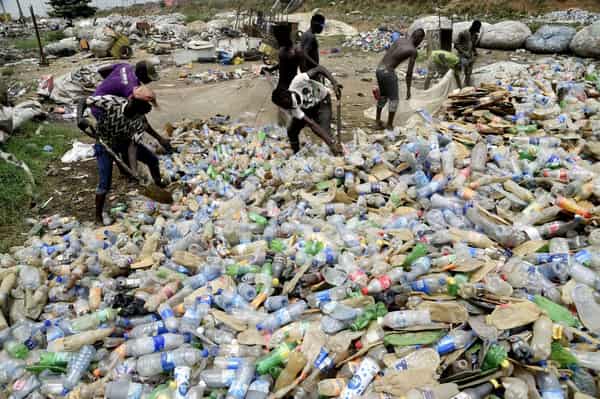
Chairman of NCF’s National Executive Council, Justice Bukola Adebiyi, opened the evening with a sobering reminder that Nigeria’s waste challenge is no longer cosmetic. She cited global estimates showing that 400 million tonnes of plastic are produced yearly, with between one and two million tonnes ending up in oceans each year. Lagos alone generates about 13,000 tonnes of waste daily, 15 to 20 per cent of which is plastic.
“These plastics clog our waterways, fuel flooding and impose health risks on communities that can least afford the consequences,” Adebiyi said. “If left unchecked, the menace could be catastrophic.”
She urged guests, many of them industry leaders, to look beyond sponsorships and adopt personal responsibility, from reducing single-use plastics to supporting recycling systems. But she also acknowledged a hard truth: most plastics in Nigeria are either unrecyclable or too costly to process, leaving communities to cope with piles of waste that re-enter the food chain or choke drainage channels.
Also speaking on NCF’s priorities, Justice Bukola Adebiyi, said the foundation’s flagship events, including the Work for Nature and the S.L. Edu Lecture, were deliberately centred on plastic pollution this year to elevate public pressure. “We are generating plastics faster than we can dispose of them,” she said. “Most of what ends up in drains is what communities eventually face as floods.”
She urged manufacturers to transition to recyclable materials and called for an expansion of recycling facilities, which remain sparse despite rising urban waste volumes.
The evening took a more grounded turn when the chairman of NCF’s Business Development Committee, Marie Fatayi-Williams, shifted the discussion from corporate stewardship to the everyday Nigerian who bears the economic and health burden of plastic pollution.
“When microplastics enter drinking water, it becomes a health problem the common man cannot afford to treat,” she said. “Blocked drainages and flooding are not abstract climate conversations; they’re the daily reality of poor households.”
She criticised weak enforcement of bans on single-use plastics, questioning why shoppers continue to receive plastic bags in stores despite supposed restrictions. “If plastics are banned, where are the affordable alternatives? And when stores sell plastic bags at higher prices, where does the money go?” she asked, calling for closer government monitoring and clearer policy pathways.
Her remarks echoed concerns that Nigeria’s approach to plastic regulation often stops at announcements, with little follow-through on compliance or investment in alternatives such as durable paper or reusable bags.
Corporate partner, Chevron Nigeria Limited, used the event to reaffirm their contributions to conservation efforts. Representative of the company, Mr Tunde Oyadiran, highlighted Chevron’s support for the Lekki Conservation Centre and recent participation in NCF’s Walk for Nature, focused on reducing plastic use.
He also acknowledged the scale of the challenge. “Plastic pollution is visible everywhere, in our cities, waterways, and even the fish we eat,” he said, adding that collaboration between government, businesses and civil society remains essential for any lasting solution.
The Green Ball’s fundraising goal reflects NCF’s new 2025–2030 strategy, which places pollution management at the centre of its work. Part of the evening’s appeal was the foundation’s promise to strengthen community-level incentives, such as cash or material exchanges for collected plastics, an approach Fatayi-Williams said offers “climate justice” for poorer communities disproportionately affected by environmental decline.