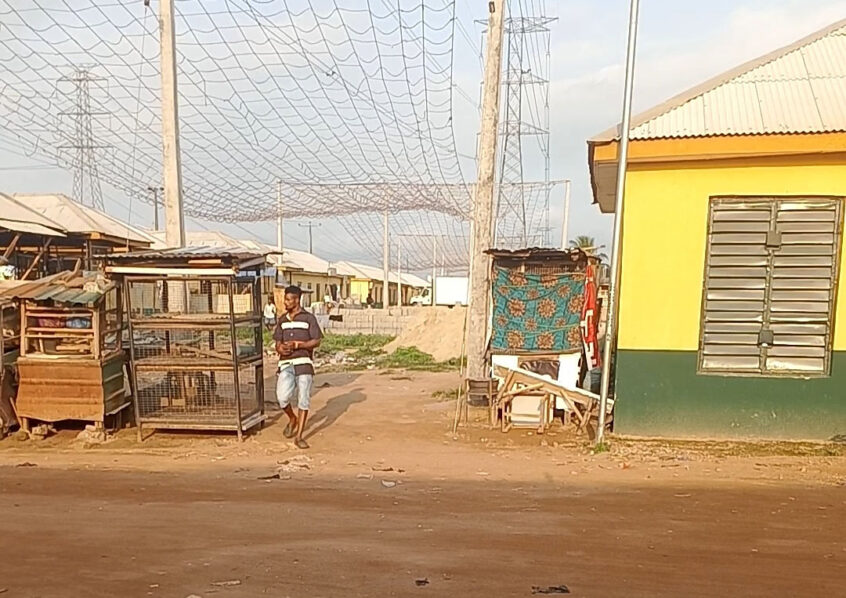
All over the country, people have continued to encroach on the Right of Way of high-tension electricity lines, erecting workshops, football fields, recreational centres and shops, farming and building residential structures. While some encroachers expressed ignorance of the inherent dangers, others have resigned to fate, expecting destiny to determine their safety. In this report, OLUDARE RICHARDS appraises the effectiveness of government efforts at ensuring compliance with and enforcing the law against encroachment on the Right of Way.
Across the country, people have continued to expose themselves to dangers that loom around Over Head Lines (OHLs), also known as high tension or power lines despite several efforts to deter them and enlighten the public on the illegality and how doing business under the high voltage carriers constitutes a threat to life.
The high voltage cables, which are used for electric power transmission, are run underground or underwater in many countries. In Nigeria, however, they are commonly hanged on dedicated electricity poles or lattice towers also called pylons. At different times, the cables have been reported to have fallen off the carrier structures due to either fault or mishap, resulting in human casualties.
Unlike the underground or underwater OHLs which are covered with reinforced or thicker insulating materials, the insulation for erected high voltage transmission lines is the air around it. The air insulation can go down through a natural course and what usually follows is electrical charging of reinforcement in buildings that are close to the transmission lines and a consequent electric shock and loss of lives.
The government had launched campaigns and orientation efforts to ask residents to be wary of the electromagnetic radiations that constitute a threat to the lives of those occupying the right of way and to know that the practice contravenes provisions of the Urban and Regional Planning and Development Law. Unfortunately, the government advocacy does not seem to have achieved the desired results, and many people remain vulnerable to electrocution.
Earlier in June 2024, the Lagos State Building Control Agency (LASBCA) warned against erecting structures or trading under high tension power lines in any part of the state. The General Manager of the agency, Gbolahan Oki, alerted Lagos residents to the danger and said the practice was giving serious concern to the state government.
“The State Urban and Regional Planning and Development Law does not only prohibit erecting building under over-head electricity wires, but also specifies the distance that should be observed between a property and a public utility such as the high tension electricity cables.
“Safety and protection of lives are the most important issues here and we must not let urbanization or material gains take the better part of us and allow the illegality to continue. Please ensure your buildings are not under high tension wires and desist from doing businesses in unauthorised places like power lines and drainage alignments. I will advise you to seek better alternative to do your business,” Oki said in a statement also posted on the LASBCA website.
But many people have continued to flout the rules, defiant of the law and expose themselves to danger seemingly without any sanction. LASBCA stated that as a way of halting further development of illegal structures under the power lines in Lagos, its enforcement department has served notices on erring occupants of RoW and in some cases evacuated them.
The question of enforcement capacity comes up in cases where the government has established a cases or cases of illegal occupation of the right of way during past operations. At Peace Estate in Gbagada area where LASBCA served abatement notices on structures illegally erected under high tension, not less than 50 buildings were affected, with a directive that the occupants should vacate the structures. According to Oki, the agency has gone a step further in establishing its presence across all strata of built environment in the state. “The Building Planning Law being enforced by LASBCA does not limit our operations to only removal of distressed, non-conforming and haphazard buildings but also cover shanties and structures under power lines.’
It was learnt that whenever there is a reports from some concerned citizens of the state over erection of structures under power lines, the agency will swing into action in no time to remove such illegal structures in the interest of public health and safety.
Oki urged all residents of the state to continue to abide by the provisions of the law to achieve the development plans of government for the benefit of all. According to him, the Lagos State Urban and Regional Planning and Development Law prohibits building being erected under the centre line of overhead electricity cables, and residents should ensure that there is a long distance between a property and high tension wire.
In 1960s, when the first transmission line (132KV) was built in Nigeria, linking Lagos to Ibadan, houses were notably distant from power transmission lines. The Nigerian Electricity Supply and Installation (NESI) standards 2015, being enforced by the Nigerian Electricity Regulatory Commission (NERC), gives a comprehensive guideline on distances in meters that buildings ought to observe in proximity to transmission lines of 330KV, 132KV, 33KV and 11KV.
Usually, when the RoW corridors are acquired, the compensation for existing buildings with Certificate of Occupancy (C of O) is usually included in the contract sum, but in the case where a structure is built after transmission lines have been erected, such building is illegal and could be demolished by the authority. Notably still, if prior to the demolition, any form of mishap involving the cutting of the line, tower or poles occurs, the transmission company will not be held liable.
“The state government through its relevant ministries and agencies will henceforth enforce applicable law strictly by removing all development and activities encroaching on the right of way of utilities and services.
“Failure to adhere to the directive would lead to the removal of such structures by government at a cost to be borne by owners, developers or occupiers of such buildings,” LASBCA said in a statement.
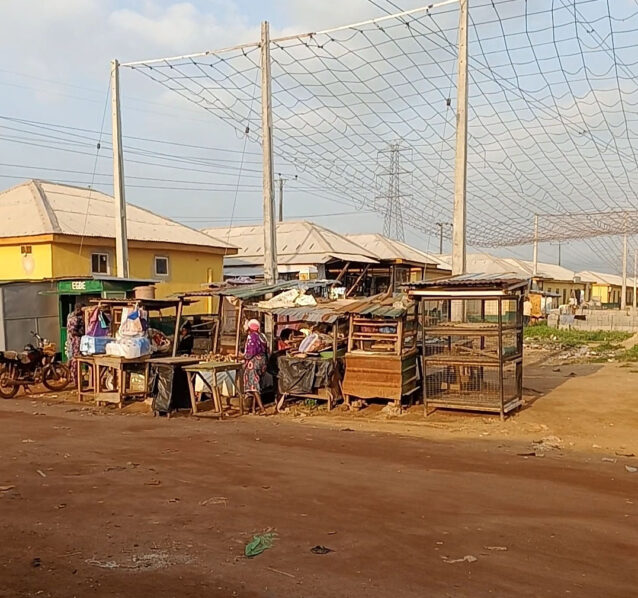 The required setback for buildings from the centre-line of Over-Head Lines and horizontal distance on either side of the OHL pole or tower is 12 metres (six metres on each side) for 11KV wire lines and 18 metres (nine metres on each side) for 33KV wire lines. The recommended setback for 132KV wire lines is 30 metres (15 metres on each side), while a 50-metre setback is recommended for 330KV power line ( 22.5metres on each side).
The ignorance of some residents can be observed during a meeting of LASBCA general manager with the Bale of Ladigboye Community and representatives of Arewa Communities in Ikorodu. It was learnt that the residents were on a visit to Oki’s office to seek approval to trade on a portion of land granted by the Bale of Ladigboye Community in the Ikorodu area of Lagos, which falls under a high tension power line. Oki was said to be totally opposed to the request.
Similarly, the Awka Capital Territory Development Authority (ACTDA) has moved to check illegal human activities around the OHLs. The agency has pulled down structures under OHLs, restating that the restrictions on erection of structures under power lines are permanent and demolition would be carried out to discourage those who would want to erect such structures in future.
The ACTDA which expressed worry that people decide to encroach on the spaces under high tension lines because of its cost-free nature said it had stopped further constructions under transmission lines and had instructed those living or operating businesses there to move out. The agency further noted that the accidents related to high tension are always fatal and the government could not condone such deadly adventure.
The management of Ibadan Electricity Distribution Company (IBEDC) has appealed to customers and the general public within its franchise area to stop buying and selling under high tension cables, warning that the associated danger far outweighs the profits of any business transaction.
IBEDC further explained that due to the weight of the cables and fire outbreaks, the wires could snap or sag, thereby causing electrical shock that could lead to disability, life-threatening injuries or even death. The company warned that electrical accidents are usually without prior warning.
Checks by The Guardian showed that a market in Ogun State, along the Akute-Ijoko road, on the outskirts of Lagos is located between two large OHLs with a long line of shops right on the inner-facing side of both pylons and the cables. The market said to have recently been developed by the government is divided by the Akute-Ijoko road which also runs between the pylons on the Jolasco Market axis where power line crossing nets were installed. Whilst the nets appear to have been installed to provide protection in the event of a mishap, their protective capacity remains controversial, especially around such a busy and densely populated market area.
Also, some marketers at Kulende Market, Sango Ilorin operate under the dangerous electric cables. They include sellers of meat, pepper, vegetables, and operators of grinding machines.
Some devastating incidents that have occurred include the electrocution of two women in the FESTAC area of Lagos caused by lightning that characterises a downpour. The Lagos State Police Public Relations Officer, Benjamin Hundeyin, disclosed this in a post on X.com. He stated that the victims were living in a shanty built under the high voltage wires which caught fire as a result of the lightning.
In a similar tragedy, a young girl died of electrocution as a result of a rain storm at Mowe Market in Obafemi-Owode Local Council of Ogun State in April, 2024. She was one of the five people that suffered electric shock during the incident. The Guardian gathered that the rainstorm affected some electric poles, which led to the accident. An eye witness said the electric shock started from the step-down transformer suspended on an electrical pole next to the shop where the incident happened.
The chairman of the council, Ogunsola Adesina, gave owners of shops under high tension cables a seven-day ultimatum to remove them as well as give access on the walkways for pedestrians.
‘I am not pleased with the news of people being electrocuted here. It is a great loss for a young girl to die due to nonchalant attitude of our people. Imagine having your shops close to an electrical pole that carries a step-down transformer. Let me add that everyone who has their shops extended beyond the normal point should start removing them from today,” the chairman said.
Beyond electrocution, electric and magnetic fields (EMF) wherever electric current flows in power lines and cables produce adverse health consequences, a research by the World Health Organisation (WHO) has shown. While there is no conclusive evidence that exposure to power lines causes harm to human health, some studies suggest that long-term exposure to it may increase the risk of certain health problems such as cancer and leukemia.
The international agreements reached at the Glasgow Climate Conference has to do with examining and increasing the strategies and objectives for reducing greenhouse gas emissions by 2030, in line with the global need to reduce global emissions by 45-50% over this decade.
Already, the electricity sector is responsible for a high percentage of greenhouse gas emissions, and is projected to increase significantly due to the electrification of transportation and parts of industrial sectors. These trends underscore the urgent need to concentrate government efforts to direct the electricity sector to Glasgow targets and to increase the existing target by 30% by 2030.
Some experts have urged the Federal Government to carry out a comprehensive technical-analytical-systemic examination of the needs and solutions for the increasing greenhouse gas emissions from the electricity sector by expanding combined solar production and storage in the structured areas that will enable the conservation of open spaces and ecosystems in Nigeria.
The Environmental Protection Ministry of Isreal, in its electrical industry development effort, said that it would use a newly created national challenges website to ask businesses and academia to help find ways to reduce non-ionizing radiation from high-voltage overhead power lines, whose health effects remain unclear. The Isreali ministry’s call for tech help is one of the first to appear on the government’s new challenges site, which is based on similar sites elsewhere in the world, for example, in America.
Scientists have been divided over whether OHLs, which create electromagnetic fields (where electric and magnetic fields combine) can cause cancer and other health problems. Although according to the World Health Organization, any health effects from low-level electromagnetic fields are likely to be small. Indeed, it says, people are surrounded by electromagnetic fields generated by fridges, TVs, and many of the other electrical appliances that are commonly found in homes.
In the UK in 2015, the National Grid undertook a study examining the technical merits and challenges associated with the under-grounding of high voltage electricity lines, compared with installing OHL. It concluded that there are a number of issues that make the under-grounding option more technically challenging and expensive. However, despite the costs and technical challenges, there are circumstances in which underground cables are a more preferable option than overhead cables.
The study explained some of the technical considerations to be taken into account. Among the considerations is the differences in the type of electrical insulation used for an underground cable when compared to an OHL This can lead to electrical cables being generally larger than OHL to allow for the dissipation of heat and insulation to physically protect the cable from damage and ensure it is not a danger to people while in service.
To match overhead line thermal performance for a 400kV double circuit, as many as 12 separate cables in four separate trenches may be needed, resulting in a work area up to 65m wide. The potential disruption of under-grounding an overhead line, which would require digging a trench along the length of the route for the cable, was also noted. The report also drew attention to the possible environmental impact of under-grounding cables, noting the potential threat to sensitive habitats and damage to archaeological heritage.
In 2012, the Institution of Engineering and Technology (IET) and an engineering firm, Parsons Brinckerhoff published the findings of an independent study into the costs of new electricity transmission infrastructure. The study concluded that excluding building, the cost of operation, maintenance and energy losses was broadly the same for OHL and underground cables.
The UK government cited the figures produced in the report in November 2023, when it argued that while it was possible to bury power lines, “it is up to 10 times more expensive and that cost will fall on the bill payer.’ The arguments in favour of under-grounding can be seen in responses to the government’s consultation on draft national policy statements for energy infrastructure, which ran between March and June 2023.